
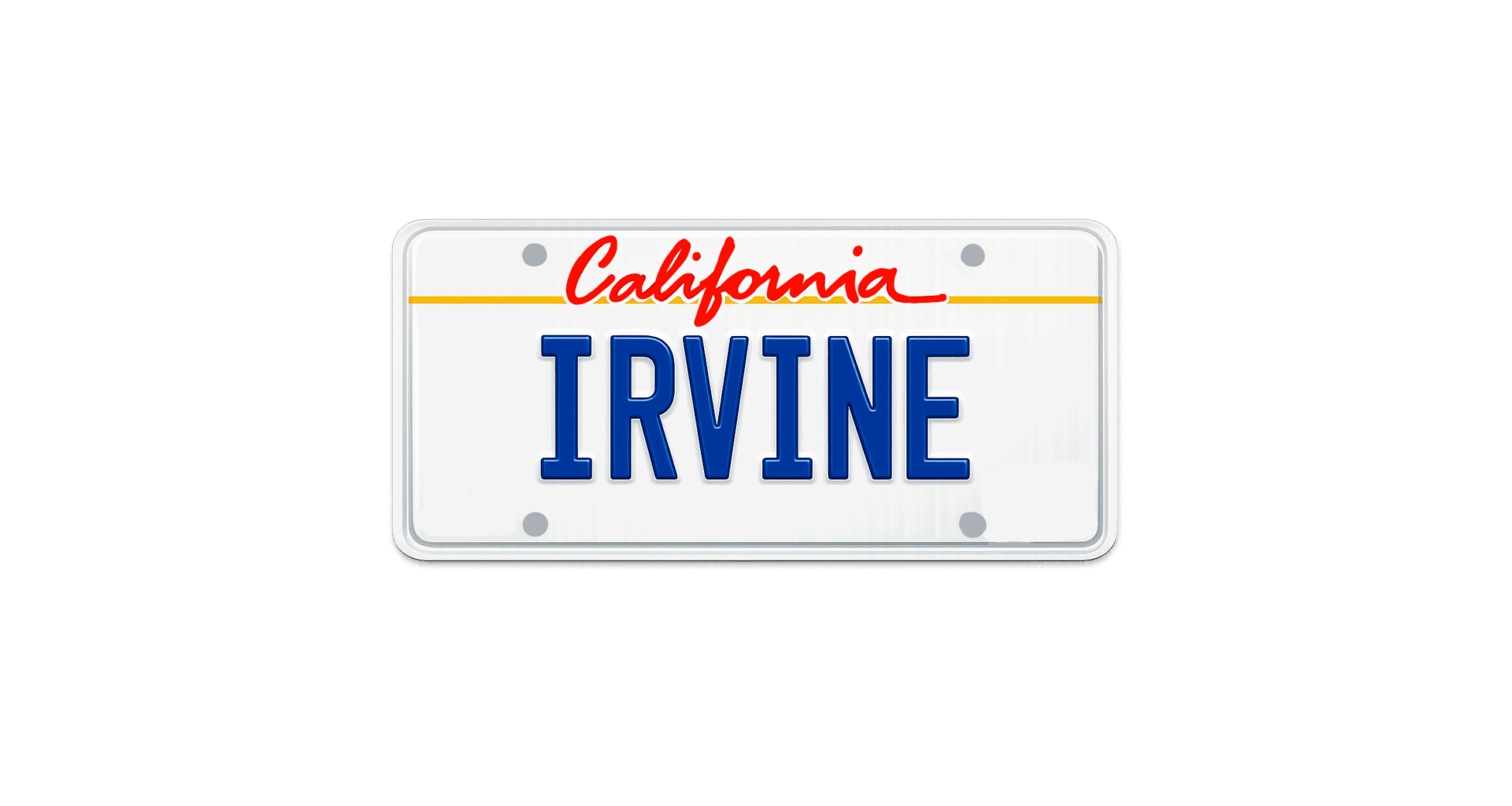
Live long enough in Irvine, California, and you might begin to think you are living in “The Truman Show.”
Sunny during all seasons, days blur into years under blue skies, white clouds, trimmed hedges, and asphalt streets. For 18 years, I grew up in Irvine, one of three babies born on a sunny December day in Irvine Regional Hospital. The city seems to sit at a constant 80 degrees, suspended in a glow, sun-dappled by palm trees. Except for a few new housing developments, Irvine is the same as it was the day I was born.
Irvine prides itself as one of the most meticulously designed cities in America. In the 1960s, as families streamed south from Los Angeles to settle open ranchland, architect William Pereira envisioned the Irvine Master Plan—“carefully wrought for a totally new city.”
“We call it the City of Irvine.”
Built with sustainability in mind, Irvine reflects its Scottish etymology: “green” or “fresh river.” Irvine is home to 310,000 residents, located just inland of Newport Beach and halfway between Los Angeles and San Diego. The town unfolds as a series of 22 “villages,” self-contained mini-suburbs each complete with its own shopping center, park, playground, and elementary school. Most people live in single-family homes or condos, designed to mimic Mediterranean-style villas—beige stucco walls, terracotta tiles, arched doorways, and pools lined with mosaics. Streets are wide and curve around houses, threading the city together.
I can begin anywhere in Irvine and end sprawled on a patch of grass. As one of the nation’s largest planned urban communities, Irvine preserves nearly a third of its area as green space; every home lies within a mile of a park or a duck-filled lake. If I walk along any street, it will lead to concrete, then open onto a trail that winds through village after village. My first house sat just off the Jeffrey Trail, a five-mile path that led to my middle school. With trails always circling back to the start, the city always seemed to usher me home.
Irvine is also famous for its delicious restaurants. As a toddler, I chased dim sum carts at the Cantonese restaurant China Garden, loading the table with egg tarts, shrimp har gao, and mango pudding until my family became regulars, proudly brandishing our secret 10% discount. I remember fashioning myself into a serious food critic at Taiko, where my family faithfully ate every Friday at the sushi bar across from our favorite itamae-san, who introduced me to uni, salmon roe, and takoyaki. I remember Yu’s Garden—open since before I was born and at all hours of the day—where tubs of piping hot sweet potato porridge accompany side dishes like garlicky pig ear, cold tofu skin, and spicy Sichuan eggplant, which would zap the jet lag out of me after a trip away.
Nearly 50% of the city is Asian. Parents circled learning centers on Saturday mornings; kids carried the same neon yellow-and-black tote bag the local math school handed out. Families gathered for annual Lunar New Year celebrations in the high school gymnasium and dance classes at the community center behind the local library. At the sprawling Irvine Chinese School, I attended traditional Chinese dance lessons, Math Olympiad exams, and free craft workshops. By the time I was of school age, I had gone to enough Kumon sessions, AYSO soccer practices, and Boomers parties to find myself connected by two or three degrees to nearly every other kid in town.
Being outdoors was central to Irvine. In elementary school, birthday parties were held—splashing around Woodbury Pool or playing freeze tag on Castle Park, on top of a true-to-size cinder-block castle that stands tall in the middle of a sandbox. As I got older, hangouts shifted to the Irvine Spectrum, where I shopped with my friends until our feet ached on the warm, clay-colored pavement beneath our feet. We skated on a half-melted ice rink in winter and rode the slow Ferris wheel on summer nights. A farm right off the highway sold the sweetest strawberries during the summer, pumpkins and pony rides during Halloween, and evergreen firs at Christmas. Every year, the local community college hosted the Baroque period piano festival, the Turkey Trot 5K on Thanksgiving, and the citywide Chemistry Olympiad.
Yet, amid the placid calm of its greenery, Irvine is deeply ambitious. A third of Fortune 500 companies have a presence in the city. Irvine is nestled along the Tech Coast, a major hub for technology, aerospace, biotech, and software companies. Elementary schools are named for landscapes grander than anything in the old ranchland: Canyon View, Santiago Hills, and Portola Springs. Streets borrow the names of elite universities—Harvard Avenue leads to a butterfly garden; Yale Avenue takes us to my mother’s favorite Korean grocery store.
Naturally, when high school ended, I felt an urgency to leave. I was bored with the city, annoyed by the predictability—Irvine seemed unable to grow up with me, suspended in a sheen of artificiality. Like Truman, I sought to find where the sea ended, to break out the dome of Seahaven. I itched for Harvard to be more than a street, to be a campus of history and purpose.
And so, I arrived at Cambridge, Massachusetts—a city that changes so unexpectedly with each season. In the fall, the leaves change colors the way one falls in love—slowly, slowly, then all at once. One morning in December, I woke up to find the campus covered in white. Another day in March, I found the lawn was suddenly a hopeful shade of green. I constantly refresh the weather app, quickly learning the difference between 10 and 20 degrees Fahrenheit.
Further, Cambridge wears its history openly, priding itself on preserving its memory. Here, the past is baked into crimson walls, uneven cobblestone roads, and Victorian townhouses. One of the oldest American cities, Cambridge arose organically—the natural green space is the Charles River, meandering, scattered with goose droppings. Most parks have slides made of tarnished metal; statues and plaques commemorate figures and landmarks dating back a couple of centuries.
But there is a precious quality to a hometown that is cheerily forgetful, finitely knowable. I am finding increasing value in Irvine’s planned nature, in the fake bright green turf in Irvine Great Park, over the sorry mushy grass in the winter months in Cambridge Common. In Irvine, I can lose track of the neighborhood while cruising down open streets, with local roads wide enough to fit four cars side by side. In Cambridge, I find myself hypervigilant for the whizzing e-biker cutting corners or the power-walking office worker hustling for the T station. It’s different, the way I interact with Cambridge, gripping my backpack straps, walking fast, triple-checking my phone for the right directions back to my dorm. In Irvine, I can remain a child: wide-eyed, light-hearted, wandering along well-paved streets that will always loop around, guiding me home before dark.
That is what makes Irvine honestly difficult to depict fairly. I can easily mock a place designed to be pristine and perfect, a city so ahistorical, so eager to fill shoes bigger than itself. When the sun rises each morning, the sky unnaturally blue, the city seems to have reset itself overnight, eerily unchanged, a utopia I can’t blame for its memorylessness—it is “master-planned” as such. Irvine is so safe, ranked for sixteen years as the safest in America, and the eighth happiest city in the country. Weather—a polite sun and calm wind—does no damage—ruffles feathers, stirs the water. Change, if any happens, is gentle, not brutal, and real, as I have now seen the ways a city can change.
It took some distance away to realize that Irvine had cared for me the way Ada Limón describes maternal love in her poem “The Raincoat.”
“My god, I thought, my whole life I’ve been under her raincoat thinking it was somehow a marvel that I never got wet,” she wrote.
Irvine is my raincoat. I had to leave—namely, fight through two blizzards this past winter—to recognize the shawl my sunny city drapes over me. In Irvine, so consistently shielded, I could move through childhood unaware of snow boots, black ice, and whips of wind. What more could I ask for from my hometown? A place where I can turn a corner and find a friendly face—the mayor who gave me a Korean name in elementary school, or my hairdresser who gave me my first haircut and also curled my hair for my prom up-do. A place where everywhere I go, there’s something beautiful: the big tire swing, cinnamon donuts at a local bakery, and second-hand books. A place where even a street named Harvard could, one day, become real.
I am grateful for the shelter Irvine has given me, but also restless for a world that is not so carefully arranged. Irvine has held me long enough for me to grow up, long enough to leave. Irvine has protected me—even if, under Southern California’s constant sun, there was never much rain to begin with.
So, like Truman, I bid Irvine farewell: “Good morning, and in case I don’t see ya, good afternoon, good evening, and good night!”
Cloris Shi ’29 (clorisshi@college.harvard.edu) would give anything to sit down again at 101 Noodle Express.