
We want to respond to Bonnie Kutch’s March 17 essay on San Diego’s effort to add missing bike infrastructure to Governor Drive. We all want a safer University City, but the case for a bike lane and traffic calming on Governor Drive is stronger than her piece allows, and her points deserve a direct response.
There is no other route.
For kids in South University City, Governor Drive isn’t a choice. It’s the only continuous east-west route through the neighborhood. Three public schools, a recreation center, two community pools, parks and baseball fields all line this corridor. Similar to the drivers of University City, bicyclists can’t take a different route. If we want safe routes to schools and community spaces, we have to make Governor Drive work for all transportation modes.
A bike lane does not block emergency vehicles, it helps them.
The reconfiguration uses no physical barriers between the bike lane and travel lanes, and lane widths won’t meaningfully change. Emergency vehicles can use the bike lane to bypass general traffic in emergencies and wildfires, making South University City safer.
The current configuration meets neither present nor future needs.
San Diego’s traffic study shows car traffic volumes have been declining for years and do not merit a four-lane arterial. Governor Drive at present is overbuilt and needlessly dangerous. Future mixed-use developments under the Community Plan will add residents, but if the city is to meet its climate goals, those folks will need safe ways to get around the neighborhood without taking a car. Contrary to what is stated in the original opinion essay, SB 79 does not use bike lanes to permit more dense growth and is instead dependent on transit infrastructure.
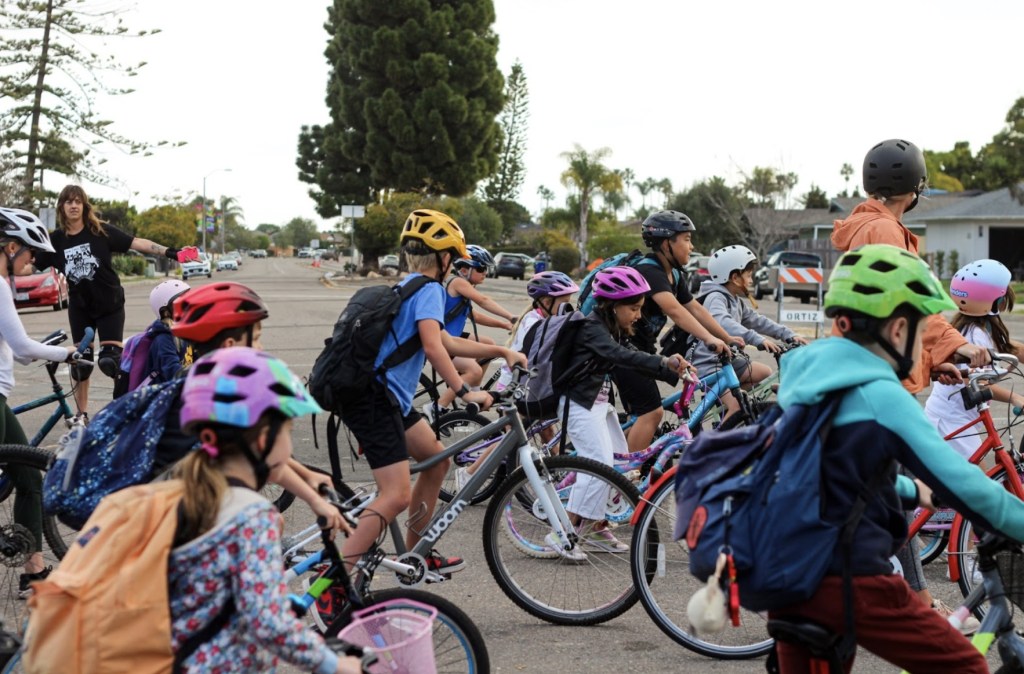
The maximum throughput of a bike lane is several times greater than a car lane. Our first bike bus included over 80 parents and students on a group ride down Governor Drive. That’s over 30 cars that were not on the road driving to school that day. The only sustainable path forward is to empower folks to get around by other means, reducing congestion for those who prefer to drive.
Road redesign is the only fix that actually works.
San Diego has identified Governor Drive as a dangerous corridor and included it in its speed management plan because traffic studies show drivers routinely exceed 35 mph. There is already an ineffective speed feedback sign on Governor Drive. Broader data show why enforcement alone won’t fix the speeding problems: SDPD traffic stops fell nearly 57% over 10 years, while at the same time, traffic deaths in San Diego rose 47%. Fewer tickets, more deaths. A lower speed limit won’t change that on a wide-open road.
This matters especially now because Governor Drive is being repaved. This is exactly the time when it would be most resource-efficient and fiscally responsible to add the missing bike infrastructure. A smooth road with the same configuration will invite faster driving. A lane configuration and added bike lane would help to achieve the desired lower speeds, with lower speed differentials.
The community has spoken and San Diego should follow through.
Kutch calls for San Diego to be more transparent with residents. We agree. And part of that means following through on what residents have already asked for. Through years of planning meetings, University City residents have consistently shown up to ask for slower traffic and safer streets. Honoring it isn’t ignoring the community, it’s listening to it.
The kids who bike to school, to practice and to the pool don’t come to public meetings. They don’t write opinion essays. But they’re among the people most affected by what we decide. As our neighborhood grows, they’ll have more company on those streets, unless we give people a real reason to leave the car at home. A buffered bike lane on Governor Drive is how we start.
Hembree is the advocacy and community manager for the San Diego County Bicycle Coalition. Wudka, who started the UC Bike Bus to ride to school with her two kids and neighbors, works as a program evaluator focused on energy efficiency programs.