
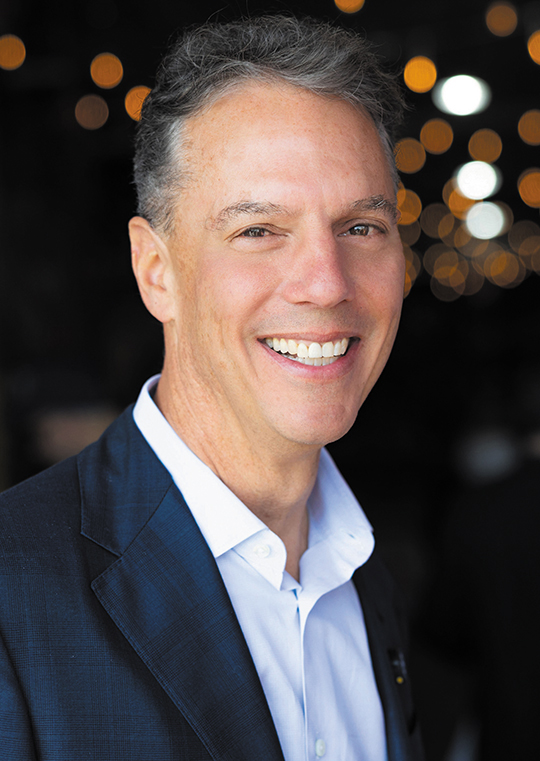
Adam Miller, candidate.
Several candidates have thrown their hats in the ring to unseat incumbent Karen Bass for the city’s top job in the Tue., June 2, primary. The Chronicle will continue candidate coverage next month.
By A.R. Johnstone
Adam Miller was the CEO of a publicly traded company he founded in his one-bedroom apartment and turned into a $5.2 billion enterprise. He was blessed enough to be able to exit that company comfortably. Instead of resting on his laurels, he decided that he wanted to give back and make Los Angeles better. We asked the Brentwood resident about his experience running charitable organizations, and why he thinks he is the right person to “fix Los Angeles.”
Larchmont Chronicle: Why did you decide to run for mayor?
Adam Miller: I’ve run multiple companies, but I’ve also run multiple nonprofits and, most recently, I’ve been hard at work as the CEO of Better Angels, a nonprofit that focuses on homelessness. That work over the last couple of years has gotten me much closer to the inner workings of the city. The deeper I went, the more troubled and frustrated I got with the state of the city. I have all the same issues every other resident has around dirty streets, broken sidewalks, broken streetlights, lack of safety, too much homelessness, not enough housing. But, in addition to working with multiple companies and nonprofits on trying to resolve the homelessness epidemic I saw firsthand as I got deeper into how the city works how truly dysfunctional and ineffective it was. I got more and more frustrated about it. Post Cornerstone (Miller’s successful education company), the goal of both me and my wife has been to get back into the community and have an impact. I realized my impact was limited, given what was going on in the city. If I really wanted to have maximum impact and help the most people in Los Angeles, the way to do that was being mayor. That’s why I’m running—to fix the city that is clearly broken.
L.C.: So, dig into the dysfunction a little bit with me. What did you feel was happening?
A.M.: There was a lack of accountability. There’s not a clear vision of how to solve these problems. There are very low expectations on performance and execution. There’s no accountability after the fact. The combination of all those things, with lack of fiscal responsibility and fiscal discipline, leads to very poor performance, which opens opportunities for fraud and corruption, and most importantly leaves the city with stuff not working. It is Management 101 and Econ 101—there’s a lot of parties to work with, but it can be done. The other thing I’ve seen firsthand is the lack of collaboration across Los Angeles. And, in that, I include the county. There’s a lot of infighting between the city and the county. You see that very clearly in the homeless sector—infighting between the mayor and City Council, and some infighting on the City Council itself. There’s a lack of vision, alignment, and execution across the board.
L.C.: I’ve heard one issue in being an effective mayor concerns the power within the City Council, which can diminish the mayor’s ability to accomplish goals.
A.M.: There are two different elements to that question. One is, obviously you want a mayor who’s good at collaboration. Somebody who is good at working with other people. Throughout my career, I have had to work with all sides to get things done in many different industries, sectors, and formats.
The other reality is, it’s not just about the City Council: it’s about the county, and other agencies in the city. We have not done a good job on this front by any stretch. There are things the county should be doing that the city doesn’t need to do. There are things the city council should be focused on to achieve their objectives that aren’t being supported by the mayor’s office. Of course, there needs to be compromise. Let’s not forget the federal government and the state government, right? We should be working better with the state and have some level of dialogue with the federal government. It’s just a reality. We might not like what’s going on, and we should be resisting what’s happening with ICE, even more forcefully than is being done today. But we also need subsidies and support. We’ve got to recover from the fires. We’ve got to fix our streets. We need infrastructure dollars. You need somebody who knows how to build relationships and be effective across groups. Normally that means across the aisle in most cities. Here I think it means different flavors of Democrats working together.
I want to answer the other pretext to your question, which is the power of the mayor. Some people think the mayor’s office is weak because of the power of the City Council. There is a tremendous amount the mayor can do without need for legislation. The mayor controls, to a large extent, the budget and agencies in this city. We have many workers, many divisions and departments which can operate better. Most of the things people want done are already authorized. I think a mayor with real operational excellence in mind can get a lot done in this city.
L.C.: Why do you think isn’t being done, or hasn’t been done in the past?
A.M.: We have people who are good at their current job, or good at legislation perhaps, but you put them in an executive role, and they don’t have the skills or experience to be effective.
L.C.: Do you think the city is ready for someone who isn’t a career politician, who is coming at this from a different perspective?
A.M.: I’m not beholden to anybody or anything, and I’m incorruptible because I don’t need any of that money. I’m going to pay myself a dollar and give the rest of the money to scholarships for kids in South and East L.A. My motivation is to fix the city for my kids and their friends. But, to do it now so we can all enjoy it while we’re still here. Right?
L.C.: There are a couple of key issues of recent interest to our community: one would be Senate Bill 79. I wanted to get your thoughts on that legislation.
A.M.: SB 79 is a punishment for our lack of movement on the housing issue. At the moment we deserve it, because housing starts are down 30% since 2019, and it’s arguably the single biggest issue around affordability. So, all these people were talking about affordability, but not addressing housing. I think we need to build dramatically more housing—not 10, or 20, or 50, or 100% more—dramatically more. We need to expedite construction, have better rules, have better processes, and have faster approvals and inspections. But we must do it in a way that preserves the character of the 99 neighborhoods that we have in this city. We can’t be putting giant buildings in the middle of residential neighborhoods with single-family homes. I’m a big supporter of the LCI (Livable Communities Initiative) and the whole idea of building livable communities on the outskirts of some of these neighborhoods, where we have commercial space and retail space that, quite frankly, is falling apart in these areas. There are other areas that are already more urbanized and have more buildings. We have dated buildings with four units that should have 12 or 20. We can do a better job of urban infill, where, again, we expedite permitting in construction and make it easier to build in the city.
L.C.: How would the L.A. Mansion Tax Measure ULA fit into that?
A.M.: ULA was a terribly drafted piece of legislation. People don’t realize that ULA, which was marketed as a mansion tax, charges that tax on affordable housing projects. I can’t think of anything more stupid than having a tax for affordable housing that applies to affordable housing. Doesn’t make any sense.
L.C.: The other big question on everybody’s mind is homelessness. We’ve thrown a ton of money at it some of which hasn’t been accounted for. Throwing more money at it doesn’t seem to be the right fix. What would you do differently?
A.M.: So the beauty here is it’s not theoretical—you don’t have to just listen to me—you can just see what I’ve already done. Better Angels is an extremely effective organization that’s been around for a couple of years and has become one of the most effective homeless reduction organizations out there in L.A. We’ve tackled the problem across five dimensions. You can read about it on the website betterangels.la, but essentially, prevention, services, shelter, technology, and housing. You can bucket it into those five things. In prevention, we’ve kept thousands of Angelenos off the streets who were already vulnerable; for instance those who were below 50% area median income, had received a financial shock, and had already received an eviction notice—we kept 97% of them housed. We have been building affordable housing with a goal of building within one-third of the time, and one-third of the cost, compared to what the city is currently doing. We’ve been doing that with a brand-new affordable housing fund to build hundreds, ultimately thousands, of units of affordable housing.
And thirdly, you’ve got to deal with the 44,000 people who are unhoused today in the city of L.A. and the 72,000 who are unhoused in L.A. County. That requires better service delivery, more efficiency in how we’re delivering the services, and leveraging interim housing. We’ve delivered services to over 12,000 unhoused individuals in L.A. in just a couple of years.
L.C.: Is that scalable?
A.M.: 100% Everything we do at Better Angels is meant to be an example of what everybody should be doing. So, it would be reallocating funds which are being spent on some of these programs that simply aren’t working and putting it toward better programs and ideas like Better Angels.
L.C.: If you could sum it up in a nutshell, what would you say to our readers and residents of Los Angeles?
A.M.: If you think L.A. is broken and you want somebody to fix it, I am the best candidate for the next mayor of L.A.
Category: News