
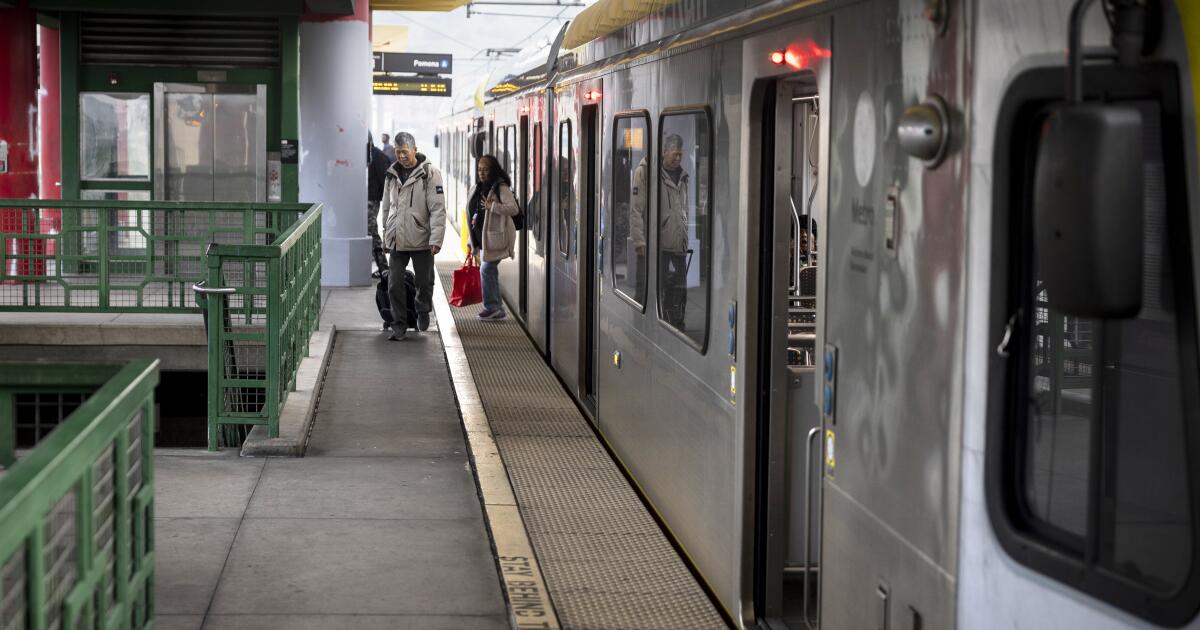
I took a ride on the Los Angeles Metro’s A-line train last weekend and it was remarkable both for what happened — the train came on time and delivered me a short stroll from my destination — and for what didn’t — no crowds, no trash and no hassles with unruly or threatening riders.
You’re reading the Essential California newsletter
Sign up to start every day with California’s most important stories.
By continuing, you agree to our Terms of Service, which include arbitration and a class action waiver. You agree that we and our third-party vendors may collect and use your information, including through cookies, pixels and similar technologies, for the purposes set forth in our Privacy Policy such as personalizing your experience and ads.
Statistics from the transportation agency that runs the region’s light rail lines and buses suggests this is more than an anomaly. Violent crime on Metro dropped 6.7% in 2025 compared to 2024. So-called “crimes against society,” like trespassing, drug use and weapons possession, dipped more sharply, by 33%.
That’s good news for a metropolis where too many people insist on riding their cars. It’s especially welcome, less than three months before World Cup soccer hordes will descend on the city and two-plus years out from an even bigger extravaganza, the 2028 Summer Olympics.
Why more people are not riding the rails
Transit systems work best when they are supported by everyone and not just, as frequently has been the case in L.A., the poor and working class. A primary complaint of people at the higher end of the socioeconomic ladder has been that Metro trains and buses don’t feel safe.
And at times that’s been true, particularly around hotspots, like B-line stations in MacArthur Park and Hollywood, where addicts have openly smoked fentanyl. During the height of Covid-era crime surge on what was then known as the Red Line, a Metro official even conceded to me that he would not advise his daughter ride that train, especially at night.
That official, who declined to be named to speak candidly about the system, said that, in some places, the system still is not as safe as it needs to be. But he also expressed relief at how much better things have gotten.
The improvement appears to be at least partly tied to an increased uniformed presence in many Metro stations. I saw it last Sunday, as my wife and I rode the train from South Pasadena to Bunker Hill downtown, to check out the Museum of Contemporary Art. Every platform from Union Station onward practically crawled with green-shirted, unarmed Metro Ambassadors and with contract security guards, wearing yellow safety vests and packing pistols.
The transit operator has been accused in the past of not properly supervising contract security personnel who occasionally used excessive force. Metro has approved the creation of an in-house police department that is supposed to centralize security and overcome oversight concerns. I asked for an update on where the new police force stands, but the agency didn’t return my call.
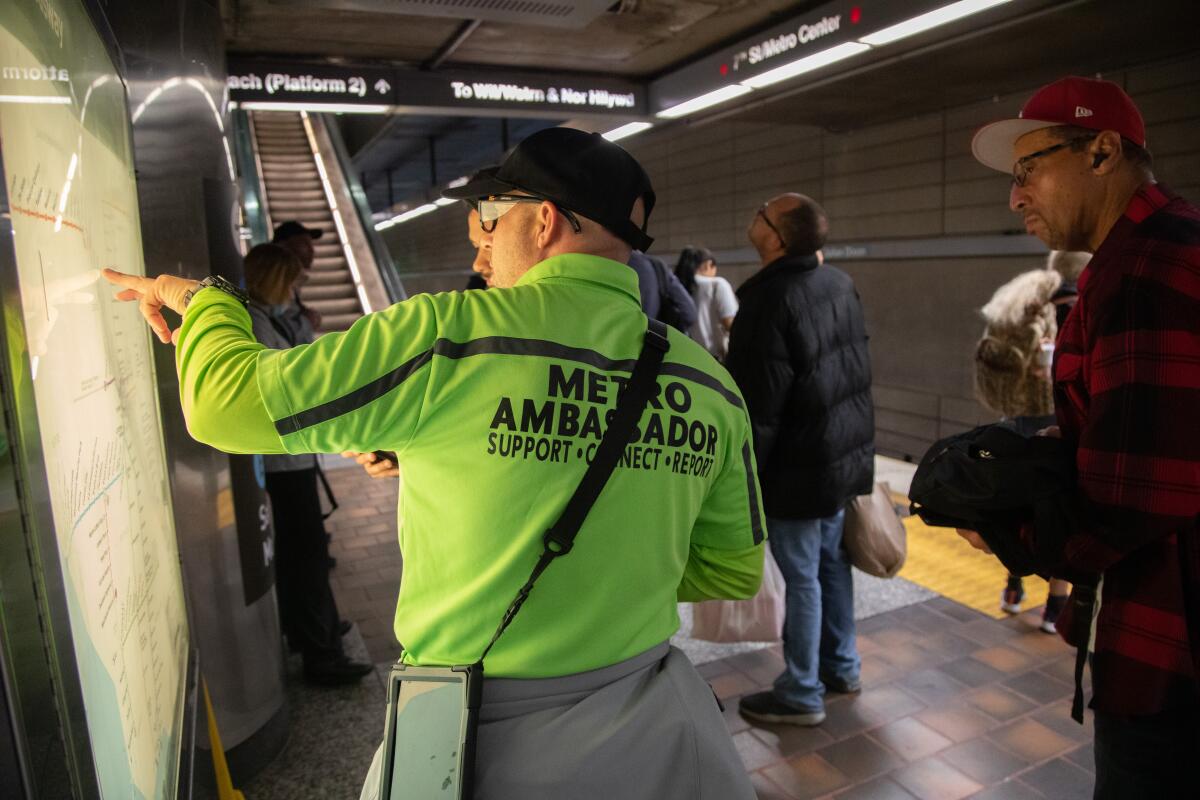
Metro Ambassador Ari Silva helps a passenger at the 7th Street / Metro Center station in 2023.
(Myung J. Chun/Los Angeles Times)
One ride made this scribe a believer
My highly unscientific, one-time test run may not prove much. But the markedly increased security presence appeared to bring a new level of order to Metro stations. The less-than 30-minute ride downtown proved fast and hassle free. No need to hunt, or pay, for parking. A pedestrian bridge directly to “museum row” on Grand Avenue has been temporarily closed for construction at the Broad Museum. But the walk to MOCA still only measured a block and a half. What a breeze!
The only sad thing for transit champions: We rode in an almost empty A-line car though ridership picked up a smidgen on the ride back to South Pas on Sunday afternoon. (For the uninitiated — the A-line runs all the way from Long Beach to Pomona.) This reflects the fact that the Los Angeles metro area continues to have the lowest transit ridership per-capita of any of the nation’s top eight public transportation hubs.
That’s not entirely surprising, given that there still aren’t enough rail lines, in particular, to get passengers close enough to their final destinations in sprawling L.A. But when it works, Metro works just fine. I’ll be riding the rails again when I meet friends downtown for a drink at the end of the work week. The rest of you doubters should give Metro another try.
Today’s top stories 
Meta CEO Mark Zuckerberg arrives at the Federal Courthouse in downtown Los Angeles to defend the company in a landmark social media addiction trial on Feb. 19.
(Jill Connelly / Getty Images)
Social media lawsuit verdictA Los Angeles jury found Instagram and YouTube liable for designing their platforms to addict young users, awarding $3 million in damages to a 20-year-old plaintiff.The landmark verdict is the first social media addiction case to reach a jury, potentially setting precedent for thousands of pending lawsuits nationwide.Backlash after officials kill a SoCal mama bearA Monrovia bear was euthanized by state wildlife officials following two incidents where she swiped at residents.Her two cubs, believed to be 2 to 3 months old, will spend the rest of their childhood in captivity in the hopes that they can one day be released back into the wild.Torchbearer of the election denialism movementFrom rural Shasta County, Clint Curtis is telling Californians they can’t trust elections — and it’s catching on with the GOP.Curtis, the county registrar of voters, has eliminated nine of the county’s 13 ballot drop boxes and hung cameras everywhere to capture election workers’ every move.What else is going onCommentary and opinionsThis morning’s must readOther must readsFor your downtime 
(Illustration by Jaya Nicely / Los Angeles Times, photo by Stephanie Breijo / Los Angeles Times)
Going outStaying inA question for you: What is the best place to see wildflower blooms in California? Send us pics!
Email us at essentialcalifornia@latimes.com, and your response might appear in the newsletter this week.
And finally … from our archives 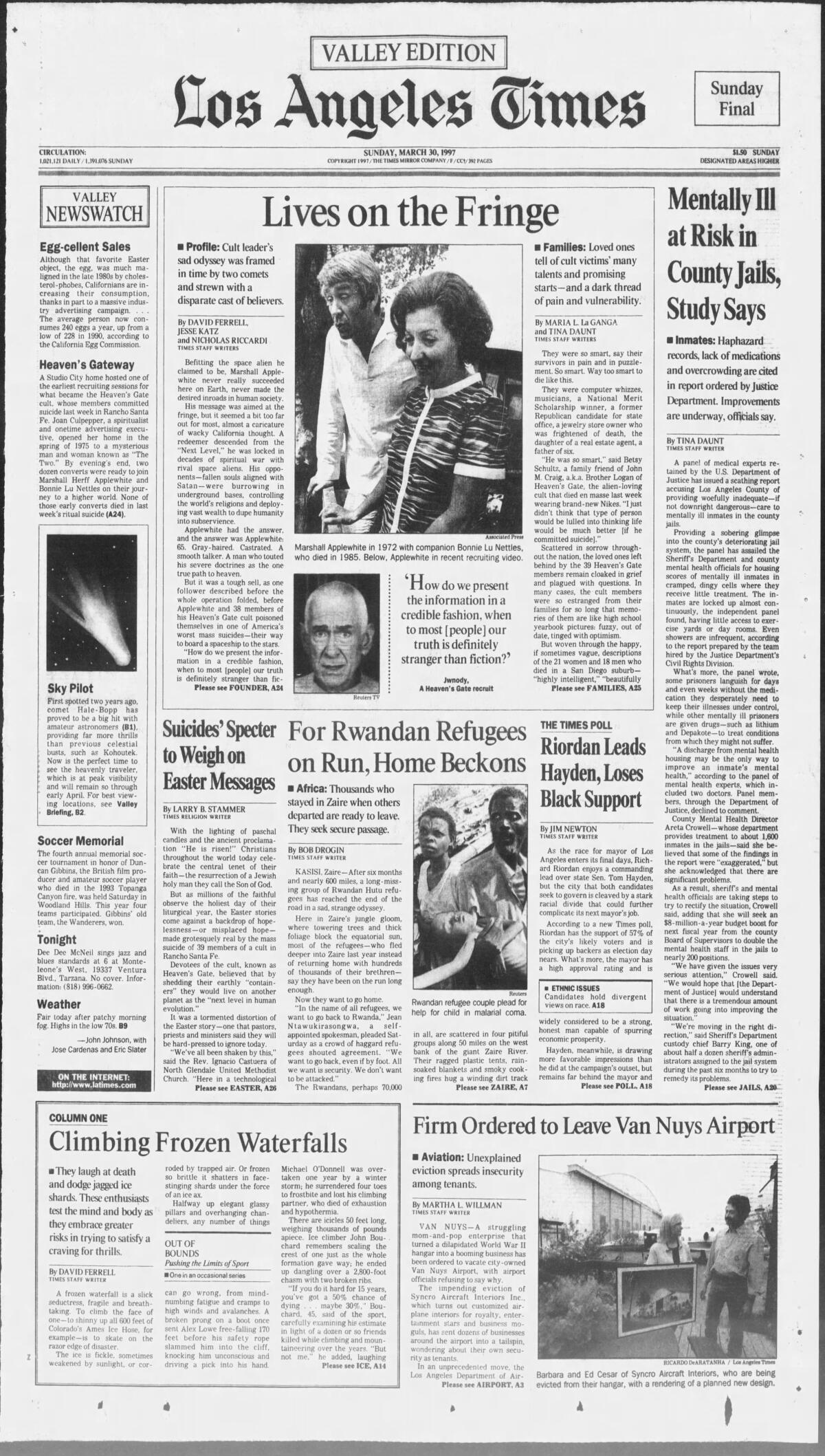
The front page of The Times’ Valley Edition from March, 30, 1997, features a story about mass suicides within the Heaven’s Gate cult.
(Los Angeles Times)
On March 26, 1997, San Diego County sheriff’s deputies discovered the bodies of 39 members of Heaven’s Gate, a religious group that committed suicide believing their souls would travel on a UFO to new bodies in a better world.
The March 30, 1997, edition of the Times’ Valley Edition featured a story on the front page about the mass suicides and the cult’s leader.
Have a great day, from the Essential California team
Jim Rainey, staff reporter
Hugo Martín, assistant editor, fast break desk
Kevinisha Walker, multiplatform editor
Andrew Campa, weekend writer
Karim Doumar, head of newsletters
How can we make this newsletter more useful? Send comments to essentialcalifornia@latimes.com. Check our top stories, topics and the latest articles on latimes.com.