
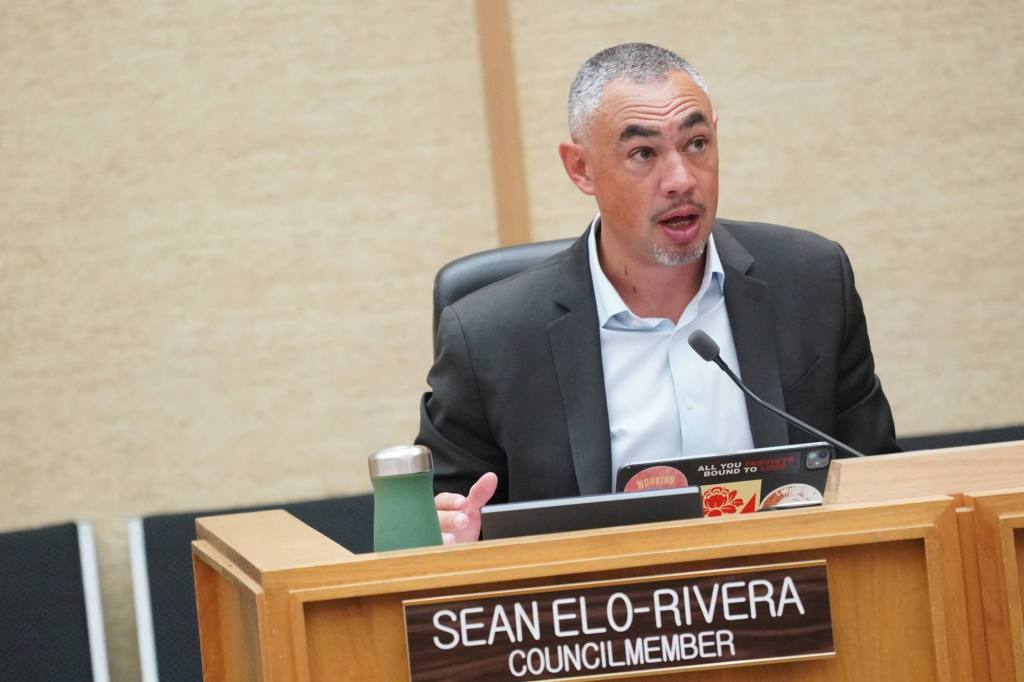
Councilmember Sean Elo-Rivera’s approach to problem solving is now predictable: identify an outsider scapegoat which will supposedly bear the cost of the councilmember’s “solution.” The misleadingly labeled “empty homes tax” ballot proposal is a prime example.
The problems are twofold: the city’s shortage of affordable housing and the council’s desire for more money. The scapegoats are owners of “empty” homes, who face taxes (in addition to their usual property taxes) of at least $10,000 per year in 2028 and beyond.
The goal is to incentivize owners of “empty” homes either to sell or to rent them. If they don’t, the new tax revenue will help ameliorate the housing shortage, the measure says — though nothing prevents the council from using the money for other purposes.
To call the measure an “empty” homes tax summons up an image of conduct that many will find worthy of regulation — taking a home off the market solely in search of an investment return. Even during colonial times, governments often insisted that owners make productive use of real estate.
But the “empty” homes tax sweeps more broadly. It includes homes that are occupied, unless they are occupied for at least half the year or are the owner’s primary residence. In other words, the tax applies to those who use their homes for personal vacations, even if the homes are occupied for three, four or five months a year. We might think that the people who own such homes are lucky to have that option. But they are using the homes in a way that has long been regarded as socially acceptable.
Focusing the tax on truly “empty” homes would regulate speculators while respecting the property rights of those putting homes to legitimate uses. But of course, such a focused measure would likely fail to reap the revenue windfall Elo-Rivera seeks.
Limiting vacation homes in a jurisdiction might sometimes be sound policy. The showing that vacation homes pose a significant problem in San Diego might someday be stronger than it is now. The city could limit the growth in vacation ownership by applying the tax only on new purchasers. But again, a prospective tax would fail to reap the revenue windfall Elo-Rivera seeks.
Elo-Rivera supports the tax partly on the grounds that it will impact hardly any San Diego residents. The temptation to tax outsiders can be difficult for voters to resist. At least with provisions like the transient occupancy tax, those paying the tax are given a meaningful choice when they decide where to travel. The empty homes tax would say to current vacation owners, “Pay the tax, sell your house, become a landlord, or abandon your current primary residence in favor of your San Diego home.”
As is often the case with Elo-Rivera’s proposals, the burden doesn’t only fall on those he vilifies. The tax would constrain current residents who might desire to relocate later without incurring the penalty imposed by the outdated rules applicable to home sales. Moreover, all taxpayers will bear the cost of litigation that would inevitably accompany passage of the measure. A Superior Court judge ruled that a similar provision in San Francisco violates state and federal law; the case is currently on appeal. In some ways, the San Francisco provision was less objectionable than the San Diego proposal, as it applied only to multi-unit properties.
More subtly, the subordination of property rights reflected in the empty homes tax measure could spread. Consider the problem of NORCs — naturally occurring retirement communities. People with growing families bought big homes. Over time, their families got smaller but their houses didn’t. They have space that growing families need more. Are these residents not at least one cause of our housing problem? If the “empty homes tax” passes, will the “empty bedrooms tax” be next?
We should recognize that all of us who live in San Diego, in whatever capacity, cause our current housing market (in conjunction with governmental regulatory missteps). San Diego will always be an expensive place to live — because people want to live here. The city isn’t well-positioned to raise the money to address this fact in a sensible way, given limits on its taxing authority and current budgetary restraints. Scapegoating outsiders is tempting until you focus on how quickly the political process can turn anyone into an outsider.
Cole is a retired professor at the University of San Diego School of Law.