
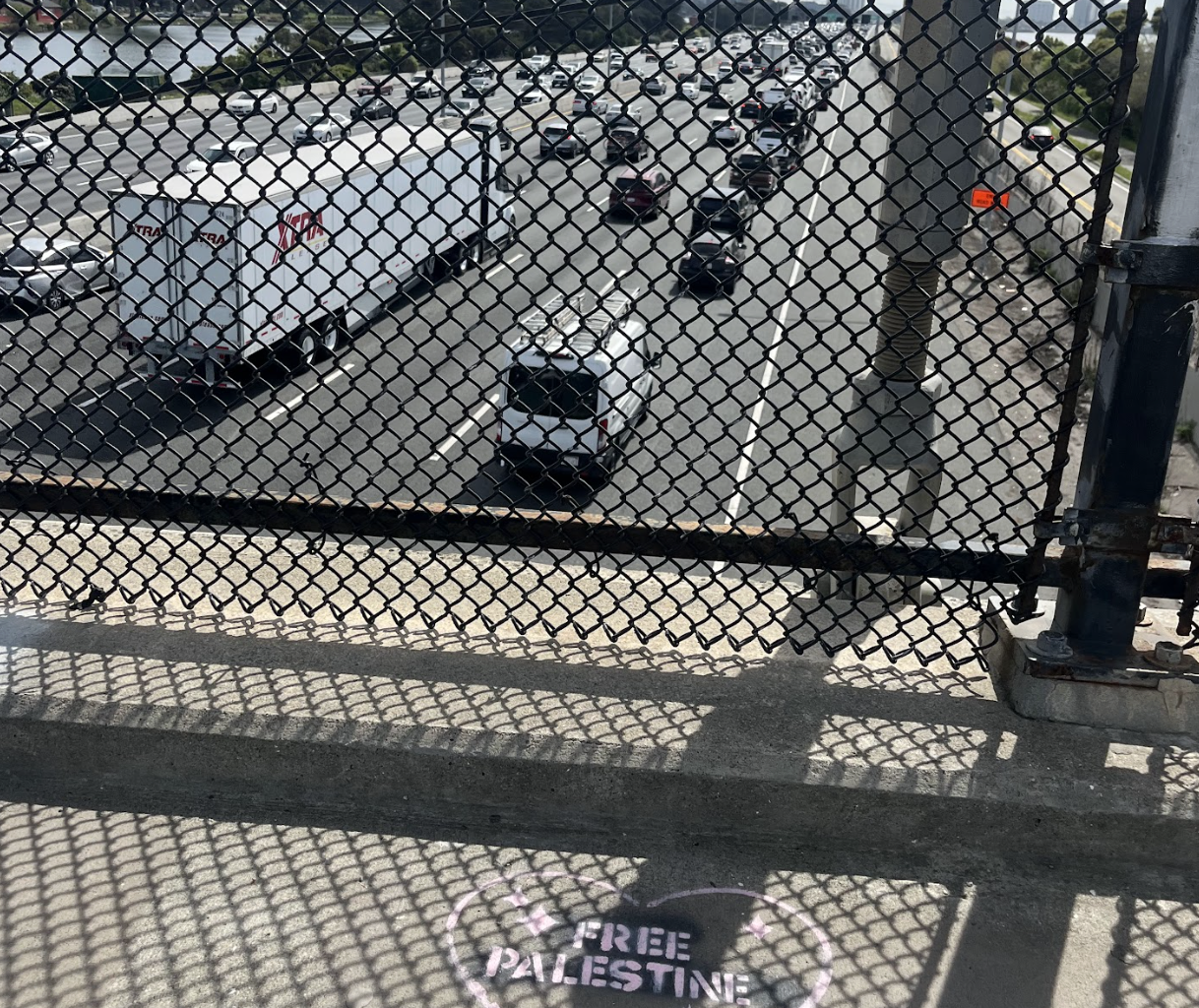
Spring break arrived as an explosion. It had been a dark first half of the semester. I spent most of it inside, hemmed in by the brutal cold. Clouds of stress, sadness and anxiety became all too familiar to my Vassar routine. So, when break came, I exploded west to California’s Bay Area—searching for new experiences and new meaning in a landscape I knew very little about. Being from Los Angeles, I had spent very little time up North. With Joni Mitchell playing in my ears, I looked out at the jagged landscape of the Bay from my plane’s window. The rolling hills, impossibly long bridges and thin skyscrapers lulled me into a romantic stupor: “Will you take me as I am? / Strung out on another man / California, I’m coming home,” Joni sang sweetly as I daydreamed about the week ahead. Life was to be lived, and here I was, ready to live it.
I spent the trip bouncing around between friends, taking long walks down to the Bay, journaling on the patios of Berkeley coffee shops—grasping as much light from the golden Californian sun as I could. I tagged along with some friends to classes at University of California, Berkeley, where I sat in on two lectures about Frantz Fanon. “Decolonization does not move towards history, but makes its own history. It rips the order of the world apart,” the professor said to the crowded lecture hall. I quickly learned that Fanon’s thinking fell on deaf ears to many in the Bay. The constant and overwhelming presence of techno-capitalism and the immense wealth that it produces loomed over me everywhere I went.
Driving into San Francisco at night, I saw the frequent advertisements for AI companies lit up bright and colorful against the dark sky. On walks through the city, I saw tech companies operating out of high-end buildings in expensive parts of town. I saw the luxury condominiums and apartments springing up all over the city, their development no doubt bolstered by the intense private land investment carried out by tech-fueled private equity. I saw the rideshare companies running rampant across the city landscape, offering privatized transportation and marketed as San Francisco’s leap into the future.
At the same time, I walked through streets crowded with unhoused people—gathered tightly around the entrance of the 16th Street and Mission station or lying motionless on the sidewalk as I walked to dinner with a friend. I visited Horsie’s Market with some friends— a horse-themed bar in the Mission District—and talked to the owner about gentrification, the Bay Area housing crisis and the growing wealth disparity he witnesses in his city every day. All of this came in between trips on the Bay Area Rapid Transit (BART), which currently faces extreme budget cuts, and is currently considering a plan to close as many as 15 stations.
The disparity was startling. Capitalism was laid out bare. I once heard a Vassar geography professor describe capitalism as being simultaneously “world-making” and “world-wrecking,” and I felt like the landscape of San Francisco was screaming his words back at me at a deafening volume.
Sitting with a close friend on a bright green lawn beneath the UC Berkeley bell tower, listening to the song of birds and eating candy peach rings, we spoke about decolonization, tech companies, and the “progress” that these companies pursue. He told me that the pursuit of a more equitable world must also be one where the “progress” of humanity can still continue. “The moon landing was amazing,” he told me, “and I don’t want to lose the ability for humanity to have big achievements like that.”
I thought about his comments in the context of the Bay Area landscape I witnessed and American history. Perhaps it is on the back of big progressions, like the moon landing, that the myth of America perpetuates. America has always been a land dominated by “progress.” It was the idea of Western “progress” that had catapulted American settlers to expand west across the continent, laying in their wake genocide, destruction and a geography irreparably altered. It was through the logic of “progress” and “development” that the United States government bulldozed entire neighborhoods during the 1960s. “Progress” meant destroying predominantly lower-income communities of color, to create highways, parking lots and shopping centers—further enshrining racism and segregation into the built environment itself. And it was only through the imperial conquest and peripheralization of entire countries and groups of people into cheap labor, that America, and other Western nations, achieved any of the wealth, success and “progress” that they boast today. Yes, there was the moon landing, but what was left in its wake?
Today, during my trip to the Bay, I saw the tech giants pursuing progress to the same end. They are the extension of the original settlers who killed and pillaged their way westward across the continent. The “progress” they create is rooted in the exploitation, suffering and dispossession of other human beings. The technologies of “tomorrow” that are being pioneered by these burgeoning techno-capitalistic industries are rooted in the destruction of the people of today. It makes perfect sense that these companies would then take on massive contracts with the Pentagon, Immigration and Customs Enforcement (ICE) and other branches of genocidal western militarism. They are born of staggering inequality, and thus recreate that same inequality across every inch of the world they affect.
If my trip to San Francisco confirmed anything to me, it is that we must be willing to destroy the logic and structures of the West as we know them. The poison of America—the poison of the West—is baked into the very root of its creation. Take from Fanon: it will take a radical rupture to defeat this world order. It is only through total upheaval that anything truly new and equitable will begin to be built. What the uneven landscape of the Bay Area shows is that abundance and progress to the level of which the most fortunate of the West are used to must be ripped from them.
“But my heart cried out for you, California / Oh, California, I’m coming home.”
So, when I fled west to California and turned to the Bay Area as my refuge, I saw that there is really no escaping the evils that permeate this country. As much as I would love to give in to Joni Mitchell’s romantic vision of California as some divine salvation, to resign myself to the Golden Gates and roaring cliffsides of my home state, I know the truth. It all must go.