
p]:text-cms-story-body-color-text clearfix”>
In Sergei Loznitsa’s new drama, stairwells are sinister. Hallways hum with invisible menace. The primary colors are drab grays and ugly browns. Faces are unsmiling. And the doors are always locked.
There are many ways to portray authoritarianism, but “Two Prosecutors” is penetrating in its depiction of a society being slowly poisoned. The film might be too much to bear if it wasn’t so brilliantly conceived and executed.
It is 1937 in the Soviet Union. Filming in a constricting boxy aspect ratio, the Ukrainian director takes us inside a corroding prison filled with men unjustly incarcerated as enemies of the state. An elderly man is tasked with burning the inmates’ letters to Stalin pleading to have their appeals heard. But one prisoner’s request doesn’t go up in smoke: a note written in blood by an aging Bolshevik professing his innocence.
Soon afterward, our main character, a newly hired prosecutor named Kornev (Aleksandr Kuznetsov), arrives at the prison, the note in hand. He plans to investigate the inmate’s claims. The rest of “Two Prosecutors” will concern the myriad forces conspiring to thwart his efforts.
Inspired by a novella by Soviet physicist Georgy Demidov, who chronicled his own harrowing experiences in the gulag from the late 1930s until the early 1950s, “Two Prosecutors” unfolds with ominous efficiency. Determined to set things right, Kornev insists on seeing the prisoner, Stepniak, only to discover how difficult such a seemingly straightforward request proves to be. Talk to the supervisor, he’s first told. After hours cooling his heels, Kornev is then informed that Stepniak is ill with an infectious disease — come back another time. But Kornev is young and infused with an idealistic zeal, refusing to let these goons stonewall him.
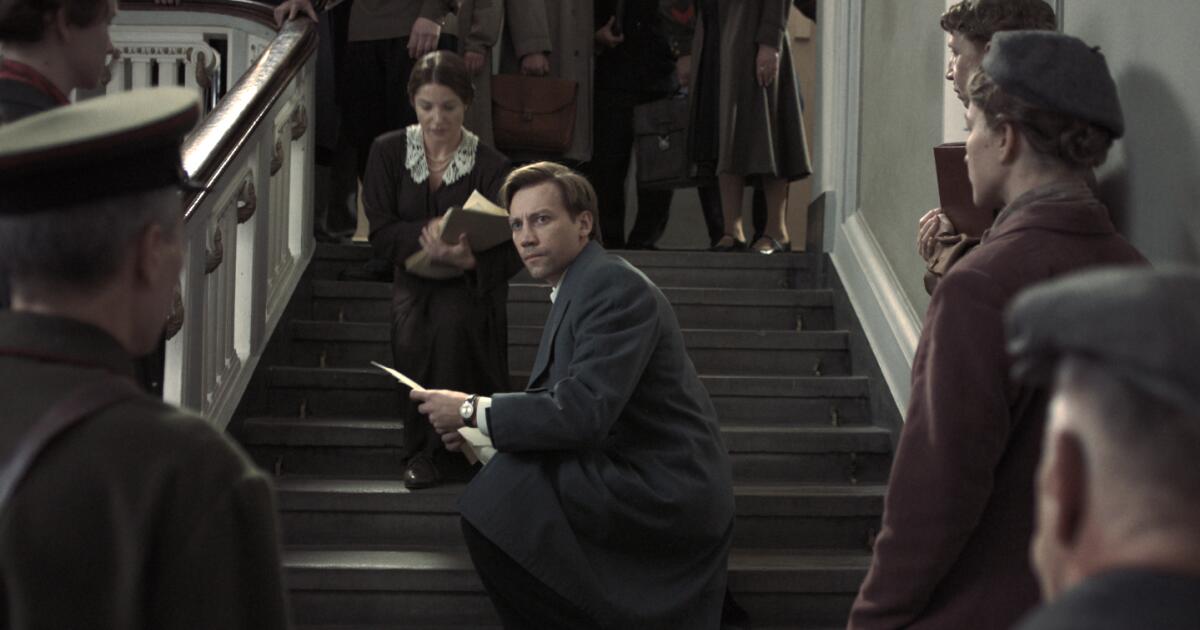
The film’s claustrophobic framing, paired with a locked-down camera, quickly creates a clammy unease. There is no violence in “Two Prosecutors” but the threat of aggression never subsides. Loznitsa includes multiple terse scenes of Kornev walking up endless stairs or waiting for a perturbed guard to unlock a door that will lead him to another door that also requires a key. Editor Danielius Kokanauskis cuts these sequences with Swiss-clock precision, mirroring the cruel precision of Soviet bureaucracy. Working with his regular cinematographer Oleg Mutu, Loznitsa gives this prison — and authoritarianism itself — a sickly luster without ever denying its wretched stench.
When Kornev finally speaks with Stepniak (Alexander Filippenko), who was himself once an idealistic lawyer, he shows the outraged young man the abuse he’s endured at the hands of the Soviet secret police. To get to this point was enough of an undertaking for Kornev, but he now must take on an even more challenging task: traveling by train to Moscow to alert his superiors. Correctly suspecting that his local officials are in cahoots with Stalin’s thugs — and that he himself may be in danger now — Kornev can only pray that the General Prosecutor (Anatoli Beliy) will take action. Kornev knows what country he lives in, but he hasn’t given up hope that justice still exists. And so he steps out of line to test his theory.
With few words, Kuznetsov projects such decency and conviction that he recalls any number of virtuous fictional lawyers of yesteryear who stood up to evil. And as an accomplished narrative filmmaker and documentarian, Loznitsa unveils deft homages to Jacques Tati and Roy Andersson, deadpan directors who reduce human behavior to its base movements. In “Two Prosecutors,” the inert nobodies blocking Kornev’s progress are crisply choreographed, Stalin’s existential choke hold strangling their very spirit.
As the obstacles mount against Kornev, his paranoia grows, leading to fleeting moments of surrealism. When a nameless secretary drops a sheaf of papers, Kornev’s response to help is instinctive, yet we cringe at the careless faux pas he commits in this unfeeling society. Later, a stranger gleefully approaches Kornev, convinced he knows him, and the effect is chilling — a glitch in the matrix in which human connection briefly flourishes.
No film since Jonathan Glazer’s wizardly “The Zone of Interest” has wielded such a meticulously controlled formal approach to visualizing the insidiousness of moral rot. But unlike that Oscar winner, “Two Prosecutors” has a man of conscience at its center — a confident crusader who becomes increasingly puny in the face of Stalin’s Soviet Union. With Trump back in office, American audiences are understandably more closely watching films from distant lands that dramatize authoritarianism, seeking clues from those nations’ past to understand our present.
“Two Prosecutors” offers no guidance and certainly no happy ending. Many viewers will correctly predict this young lawyer’s fate, but Loznitsa isn’t after plot twists; he’s more interested in the gut punch of the inevitable. Kornev’s tragedy is that, while he may not be behind bars, he can’t see the prison he’s trapped in.
‘Two Prosecutors’
In Russian and Ukrainian, with subtitles
Not rated
Running time: 1 hour, 58 minutes
Playing: Opens Friday, March 27 at Laemmle Royal