
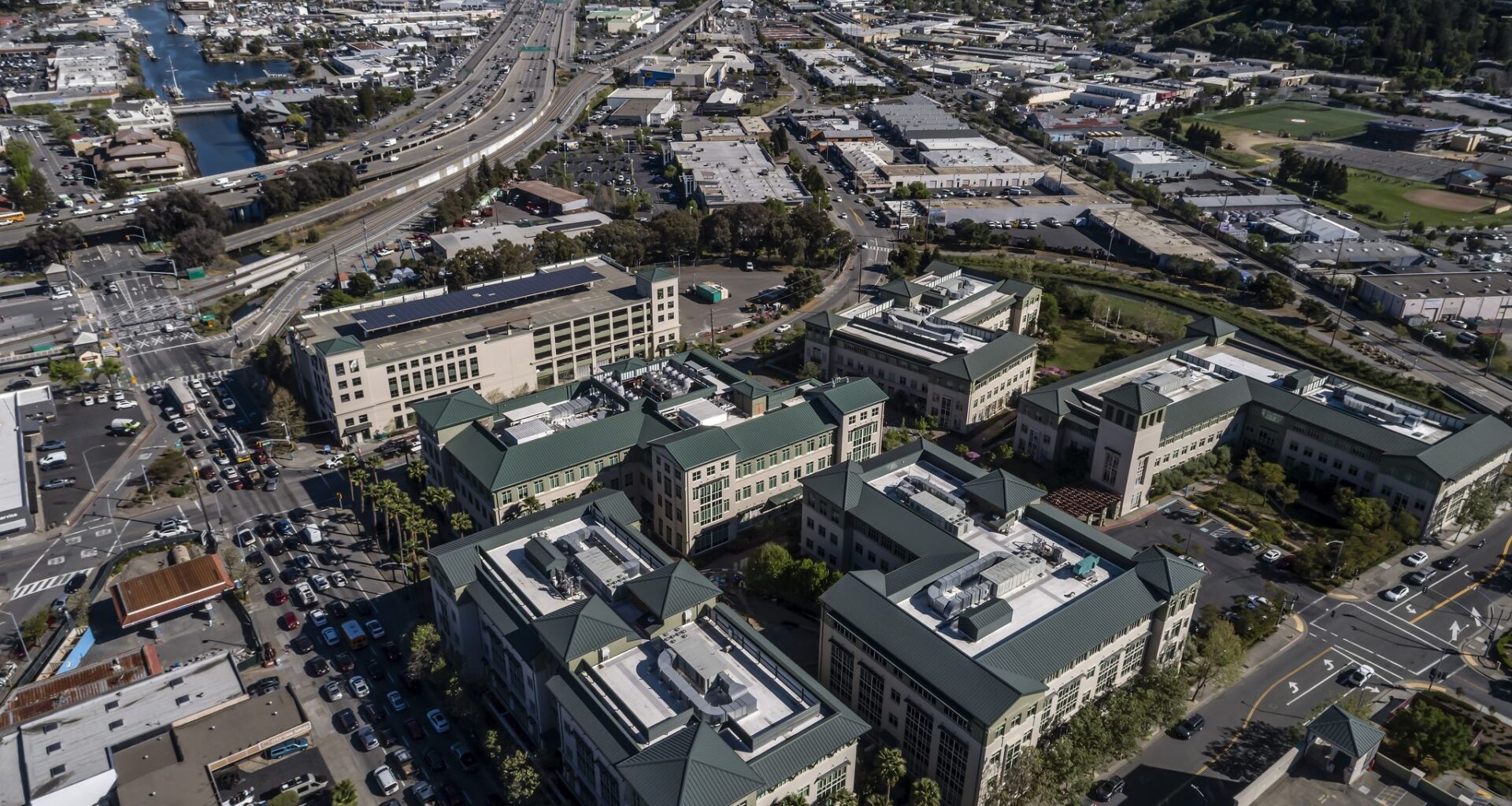
An aerial view of downtown San Rafael, which could look much different if several proposed high rise towers are built.
Carlos Avila Gonzalez/S.F. Chronicle
A long-vacant office building in San Rafael tucked between Highway 101 and a Kentucky Fried Chicken is slated to transform into a 17-story tower of steel and glass.
If built as planned, the project at 700 Irwin St. would replace a dilapidated four-story building in Marin County’s largest city with a residential high rise featuring 200 apartments, floor-to-ceiling windows and a new waterfront promenade.
A 17-story apartment building would not stand out in downtown San Francisco, but the tower would be a radical departure for Marin County, where cities hew closely to valleys and hillsides, and it would become the tallest building in the North Bay — by a large margin. It’s just one in a wave of high-rise proposals that could reshape San Rafael.
Article continues below this ad
Ten high rise residential buildings are in various stages of development in the city — from preliminary concepts to construction — and collectively propose to add about 1,600 housing units to the city’s housing stock. If even a portion of the projects move forward, San Rafael’s skyline could grow from a low-rise small city with historic charm into a taller, more urban center within a decade.
The empty building at 700 Irwin St. in San Rafael is slated to be replaced with a 17-story tower, which would be the tallest in Marin County.
Carlos Avila Gonzalez/S.F. Chronicle
“The skyline and the community is going to change … but the height is really what makes people pause,” San Rafael Mayor Kate Colin said.
San Rafael’s potential transformation reflects a broader shift unfolding across California. State laws are pushing cities to accommodate more density to tackle the state’s housing crisis — and giving developers the legal tools to blow past local limits on height and scale.
Article continues below this ad
San Francisco Chronicle Logo
Make us a Preferred Source to get more of our news when you search.
Add Preferred Source
Height has become a flashpoint across the Bay Area as cities grapple with pro-housing laws and the dire need for more places for people to live. In San Francisco, proposals for residential towers, including a 23-story apartment building proposed near the Embarcadero, have drawn fierce opposition. On the Peninsula, San Mateo city officials are reviewing plans for a 21-story residential tower.
San Rafael started as a small Spanish mission settlement in the 1800s and has grown into a diverse, economic hub and working class stronghold of about 60,000 at the southeast end of Ross Valley with a toehold on San Pablo Bay.
Eight of the ten tall development projects would rise up near Fourth Street, the city’s eclectic main street commercial district with a mix of restored historic facades and modern storefronts housing cafes and boutiques alongside dentist offices, architects and florists.
The building at 1000 Fourth St. is currently the tallest in San Rafael. It could soon be eclipsed in height by several new buildings.
Carlos Avila Gonzalez/S.F. Chronicle
Currently, the tallest existing building is an eight-story commercial tower at 1000 Fourth Street, anchored by a bank, and it easily outflanks the rest of downtown, which is mostly two, three and four stories high.
Article continues below this ad
Outside on a bench, Alexandra Adu was taking in the late morning sun before heading into the bank. She lives in a fourth-floor apartment nearby on Third Street and lamented that one of the high rises already approved by the city would block her view of the Marin County hills.
Three of the new buildings would be eight stories tall, with other buildings proposed at six, seven and 13 stories high.
“I’m not in favor,” Adu said.
Her reaction reflects a common local sentiment that favors the familiar over big changes.
But the stakes are high in Marin County, which must plan for more than 14,000 new residential units by 2031, including about 3,200 units in San Rafael.
Article continues below this ad
Micah Hinkle, San Rafael’s community development director, said downtown is the logical place for the bulk of the city’s new housing. Office vacancies rose after the pandemic, and underused commercial sites are ripe for redevelopment.
“It has the infrastructure, the transit access, the services — if you’re going to build housing, this is where it makes sense,” Hinkle said.
A pedestrian walks by an empty lot where the building at 703 Third St. once stood in San Rafael. The site is slated to be replaced with a new tower.
Carlos Avila Gonzalez/S.F. Chronicle
But San Rafael had envisioned a more modest silhouette for downtown’s economic revival with new buildings hovering around five or six stories. Don Dickenson, a former planning commissioner who has been closely following the projects, said he’s concerned the city isn’t ready to handle the additional traffic and other infrastructural demands.
“There’s a lot of disbelief that this is really happening,” Dickenson said.
Article continues below this ad
When 700 Irwin came before the planning commission, some members tried to push back against the project but were met with a wall of legal avenues for developers to exceed local restrictions. At a January meeting, Commissioner Jack Salvemini lamented that “it doesn’t seem like I’m making choices for the residents of San Rafael.”
“It feels like I’m making choices for developers from out of town,” he said.
The project survived three appeals and the council upheld the planning commission’s vote in a split 3-2 vote last month.
Colin, the mayor, was one of the dissenting voters. She said San Rafael stands to thrive with more people living downtown, but she’s also frustrated at state housing laws that have limited cities’ abilities to negotiate with developers to reach compromises.
She was concerned by the scale of the 17-story building and its location in a low lying area along the canal that is prone to flooding.
“San Rafael has been welcoming (to development), and I’m concerned that with these big, large projects, that goodwill is going to go away,” Colin said.
Traffic can back up for many city blocks in central San Rafael during peak commute hours and critics worry about worsening congestion. Some developments, including 700 Irwin, include mechanical stacking parking systems more common in places like Japan.
Construction is under way at 930 Irwin St. in San Rafael. The site is slated for demolition and replacement with a new tower.
Carlos Avila Gonzalez/S.F. Chronicle
But housing advocates say new developments always draw complaints about traffic and height, which can melt away once the project is built. And the city’s dire need for new housing outweighs aesthetic concerns.
“We need housing, we urgently need housing,” said Cruz Vargas, a 53-year-old single mother and housekeeper, speaking through an interpreter with Canal Alliance.
The 700 Irwin project is planned just east of Highway 101 and downtown at the western end of San Rafael’s canal district, a dense, working class neighborhood of about 12,000. It gained the support of the Canal Alliance, a nonprofit that serves low-income residents, because the developers reserved 15 apartments for low income and another 15 for moderate income residents.
Vargas said she’s spent the last 20 years in the same studio apartment with her now-adult son. She’s looked for a larger apartment but could never find something she could afford.
But the lists are long for scant affordable housing, and although most development projects reserve a portion of units for low income residents, it’s unclear how much they will help residents like Vargas.
Lori Droste, housing and planning policy director at SPUR, said the Bay Area needs housing at all levels — from luxury to market rate to affordable. And the vast majority of renters live in market rate apartments, scraping by as best they can.
“Doing nothing isn’t a neutral option — it just means higher prices and displacement,” Droste said.
Not all of the proposed high-rises for San Rafael may ultimately be built. Projects of that scale can shift with variables from financing to construction costs, particularly in a volatile market.
Downtown San Rafael is still rebuilding after the pandemic when too many businesses closed. Fourth Street is dotted with vacant storefronts and large vacant office buildings.
The empty building at 1515 Fourth St. in San Rafael is slated for demolition and replacement with a new tower.
Carlos Avila Gonzalez/S.F. Chronicle
Inside Graffeo Coffee, the only outpost of the iconic San Francisco roastery, a steady stream of customers came in to buy pounds of beans. Behind the counter in a black T-shirt emblazoned with the image of jazz trumpetist Freddy Hubbard, Joey Edelman filled bags of beans as a steady stream of customers walked up to the counter.
Edelman, a 64-year-old jazz pianist, bought his home in nearby San Anselmo in 1990 and can’t imagine being able to afford the same today. He started working at the roastery during the pandemic when his music student roster cratered and the gigs dried up. He said the new apartment buildings would likely worsen the city’s traffic slowdowns, but that the city simply needs new housing.
“Marin County has always had a problem: If you work here, you can’t afford to live here,” Edelman said.
Already, construction is underway on an eight story apartment building just two blocks away from the 700 Irwin project.
Hinkle said the pace of development will depend on how quickly residents fill these first tall buildings.
For now, though, the pipeline is full — and the skyline could soon follow.
“This summer, the cranes will start to arrive,” Dickenson said.