

Ricky Satomi did not set out to work in the wild forests of the Western Sierra. He grew up outside of Los Angeles in what was once citrus country, and after arriving at UC Berkeley, he settled on studies in forestry. Today, a routine morning might find him on a hillside evaluating forest health, or working with community leaders on wildfire prevention.
At an urban campus such as Berkeley, Satomi’s career path is not typical. Graduates usually end up in cities, where there are greater concentrations of power, wealth and opportunity.
And yet, he’s deeply engaged with communities in four rural counties that extend from California’s Central Valley east to the high mountains, and he believes the work will shape the well-being of those communities far into the future.
“At Berkeley, we are often trained to tackle the big picture issues, to do big things in high places,” Satomi says. “At the same time, you can have so much more impact at the local scale. … Rather than trying to fix the entire state’s wildfire problem in one swing, you can build momentum by focusing on one community at a time.”
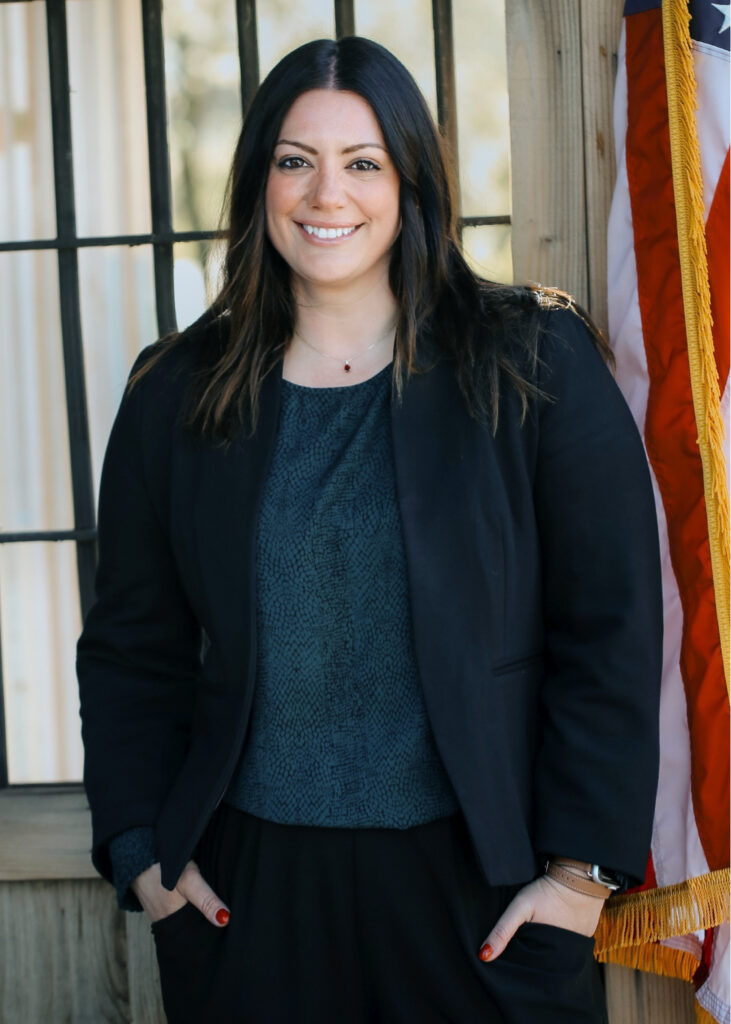 Sarah Edwards, the Calaveras County counsel, earned her law degree at UC Berkeley. She sees a range of benefits when students from rural communities study at Berkeley and return home.
Photo courtesy of Sarah Edwards
Sarah Edwards tells a similar story. She grew up in the mountains of Calaveras County, and came down to Berkeley for a bachelor’s degree and a law degree. Today, a lot of her old friends and classmates are in the Bay Area, Sacramento or Washington, D.C. But she returned home and now serves as Calaveras County counsel, a critical role for the county and its 45,000 residents.
“You hear often about people leaving areas like this, going out and getting an education and never coming back,” she says. “I wouldn’t say that people should never leave. But I think it’s good when people leave, gain these experiences and then come back. They bring their experience to these communities, and there’s an interplay. And then maybe all of us can realize that the divide between cities and rural areas isn’t as big as we sometimes think it is.”
Edwards got her degree from Berkeley Law in 2009; Satomi received his master’s degree in forestry in 2016. They’re emblematic of a little-known alumni cohort: They move to the Central Valley to work in agriculture, or to the mountains to work in forestry; they help run small towns or provide health care in rural areas. And in time, they emerge as leaders who contribute to the strength of their communities, while creating a bridge that links campus, city and countryside.
One powerful example: Brent Holtz received his master’s degree in plant pathology in 1989, and his Ph.D. in 1993. As a UC farm adviser for 32 years and director of the UC Cooperative Extension office in San Joaquin County for 15 years, he has helped revolutionize almond growing in the Central Valley.
Another example: Rey León’s work as a social activist in the Central Valley began even before he graduated from Berkeley in 1997. Today, he’s the mayor of Huron, a tiny city an hour’s drive south of Fresno, working to bring economic, health and educational development to one of the poorest cities in the state.
“Berkeley was like a cocoon for me,” says León. “It was instrumental in my development as a thinker, as a leader, as a human being — and as a doer, a fixer and a maker.”
Each of the four works in a different field and a different region, but their experiences have striking parallels: Berkeley built their knowledge and shaped their values. In their new communities and jobs, they sometimes have had to navigate mistrust that arises from Berkeley’s reputation as a liberal bastion. But they worked hard, built relationships and in time earned positions of leadership — they evolved, but held on to their ideals.
‘Where do you think your food comes from?’
Despite their accomplishments, each also says that their work is not often recognized by the campus community. But that reflects a statewide phenomenon, says James Gallagher, the top Republican in the California Assembly.
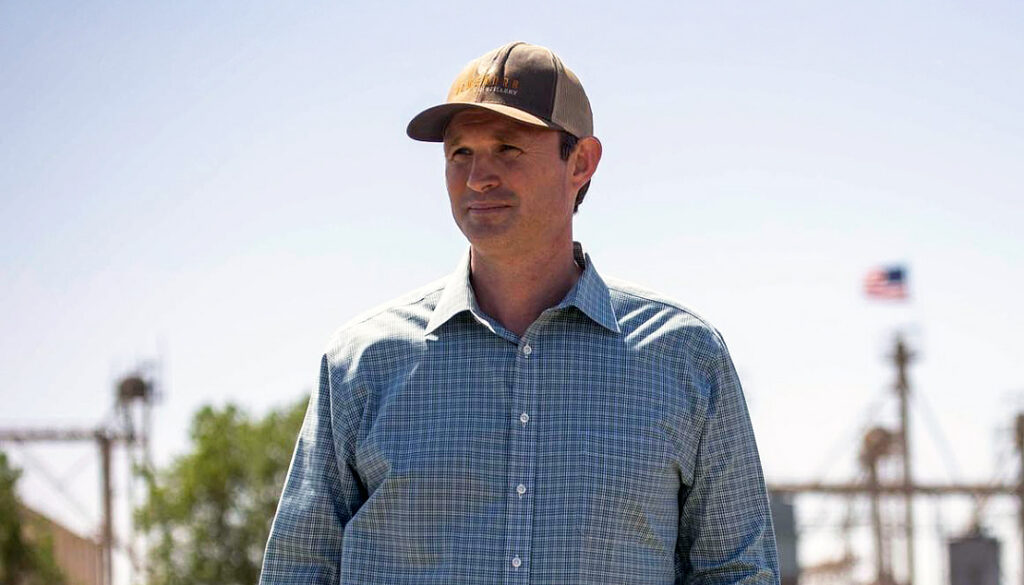 UC Berkeley graduate James Gallagher has risen from Sutter County politics to become the highest-ranking Republican in the California Assembly. Rural Californians are routinely overlooked in state affairs, he said, and he suggested that Berkeley could do more to provide support outside of urban areas.
Courtesy of Assembly Member James Gallagher
Gallagher was raised in Sutter County, graduated from Berkeley in 2003 with a degree in political science, and now farms rice and walnuts north of Sacramento. In a political culture dominated by city-centric politicians and policymakers, he says, California’s rural residents are “very much overlooked.”
“I do meet other Cal graduates,” he said in a recent interview, “and there’s always a great sense of camaraderie. We say, ‘Go Bears,’ and we reminisce on the time we spent there.
“But I wouldn’t say there’s a lot of them in rural California …. Berkeley just doesn’t touch us a lot. We don’t hear, ‘Hey, here’s what we’re doing to better your lives,’ or ‘Here are some new things that we think could be helpful to your community.’ Berkeley just doesn’t focus much on rural parts of the state.”
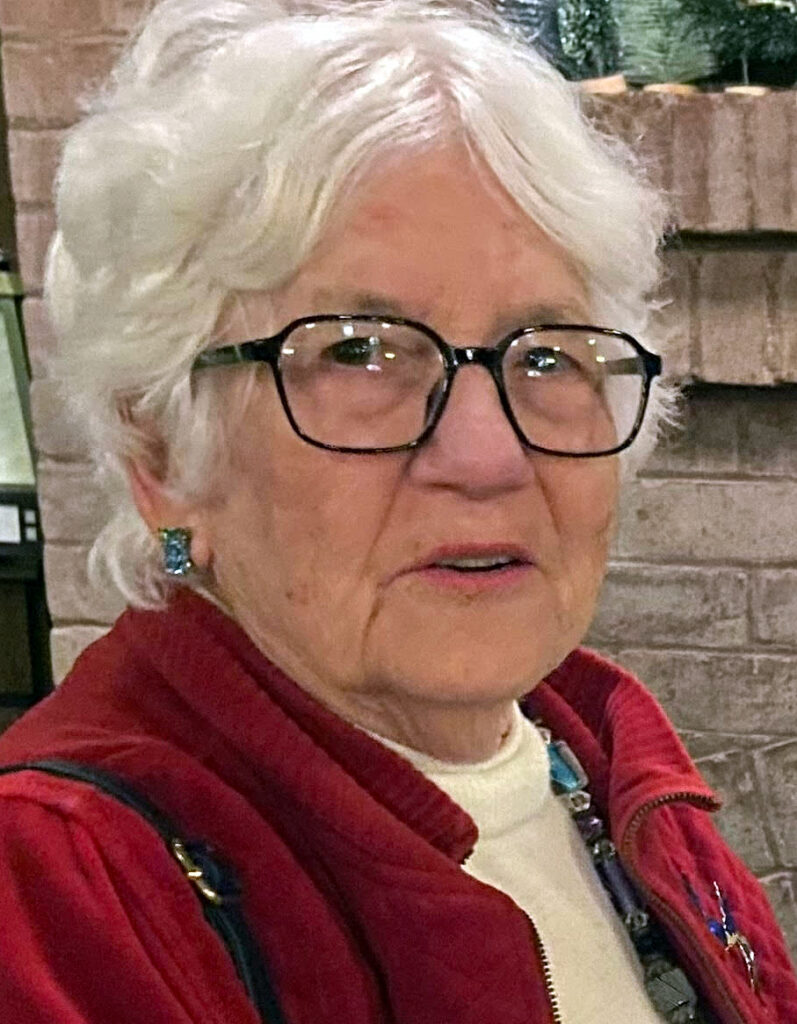 Karen Merritt, an affiliate of UC Berkeley’s Center for Studies in Higher Education, said the campus a century ago had a robust presence in rural California. But, she said, that engagement has faded in recent decades.
Courtesy of the UC Berkeley Center for Studies in Higher Education
Historically, UC Berkeley was a major presence in the state’s agriculture, forestry and mining regions, said Karen Merritt, an affiliate of Berkeley’s Center for Studies in Higher Education. The university farm was founded in Davis in 1908, and Berkeley scholars for decades led its ambitious education and research.
But the mining school closed after World War II and Davis became a fully separate UC campus in 1959. Merritt said Berkeley’s connection with rural California did a slow fade.
Merritt served for two decades as director of academic planning and program review in the office of the UC president. In the early 2000s she helped guide efforts to establish a UC campus in the Central Valley at Merced, and during that project, she sometimes noticed a condescension toward rural California.
“There was a coastal attitude that people in the Valley were sort of unsophisticated country cousins, barefoot, chewing on a piece of straw,” she explained.
She recalled walking across campus with her husband, the late film professor Russell Merritt, and meeting a colleague who complained that the money for Merced would be better spent at Berkeley.
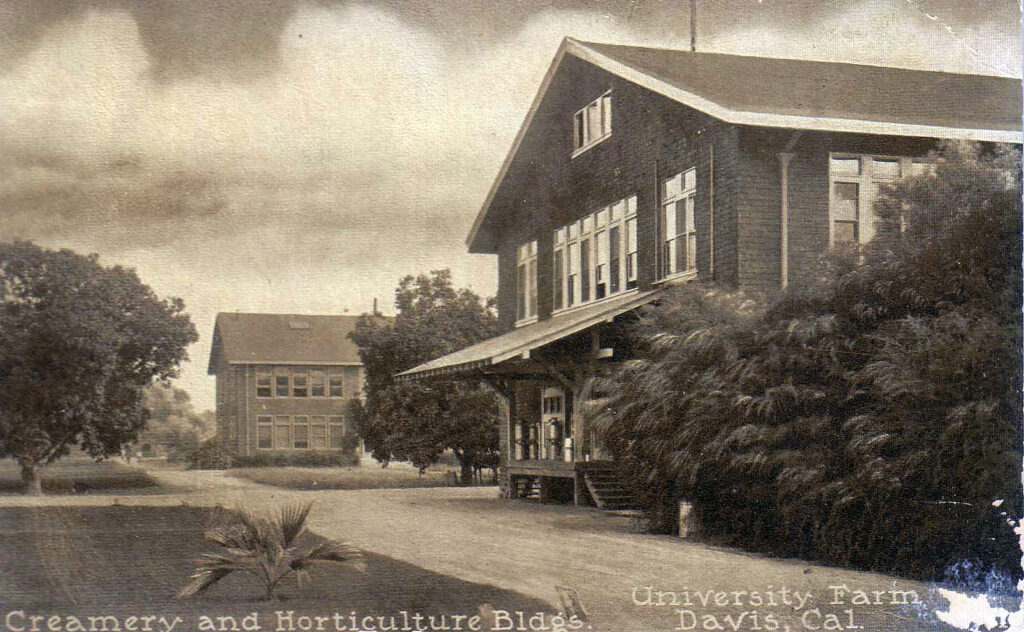 The Creamery and Horticulture buildings at the University of California farm in Davis, Calif., in the early 1900s.
“‘There’s a problem with students going to UC in the Valley — send them to Berkeley,’” the colleague told them. “They don’t need to be in the Valley anymore.’ Well, that was a silly thing to say. And Russell gave the obvious answer: ‘Where do you think your food comes from?’”
To be sure, some Berkeley programs have ongoing commitment to rural California. Gallagher acknowledged the importance of the forestry program in addressing wildfire risk and recovery. The Berkeley Food Institute has a focus on rural food systems. The Rural Health Innovation Program, founded in 2023, is quietly winning national attention.
Berkeley grads who choose careers in California’s rural areas and small towns find that the journey sometimes has challenges, but also deep rewards.
Leading an almond revolution
For some, the move to rural California is a natural evolution — they’re simply going home.
Holtz grew up in the San Joaquin Valley, moving back and forth between his parents’ home in Escalon and his grandfather’s farm just outside of Modesto. His grandfather worked at a local nursery, and plant diseases were a constant concern. So Holtz was attracted to farming at an early age.
“I wanted to study plant pathology so that I could help cure nursery and tree fruit diseases, helping local agriculture in some manner,” he recalled. “I wanted to make an impact in that way.”
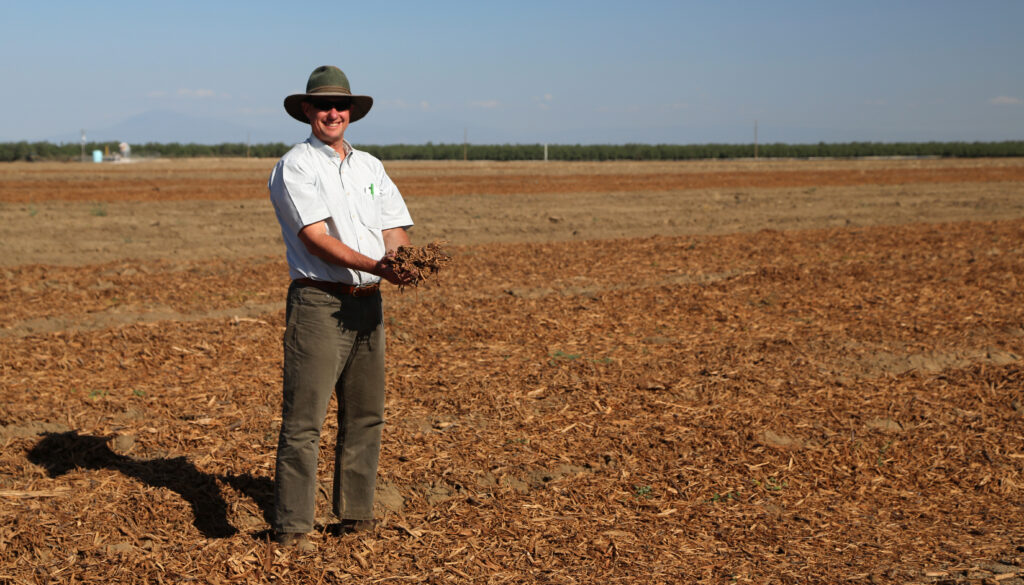 Berkeley graduate Brent Holtz developed an innovative strategy for almond growing: Instead of burning old trees, put them in a chipper and use them to enrich the orchard soil. The idea has revolutionized almond growing in the Central Valley.
Courtesy of Brent Holtz
When his grandfather could no longer run the farm, Holtz’s father stepped in. Over the years, he watched his father feed fallen limbs and tree prunings into a chipper, and then saw how the chips would compost and turn into rich black soil around the trees.
Holtz went to Berkeley for his master’s and Ph.D. in plant pathology. His dream for the future? To work as a farm adviser for UC Agriculture and Natural Resources (UC ANR).
In 2003, a new California law banned farmers from burning their old trees in the southern San Joaquin Valley where the air was polluted. The law aimed to control smoke and pollution, but because it challenged longstanding agricultural practices, many farmers were furious. But Holtz remembered his father’s approach, and initiated a research study that showed how enriching orchard soil with wood chips from old trees could help the next generation of trees produce more fruit, with less water and little risk of transferring plant diseases.
He called the approach “Whole Orchard Recycling,” and as a farm adviser, he had a solid platform for promoting this practice. Despite resistance, he persisted — and gradually, over a span of years, his ideas won wide approval.
Today, Holtz holds leadership positions in a variety of San Joaquin Valley organizations: the Agricultural Advisory Board, the Farm Bureau Federation board and the California Clean Biomass Collaborative.
In 2024, the Almond Board of California honored him with its Almond Technical Achievement Award, saying that his pioneering work “revolutionized how almond growers approach orchard sustainability.” In the same year, UC ANR awarded Holtz its distinguished service award in outstanding research.
Holtz credits his Berkeley years with a major role in his innovation. “The classes at Berkeley just got my mind thinking in terms of sustainable practices,” he recalled. “Recycling a whole orchard back into the ground is about as sustainable as you can get.”
‘I never wanted to be a politician’
León spent most of his childhood in Huron, a flat, fertile, sunbaked hub of lettuce farming an hour’s drive south of Fresno. As a youth, he was quiet, a self-described nerd. Which is hard to believe, because today, as the mayor of Huron, he is vocal and high-energy, identifying problems and proposing solutions that are by turns idealistic, practical and visionary.
His parents arrived from Mexico in the 1950s. His father had a fourth-grade education and his mother left school after third grade. He is, at his core, a son of Huron. He seems to know almost everyone — teachers, farm workers, politicians. He sees how limited educational resources, public transportation and health care lock people into poverty.
For León, Berkeley in the 1990s was a turning point. He arrived intending to become an environmental scientist, but the climate of ideas and political commitment woke something in him. He joined the 1993 Third World Strike, a student movement demanding that ethnic studies at Berkeley be preserved and improved. He changed his major to Chicano Studies.
Even before graduation, he was bringing his organizing energy back to Huron. In 1994, he ran a survey of families for a local health clinic, and the same year organized a health fair. After that fair, a clinic doctor pulled him aside with some unsettling news.
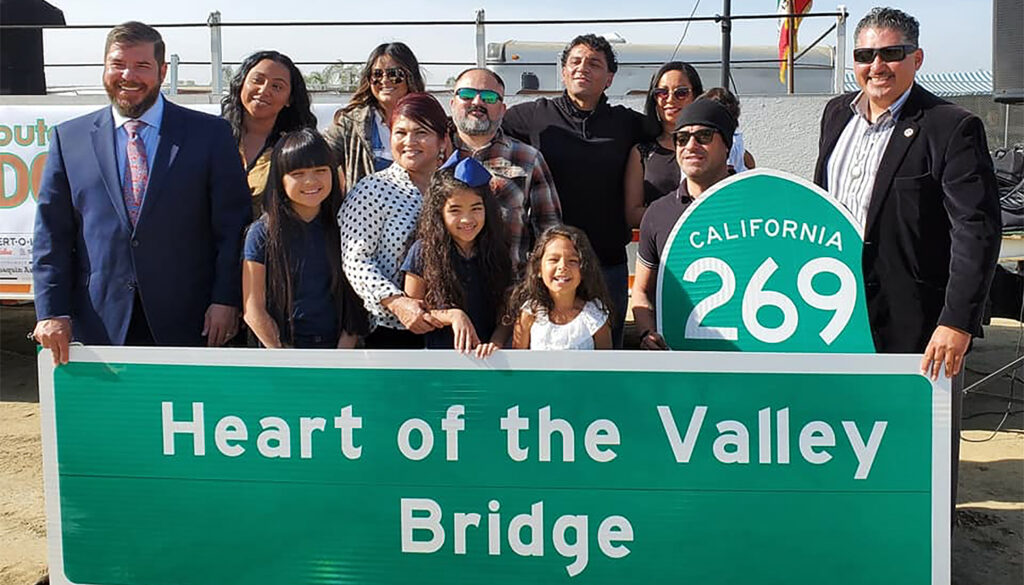 Huron Mayor Rey León (right) and California Assembly member Dr. Joaquin Arambula (left) flank a group of staff and family members celebrating the completion of a major bridge on the Huron’s main road. A flood on the road left six people dead in 1995, and León worked for nearly two decades to win funding and then helped steer the project to completion in 2019.
Photo courtesy of Huron Mayor Rey León
“He told me, ‘Hey, if you would not have done this, at least one person would have died,’” León said. “‘One woman, her blood pressure was so high she would not have woken up tomorrow morning.’ This just blew my mind — so I organized the fair for the next three summers, for free.”
León recalls at least one occasion when a colleague offered him a job in the Bay Area, for a real salary, but he was too busy with local projects. His work expanded from health activism to education, transportation, air pollution and environmental justice, often carried out through The LEAP Institute, a nonprofit he founded.
In 1995, a flood killed six people on a Huron road known for its danger in heavy rains, and in the early 2000s, León began working to build a bridge. The effort extended across nearly two decades, until he was elected Huron mayor in 2016 and won the remainder of funding for the $31 million project. He created a program to use electric vehicles to drive Huron residents to Fresno for medical appointments. He estimates that he’s helped to generate $100 million in infrastructure improvements for Huron. With local students forced to attend high school about an hour’s drive away, he’s pressing state and local officials to build a high school in the city.
“I never wanted to be a quote-unquote ‘politician,’” he said. “In college, as a radical, I thought that was a negative thing. So I was more an organizer and an advocate. But then I started thinking about it. Running for mayor was looming over my head — all these folks just kept bugging me to do it. And so I asked myself, ‘Do I just run for mayor, and get the work done from within?’”
He won in a landslide. Now, after 10 years in the post, León will stand for election to the Fresno County Board of Supervisors in June.
Impact lasting decades into the future
There’s another parallel in the experience shared by Sarah Edwards, Brent Holtz, Rey León and Ricky Satomi: They have put in years of work, and have risen to positions of influence.
Satomi has served as a UC ANR Extension forestry advisor for Shasta, Trinity and Siskiyou counties, and now is a forester for Sutter, Yuba, Nevada and Butte Counties. He’s co-chair of the UC ANR Forestry Program Team and serves in leadership roles with the California Society of American Foresters, the Forestry Institute for Teachers and the Forestry Mentorship Program.
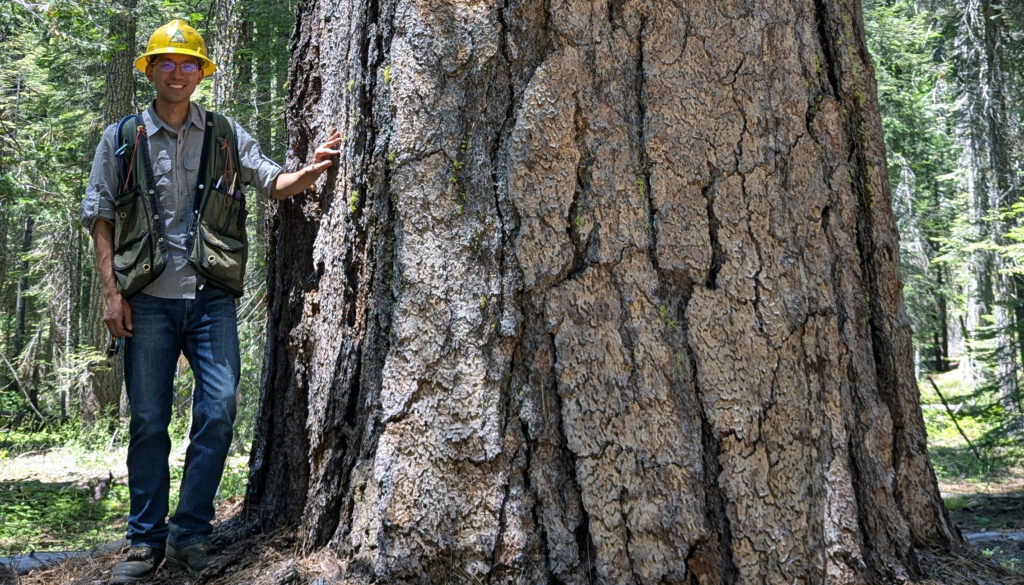 Ricky Satomi said UC Berkeley graduates are a robust presence in California’s forestry community, both as forest managers and in the timber industry.
Photo courtesy of Ricky Satomi
He’s not just a forester, but an educator and a diplomat. He works closely with timber industry groups on new research and practices, with community groups on fire prevention and disaster recovery, and with forestry-education schools.
By the nature of their work, foresters have to think about how trees and forest landscapes grow and change over time.
“We operate on a very, very long timescale,” he explained. “We’re setting up the land with a plan in mind, so that whoever comes after us, a generation from now, can see what we’ve done and carry it forward. That means that the decisions we make today have an impact lasting decades into the future.”
Perhaps that’s also a model for a more robust relationship between UC Berkeley and the communities of rural and small-town California. If students from rural areas and small towns come to Berkeley, and if graduates leave campus and go to work in those areas, then there will be a continual exchange of ideas, experience — and understanding.
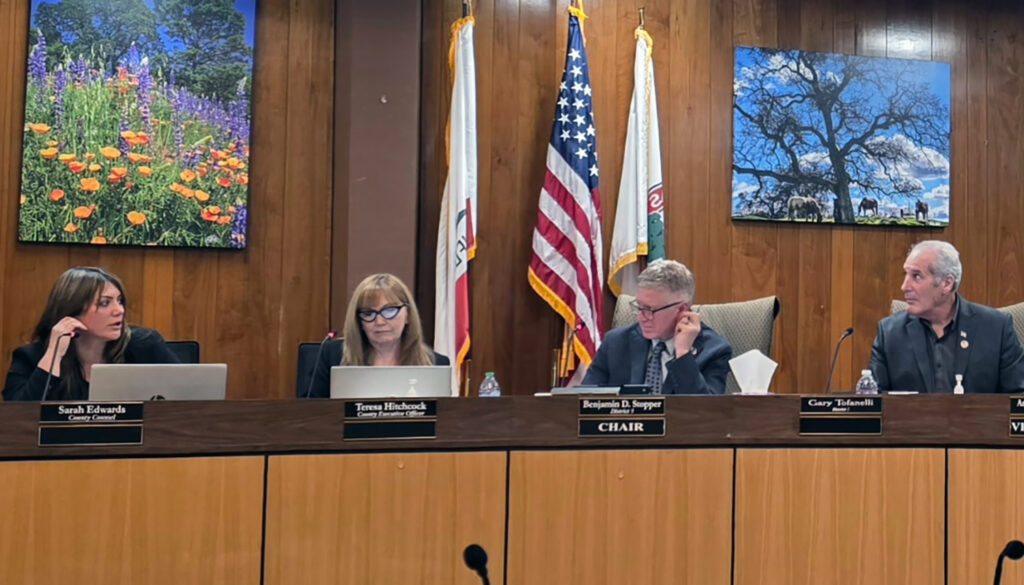 Sarah Edwards, the Calaveras County counsel (at left), works regularly with the county’s Board of Supervisors. She said that leaving home to attend UC Berkeley and years of experience in the Bay Area expanded her horizons and helped her to be a better lawyer when she returned home to work.
Sarah Edwards remembers well what it was like as a young woman to arrive in the bustling international metropolis of UC Berkeley — overwhelming, at first, but then thrilling.
“I have no idea what I would be like as a person had I not spent seven years at Cal,” she said. “It exposed me to such a variety of people and experiences and ideas and foods that I would never have been exposed to had I stayed here in Calaveras County my whole life. I think I bring that experience back with me. It informs who I am as a person, and how I do my work.”
That holds for younger people today, and for future generations, Edwards added. “It’s important for kids from around here to see that it’s an option to go somewhere like Berkeley — I don’t think that’s always on everyone’s radar. For folks who may be from places like this, you’re just exposed to things that you’re not going to be exposed to otherwise.”
Gallagher, the Assembly minority leader, offered a complementary view. “Things are different in rural parts of the state, in farming and other livelihoods,” he said. “One thing that Berkeley is good at doing is really trying to help people better understand each other, and that different groups have different needs. Hopefully, that’s something that can be done better for rural California.”
Certainly, Merritt said, more UC Berkeley students should see rural California as a laboratory for discovery and innovation — a place where the future can be shaped.
“These communities all have their own personalities,” she said. “It’s very appealing to be close to people who are growing things and who are dealing with all of the policy issues and environmental issues. Climate change is just one example — it’s such an obvious challenge that’s going to be hitting the rural areas and that will hurt us all in the future.
“So what I would tell a student is, if you’re interested in things that arise because of the nature of rural areas, but can have a huge social impact beyond the rural areas, this is an exciting place to try things out.”