
When Elias Shawel used to drive taxis in San Francisco, his passengers always asked him where to find the best Ethiopian food. But nowhere in the city was making food as spicy as he liked it.

“Seriously, it was not that good,” he said.
So he took matters into his own hands. Today, Shawel and his wife Nani Tsegaye run two Ethiopian restaurants in the city: the Tadu Ethiopian Kitchen in the Tenderloin and the House of Tadu Ethiopian Kitchen in Mission Bay. Both are some of the best destinations in SF to get a hearty, nourishing meal for under $20.
Article continues below this ad
“It was his dream to open a restaurant, and it worked out really well because I have the financial background,” said Tsegaye, who used to be an accountant for hotels.
A pedestrian walks by the House of Tadu Ethiopian Kitchen in San Francisco on March 3, 2026.
Douglas Zimmerman/SFGATE
Customers prepare to order at the House of Tadu Ethiopian Kitchen in San Francisco on March 3, 2026.
Douglas Zimmerman/SFGATE
Owners Nani Tsegaye, left, and Elias Shawel stand with some of their dishes at the House of Tadu Ethiopian Kitchen in San Francisco on March 3, 2026.
Douglas Zimmerman/SFGATE
When I met the couple at their Mission Bay restaurant on a recent Tuesday afternoon, Tsegaye effortlessly whirled around the kitchen preparing an order of special kitfo (rare ground beef sauteed with spices and butter and served with a side of salad and gomen, or collard greens) while Shawel, soft-spoken but warm with customers, took orders at the front. Both of them are talented cooks, but it’s Tsegaye’s accounting skills paired with Shawel’s entrepreneurial spirit that have made their businesses successful.
Article continues below this ad
Make SFGATE a preferred source so your search results prioritize writing by actual people, not AI.
Add Preferred Source
Shawel grew up working for his family’s shoe business in Addis Ababa, the capital of Ethiopia. He moved to SF in 2007 and met Tsegaye a few years later at a mutual friend’s baptism in San Jose. She’d lived in Georgia since she was 15 but was from the same city in Ethiopia as Shawel. The couple hit it off, and she moved to California.
Then came Uber. The app rang the death knell for the taxi business when it launched in SF in 2010. But with the shift, Shawel saw an opportunity to pursue his dream.
The couple opened their first restaurant, Tadu Ethiopian Kitchen, in 2014. The 600-square-foot eatery on Ellis Street had just five tables, an open kitchen and cheery orange walls. They named it after Shawel’s grandmother, who had always encouraged him to start his own business. Neither Shawel nor Tsegaye had ever worked in a kitchen before, but both had learned how to cook traditional Ethiopian cuisine from their families.
Article continues below this ad
Sambussas stuffed with lentils at the House of Tadu Ethiopian Kitchen in San Francisco on March 3, 2026.
Douglas Zimmerman/SFGATE
Owner Nani Tsegaye cooks up a dish in the kitchen at the House of Tadu Ethiopian Kitchen in San Francisco on March 3, 2026.
Douglas Zimmerman/SFGATE
“We just jumped in it,” Tsegaye said. “We were learning as we went.”
About a month after they opened, a San Francisco Chronicle article came out about Tadu Ethiopian Kitchen. Suddenly, they were busy. Tadu gained a loyal following of downtown office workers and neighbors, and by 2017, it had outgrown the tiny space. That year, the couple opened their second, larger location in Mission Bay.
Article continues below this ad
The House of Tadu was one of the first restaurants to take a chance on Mission Bay before Chase Center opened and the Thrive City and Mission Rock developments had cropped up — now, the Fourth Street restaurant is a prime location. The newer spot is much more modern than the Ellis Street one, with electric blue walls, high exposed ceilings and concrete floors. But, according to Shawel, there’s one even bigger difference between the two restaurants.
“At the other one, they don’t ask for a fork,” he said with a twinkle in his eye. “Over here, they need a fork.” Tsegaye laughed, clarifying that many people request a fork because they are taking their lunch back to the office. In any case, the couple truly loves introducing people to Ethiopian food.
“One thing that drives us more than anything else is that we’re exposing our culture,” Tsegaye said.
Owner Elias Shawel talks with customers at the House of Tadu Ethiopian Kitchen in San Francisco on March 3, 2026.
Douglas Zimmerman/SFGATE
The vegetarian combination dish with kik alicha wot, misir wot, gomen, alicha tikil gomen and key sir wot at the House of Tadu Ethiopian Kitchen in San Francisco on March 3, 2026.
Douglas Zimmerman/SFGATE
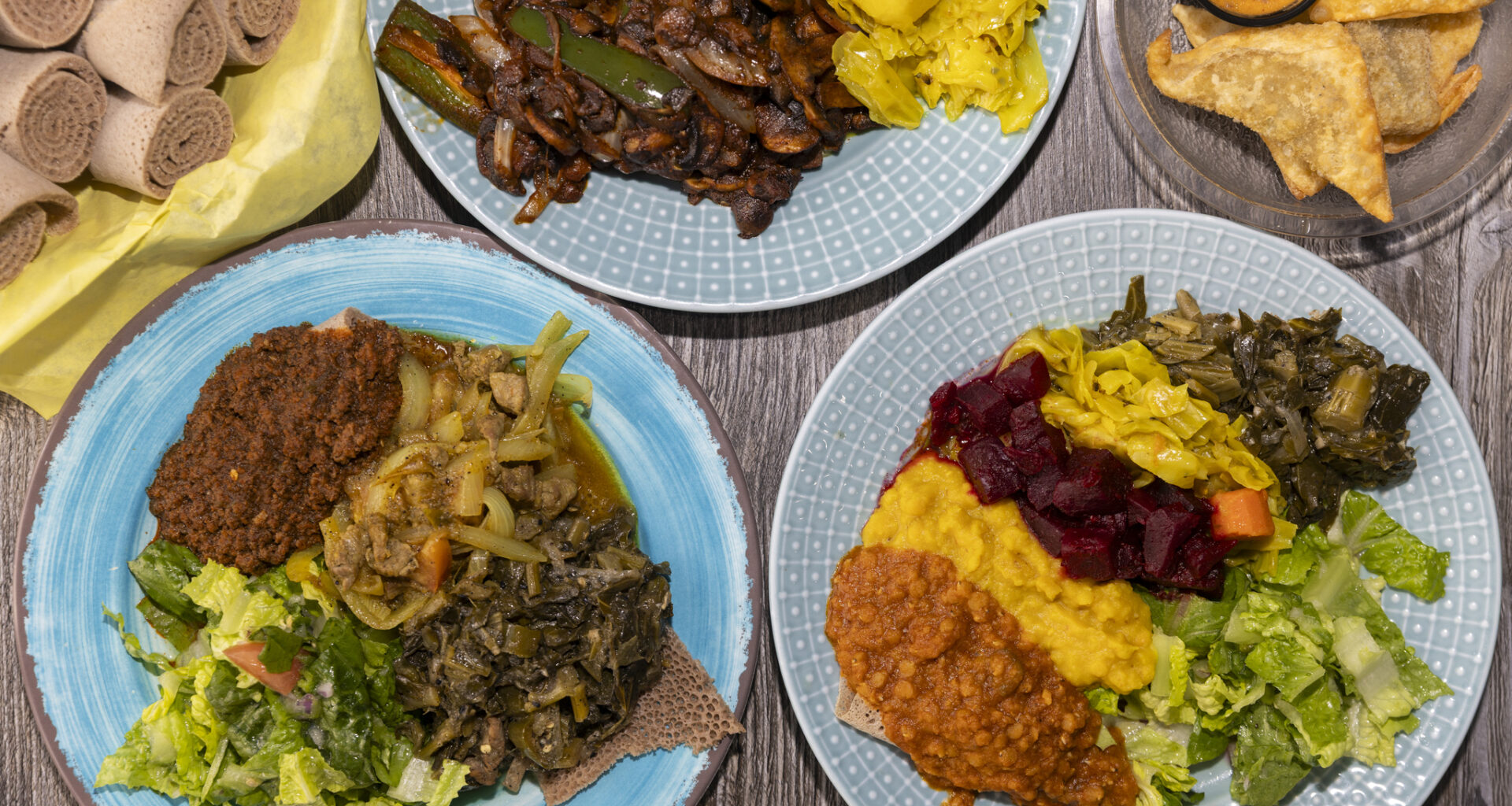
The House of Tadu’s most popular dish is the vegetarian combo, a rainbow sampler plate of wots (stews): kik alicha wot (mild, earthy stewed yellow split peas); misir wot (spiced red lentils); gomen (savory collard greens); alicha tikil gomen (braised cabbage, carrots and potatoes); and key sir wot (cubed beets) served with a lemony green salad and injera, the spongy fermented flatbread used to scoop up each bite ($18.50). It’s a rich and flavorful dish, thanks to Tadu importing all of its spices straight from Ethiopia. It was also more assertive in its heat than what I’ve experienced at many Ethiopian restaurants in the Bay Area — a refreshing change.
Article continues below this ad
Other highlights are the sambussas, light and crispy triangles stuffed with your choice of lentils or ground beef ($9.50), and the mushroom tibs ($15.50), which are sauteed with onions, tomatoes, jalapenos and bell peppers in a spicy berbere that makes the humble veggies sing. For a budget option, the kitfo wrap is very popular: a medium-rare ground beef that’s sauteed in butter and sauces with ayib cheese and wrapped in injera like a burrito ($13.50).
Portions are generous — nearly two meals’ worth — and most items on the menu are between $14 and $19. Tsegaye said they manage to keep overall prices low by having the higher profit margin dishes compensate for the lower profit margin ones. They charge roughly the same for the meat combo and the vegetarian combo, for example, even though meat is more expensive than veggies.
Rolls of injera at the House of Tadu Ethiopian Kitchen in San Francisco on March 3, 2026.
Douglas Zimmerman/SFGATE
Chef-owner Nani Tsegaye makes a special kitfo plate, which consists of rare ground beef mixed with homemade butter and spices, as well as onions and jalapenos, at the House of Tadu Ethiopian Kitchen in San Francisco on March 3, 2026.
Douglas Zimmerman/SFGATE
But Tadu’s success is really thanks to a loyal core of regulars who can’t seem to go more than a week without their veggie combo fix. For the couple, that accessibility is the whole point — when they take their own children out to eat, they’re always looking for a bill that doesn’t break the bank.
Article continues below this ad
“The only way this would work, for us at least, is having more volume,” Tsegaye said. “So you have good pricing, everybody can afford it, and then you have to have a good amount of your customers coming back.”
She added that consistently serving delicious, flavorful food is a huge part of it, too. “That’s why we spend a lot of time here, because the quality is one thing that we cannot compromise on,” she said.
In January, Tsegaye and Shawel were forced to raise prices by about $2 per item across the board at the Mission Bay restaurant due to tariffs and other rising costs. But they haven’t yet upped them at the Ellis Street eatery. Keeping their food affordable has always been very important to them.
“We were very intentional in doing that,” Tsegaye said. “I think with the fact that our first place was in the Tenderloin, we always keep that in mind because we want our pricing to have good social economic diversity.”
Article continues below this ad
Chef-owner Nani Tsegaye prepares some dishes in the kitchen at the House of Tadu Ethiopian Kitchen in San Francisco on March 3, 2026.
Douglas Zimmerman/SFGATE
A sign board shows the dishes and prices at the House of Tadu Ethiopian Kitchen in San Francisco on March 3, 2026.
Douglas Zimmerman/SFGATE
The vegetarian combination dish with kik alicha wot, misir wot, gomen, alicha tikil gomen and key sir wot at the House of Tadu Ethiopian Kitchen in San Francisco on March 3, 2026.
Douglas Zimmerman/SFGATE
Even with two restaurants, the couple remains very hands-on at both eateries. Six days a week, you’ll find at least one of them at each Tadu location — tending to simmering pots, taking orders and chatting up regulars. For Tsegaye and Shawel, the demanding schedule is a fair price to pay for a community that has carried them for over a decade.
Article continues below this ad
“Some we’ve known since the first Tadu opened up,” Tsegaye said. “We love our customers. They keep us going.”
The Chronicle and SFGATE are both owned by Hearst but have separate newsrooms.
House of Tadu Ethiopian Kitchen, 1130 Fourth St., San Francisco. Open Monday through Saturday, 11:30 a.m.-9 p.m., closed Sunday.
Article continues below this ad
Tadu Ethiopian Kitchen, 484 Ellis St., San Francisco. Open Wednesday through Thursday, 11:30 a.m.-4 p.m., Friday, 11:30 a.m.-3 p.m., closed Saturday through Tuesday. The new hours of Wednesday through Sunday, 4:30-9:30 p.m., begin on April 1.