
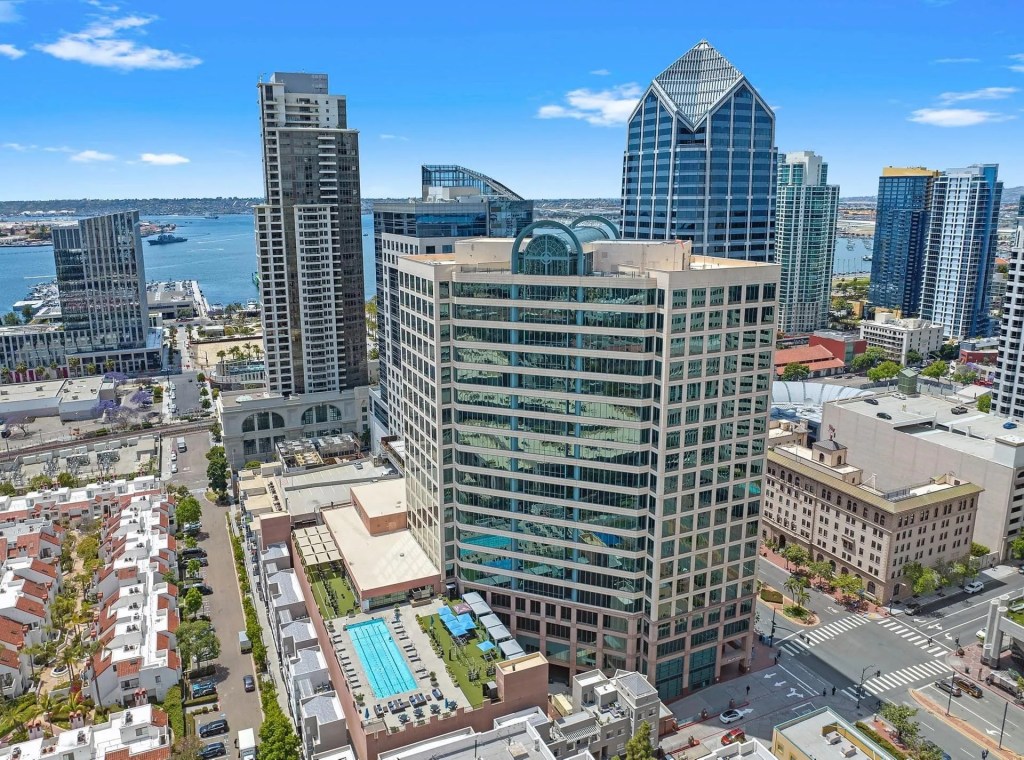
A narrow slice of downtown San Diego’s depressed office market is just a name change away from a vibe shift — or at least that’s the thinking behind an entrepreneurial building owner’s campaign to rebrand the westernmost portion of Broadway as “WeBro.”
On Thursday, Daniel Negari, the owner of two west Broadway office towers, introduced a crowd of commercial real estate professionals to his recently coined term for the neighborhood west of the US Grant Hotel on Broadway.
The WeBro corridor, as defined by Negari, includes the office towers at 225 Broadway, 402 W. Broadway (Emerald Plaza), 101 W. Broadway, 501 W. Broadway, 600 W. Broadway (One America Plaza) and 655 W. Broadway. Here, just 13.5% of office space is available for rent, Negari said, meaning the corridor has one of the tightest vacancy rates in the country.
Negari is one of a handful of high-net worth individuals and family offices that have recently entered the downtown office market amid a sea change in ownership. His real estate firm XYZ purchased 225 Broadway and 501 W. Broadway from Irvine Company in late 2024 and 2025. Businessman John Saca’s real estate company Saca Development similarly invested in two former Irvine Company assets, 101 W. Broadway and One America Plaza.
The pair were joined Thursday by two other new downtown building owners, Eric Gan of Ganmi and Julie Dubik of Prebys Foundation, for a panel discussion hosted by NAOIP. The discussion, moderated by Cushman & Wakefield executive Derek Hulse, centered on the shift in downtown office ownership from institutional real estate investors to private capital.
In February, Gan’s family office purchased 1 Columbia Place and 2 Columbia Place. In April 2025, Prebys Foundation purchased 401 B St., better known as Wells Fargo Plaza.
Negari said the crop of new owners brings new life to a downtown that already boasts great weather, ample parking, public transit and established industries.
The WeBro initiative, which Negari describes as a cultural movement, seeks to build on the existing energy, albeit in a specific part of town that the real estate executive views as removed from downtown’s biggest challenges.
“You have a new set of property owners that are all invested in bringing this corridor to a pristine look and feel. We’re the most occupied area of downtown, and of actually all the downtowns. So we want to keep that momentum going and give it a proper refresh and a proper rebrand,” Negari told the Union-Tribune. “The vision is … an arts and entertainment district, something where we can take the medians in the street, beautify them, change the trees, bring in some digital signage and do something with the sidewalks. … We need to make it all uniform and really celebrate the boulevard.”
The initiative, which is still in its infancy, could be funded by the property owners or in collaboration with the Downtown San Diego Partnership, which manages the area’s property and business improvement district.
Looking at downtown as a whole, the new building owners aren’t naive to obstacles impeding a recovery, with the Campus at Horton and Research and Development District (RaDD) properties viewed as the biggest drag on the market.
The Campus at Horton is the reincarnation of Horton Plaza, the 1980s-era, post-modern mall famous for helping to revitalize downtown. Stockdale Capital Partners, a Los Angeles-based real estate investment firm, converted the mall into a mixed-use campus with 300,000 square feet of retail and around 650,000 square feet of office space. But the developer’s lender foreclosed on the asset last year, and the project remains empty and unfinished.
“I think that Westfield, instead of selling (Horton Plaza), should have doubled down and done more of an entertainment base and rebranded it instead of selling it. But unfortunately, (Stockdale) bought it and decided to do life science and put in a plethora of space that I don’t think is ever going to get leased,” Saca said at the event. “I’m not sure what you do there. I think it almost needs to be repositioned. I don’t know if it’s ever going to work for office.”
The building owners also identified homelessness, cleanliness, a lack of retail options, and the city’s budget deficit as additional barriers to revitalizing downtown.
Gan, who was the longtime executive vice president at Japanese telecommunications company SoftBank Corp. and now lives in San Diego, said he’s hoping to engineer a new ecosystem downtown that appeals to foreign companies in Japan, Hong Kong and Singapore.
As part of that effort, Gan said he’s working with the San Diego Regional Economic Development Corporation to lead a delegation that includes San Diego Mayor Todd Gloria on a trip to Japan in September. In his view, the problem of the empty Horton and RaDD projects can be solved with the right international outlook.
“They’re not elephants,” Gan told the audience. “If you compare them to what we’ve seen in New York and Tokyo, these are tiny buildings. … I will not be scared of these big projects. We just need a big company.”