
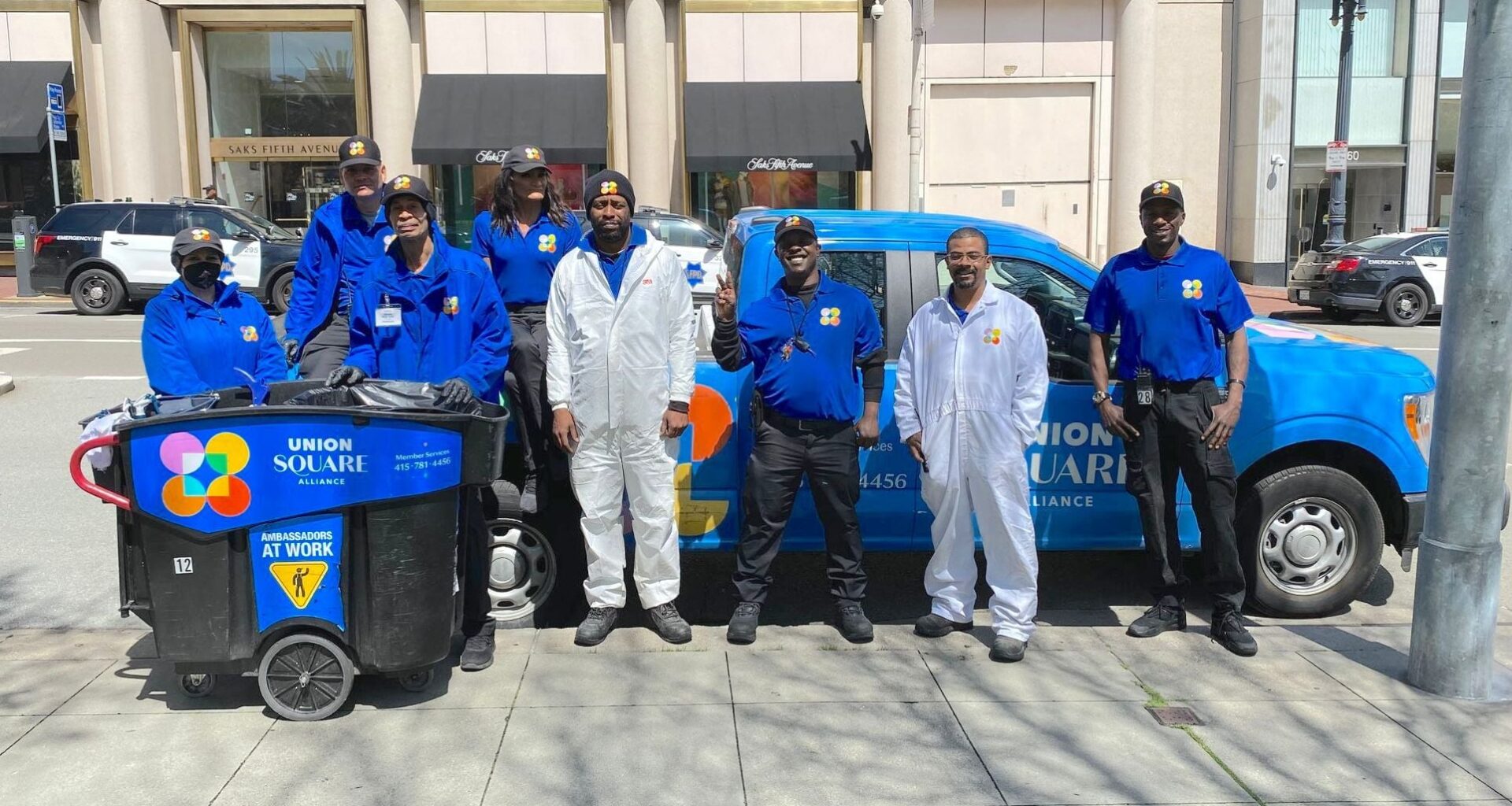
The SF Downtown Development Corporation awarded two safety ambassador programs — stationed in Union Square, Yerba Buena, and at downtown BART stations — a $5 million grant to stay afloat for the next year, as city funding for the programs will expire April 1.
With city funding set to expire April 1, the San Francisco Downtown Development Corporation (DDC) is stepping in with a $5 million grant to keep the so-called ambassador programs running and expand coverage, as the Chronicle reports. These on-the-street ambassadors assist tourists, monitor unusual activity, conduct welfare checks, and intervene in conflicts.
Program leaders say the presence of the privately funded safety ambassadors, introduced after the pandemic hollowed out downtown, has helped improve both safety conditions and public perception downtown. Last year, the effort reportedly resulted in about 250 emergency calls facilitated by ambassadors, along with generating roughly 1,300 service requests to city agencies — including administering Narcan in around 50 cases, according to the Chronicle.
“Establishing safety and cleanliness as a foundational condition is critical to ensuring that the work that’s underway can continue,” said DDC’s CEO, Shola Olatoye.
The SF Business Times reports the investment will support 21 ambassadors along the stretch from Union Square to Yerba Buena through the Heart Ambassador Program — up from 18 when the program launched in 2024 under Mayor London Breed.
The grant will also reportedly expand DDC’s Market Street Safe Corridor Program, which the group launched last July, initially employing 22 full-time and 11 part-time ambassadors. The program currently operates during the morning commute hours at Embarcadero and Montgomery BART stations and will expand to include Powell Street BART Station, according to Hoodline. Funding from the grant is expected to last a year.
In Union Square, nine ambassadors are currently deployed 24/7, while another nine cover Yerba Buena daily from morning into the evening, working both fixed posts and street patrols. The DDC’s CEO, Shola Olatoye, pointed to data from the Safe Corridor pilot showing a 53% drop in safety-related 911 calls.
“We can come in and fill critical gaps — and we can move quickly with high-impact capital,” said Olatoye, speaking to the Chronicle.
Backed by major donors including Laurene Powell Jobs, the Emerson Collective, the Dolby Family, and Chris Larsen, the DDC formed to channel private funding into civic needs. Olatoye told the SF Business Times in December the DDC was preparing to take on larger development projects while working to establish a legal entity that can tap both private markets and public financing tools.
The group, which launched last spring, said in December it had raised $60 million from individuals and tech companies including OpenAI, Google, and Salesforce, along with real estate firms like Prado Group and other donors. The funding is reportedly intended to support safety, cleanliness, and activation efforts downtown, including expanding the ambassador programs.
The Chronicle notes that Mayor Lurie has cast downtown’s recovery as a shift toward a 24/7 neighborhood, after years of pandemic-era vacancies across the commercial core.
That vision — centered on safety, cleanliness, and activating public spaces, particularly ahead of global events like the Super Bowl and World Cup — has drawn criticism from those who say it leans on visible, short-term fixes while overlooking long-term investment in the communities and cultural institutions that define the city.
Arts organizations in the Yerba Buena area have faced cuts, layoffs, and closures — like the recent closure of the Contemporary Jewish Museum — underscoring those concerns even as safety-focused programs expand, as the Chronicle points out.
Shola Olatoye said significant challenges remain, noting that efforts to revive storefronts, office activity, and cultural venues depend on people feeling safe downtown.
“Downtown is the economic engine of our city. The revenue generated here funds critical services across the city, including Muni and our parks, said Lurie, per the Chronicle. “That revenue pays our first responders and sustains critical services that help families thrive.”
Image: Block by Block
Related: How Many ‘Ambassadors’ Does the City Need? SF Community Ambassadors Rally to Save Their Jobs