
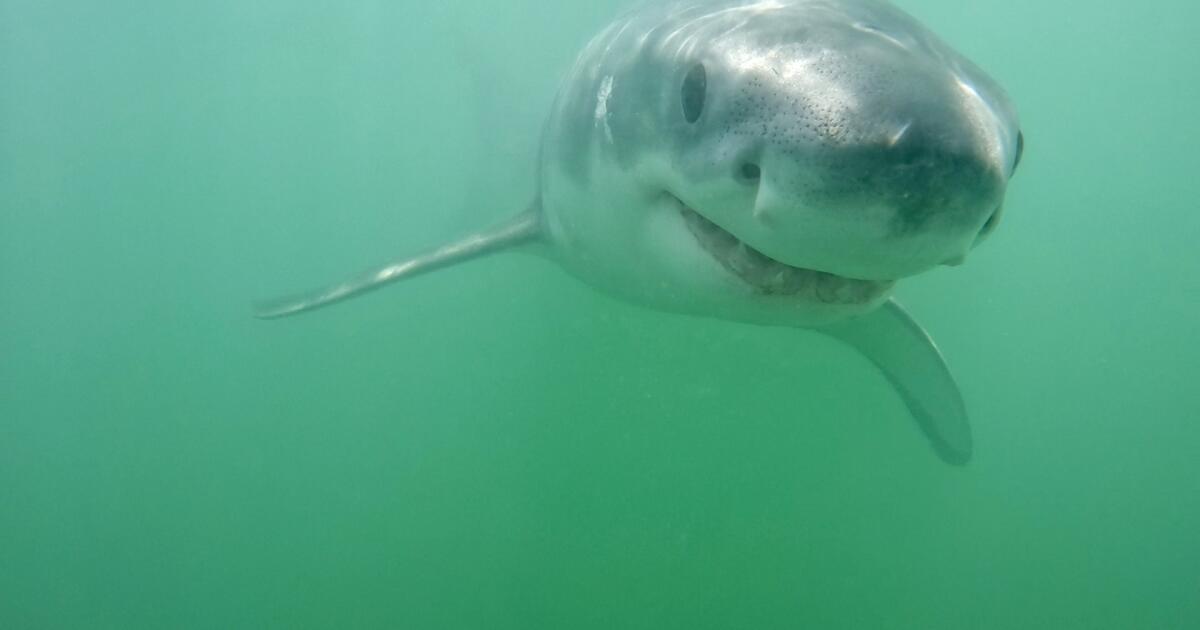
An 8-foot great white shark was spotted circling a surfer in Newport Beach on Thursday afternoon, triggering an immediate shutdown of the nearby shoreline, authorities said.
With unseasonably warm weather and the start of an El Niño cycle, Cal State Long Beach Shark Lab Director Chris Lowe predicts this sighting is just the start of a “very sharky summer.”
Lifeguards with the Newport Beach Fire Department spotted the sizable — although still juvenile — shark in the waters off 35th Street around 1:15 p.m. and ordered everyone out of the water within a two-mile range. The Newport Beach Police Department and Orange County Sheriff’s Department were notified, and a surveillance vessel requested. The beach area was reopened by 5:45 p.m.
“Shark sightings are rare along our coastline,” the Fire Department said in a statement before the beach was reopened. “When observed, these animals are typically transiting through the area. Out of an abundance of caution, we ask that the public avoid the water in this vicinity until the all-clear is issued.”
Lowe, who has been studying the behavior of juvenile great white sharks along the Southern California coast for 20 years, was not surprised by the appearance of a finned friend.
“As we speak, a juvenile white shark is swimming underneath a surfer or swimmer somewhere in Southern California,” he said. “That one [off Newport Beach] got observed by somebody, but our previous data shows that type of interaction happens all the time.”
Over a two-year period, researchers at the Shark Lab used drones to study more than two dozen beaches up and down the California coastline and found juvenile white sharks congregating at two spots in southern Santa Barbara County and central San Diego County.
At those locations, sharks and people were found swimming together 97% of the time.
In the last 10 years, the lab has measured a significant increase in the number of juvenile great white sharks spending winter in Southern California, Lowe said. Before that, great whites typically did not show up in local waters in notable numbers until spring or summer.
Lowe primarily attributes this behavior shift to warming waters from climate change.
He expects more shark sightings in the coming weeks as the Southland, which is currently experiencing the hottest March on record, is seeing unseasonably warm waters. The region is also entering the start of a strong El Niño cycle, which will fuel unusually warm Pacific Ocean waters and could draw other less common shark breeds such as hammerheads into local waters, he said.
“The last time we had a strong El Niño was in 2015 and 2016, and we had a lot of juvenile white sharks hanging around early,” he said. “So I’m expecting this year to be a sharky summer.”
Although the phrase “sharky summer” might send shivers down the spines of some swimmers, Lowe does not believe this is cause for major alarm.
In fact, it might even come with some benefits.
For starters, a large shark population reflects a healthy ocean with plentiful prey. It also means that there will be more sharks feeding on stingrays, which are responsible for around 10,000 injuries in California every summer, Lowe said.
But most importantly, he noted, shark bites are rare in California — especially considering the number of people who are swimming, surfing, kayaking or otherwise enjoying the ocean at any time.
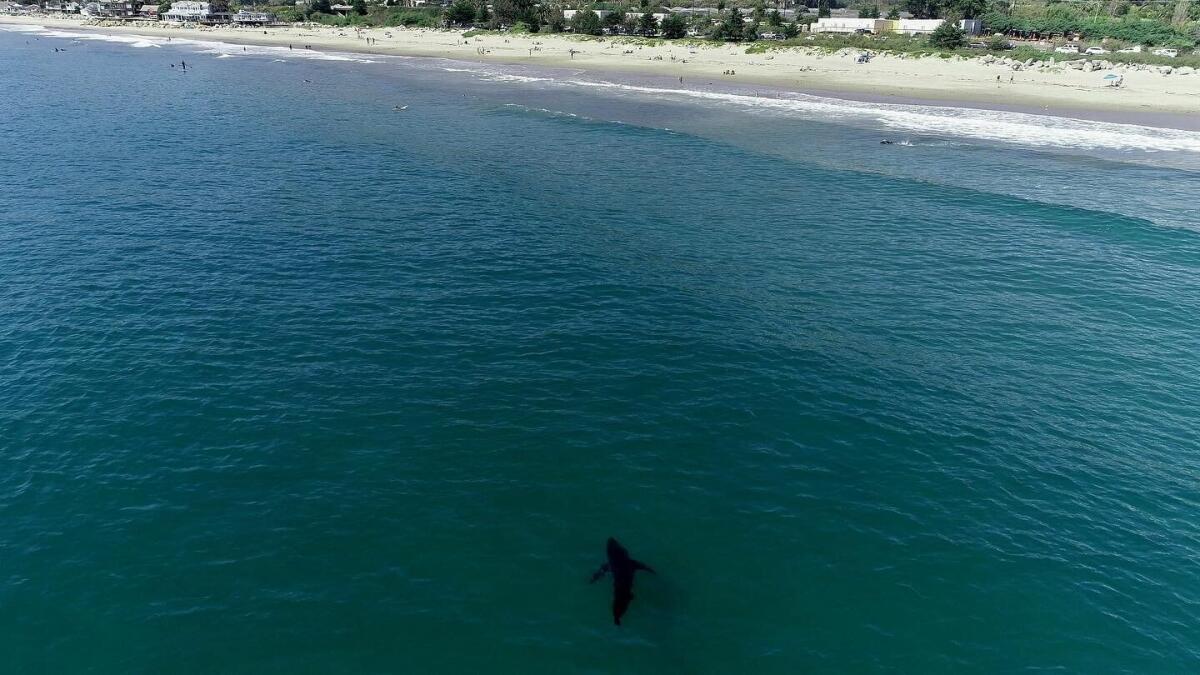
A white shark cruises along near the shore of Carpinteria in 2023.
(Cal State Long Beach Shark Lab)
From 1950 to 2022, the state recorded a total of 202 shark-related incidents, of which nearly 90% were believed to involve white sharks, according to the California Department of Fish and Wildlife’s Shark Incident Database. During that 72-year period, there were 15 shark-related fatalities, 59 major injuries and 49 minor injuries.
From 2012 to 2022, the most recent decade for which data are available, there were a total of 24 shark injuries and three fatalities recorded.
Ongoing studies at the Shark Lab suggest that there might actually be a correlation between the high number of people in the ocean and the relatively low number of shark bites.
“Because sharks are around people in the water all the time now, we think that they can actually identify people,” he said. “We don’t pose a threat, they don’t consider us food, so as a result they just ignore us.”
Scientists are still trying to figure out why, in rare instances, sharks will bite people.
“One of our favorite hypotheses is that the shark mistakes a human for their natural prey,” Lowe said, “so they confuse us as a seal or sea lion, then they bite, they realize we’re not, and they leave.”
Sharks might also bite as a defensive measure when humans get too close for comfort, he added.
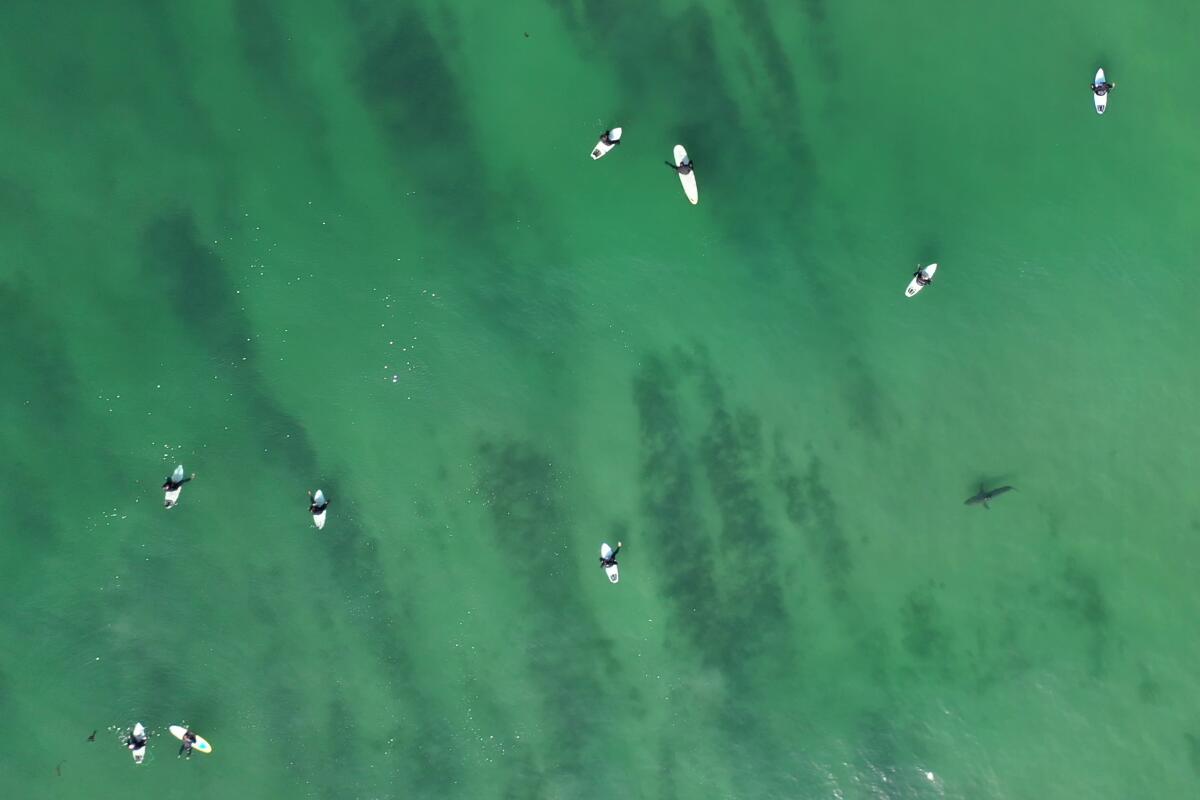
A white shark swims in the water among surfers in Del Mar in 2023.
(Cal State Long Beach Shark Lab)
Fortunately, there are simple steps that swimmers, surfers and kayakers can take to stay safe in the ocean.
The most important, he said, is always to remain in a group with other people. He also advises recreating in areas where there are lifeguards keeping an eye out for sharks and to avoid swimming or surfing around dawn and dusk when shark feeding behavior tends to peak.
Lowe also recommends paying attention to the behavior of other nearby marine life. For example, a seal or sea lion attempting to climb onto a surfboard is usually a good sign to paddle into shore.
“That animal is trying to get out of the water for a reason, and it’s usually because it senses a predator around,” he said, “so your arms and legs hanging in the water is probably not a good idea for you.”
Lastly, he said, don’t underestimate the power of your own animal instincts.
“I often tell people I trust those little hairs in the back of my neck,” Lowe said. “I think they communicate more to us than we realize.”