
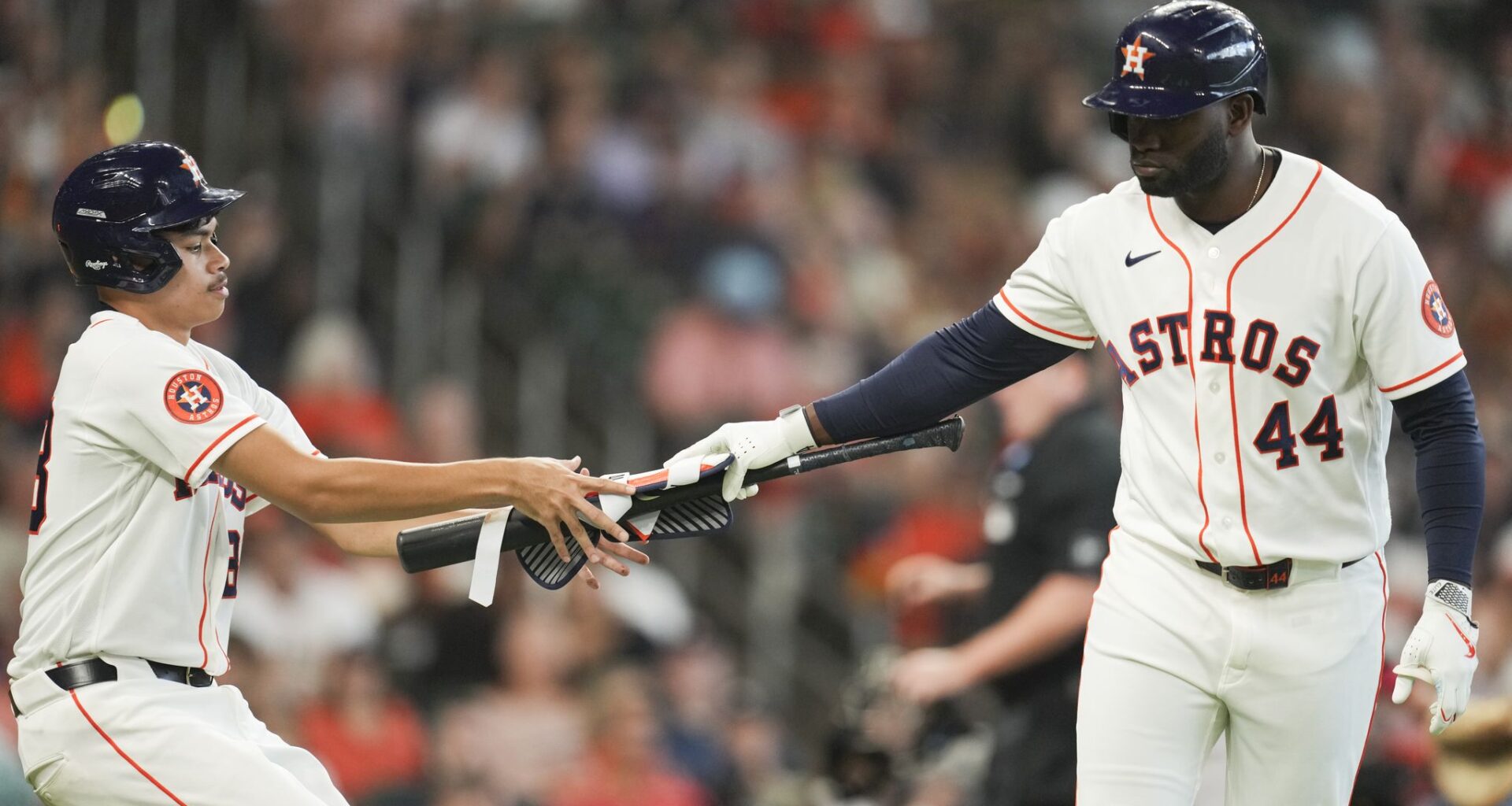
Houston Astros Yordan Alvarez (44) is walked during the third inning of a MLB baseball game on Opening Day at Daikin Park, Thursday, March 26, 2026, in Houston.
Jason Fochtman/Houston Chronicle
In the third inning of the season’s first game, Yordan Alvarez was intentionally walked. A Houston Astros runner stood at second base, with two out in a scoreless affair still in its early stages. Kurt Suzuki, the Los Angeles Angels first-year manager, made a pointed move to try to preserve the tie. Alvarez, not allowed to swing, jogged down to first base.
“I saw the manager giving the signs to the catcher,” Alvarez later said through an interpreter, “so I think I knew it before even the catcher did.”
Two spots away in Houston’s lineup, Carlos Correa said he was “not really” surprised by the ploy, either. Alvarez had nearly homered in his first at-bat against Angels starter José Soriano, only to see the ball carom off a beam on the Daikin Park ceiling. Correa mentioned that swing, as well as the platoon sense of passing a matchup with Alvarez.
Article continues below this ad
“When you think about most feared hitters in the league, you’ve got (Shohei) Ohtani, (Aaron) Judge and Yordan, right, so whoever is hitting behind him is going to see that situation happen a lot,” Correa said. “It doesn’t surprise me. Especially with a righty throwing sinkers at 100 mph, the matchup favors against a right-handed hitter (rather) than a left-handed hitter.”
To what extent a platoon edge — as opposed to just the threat of Alvarez — influenced Suzuki’s decision was unclear. In his 31 starts last season, Soriano actually held left-handed hitters to a lower OPS (.666) than right-handed hitters (.715). Later in the Astros’ 3-0 season-opening loss, Suzuki brought a righty in from his bullpen to face Alvarez with two runners on base.
Yet the third-inning move, as Correa noted, did allow Soriano to bypass one of two left-handed hitters in Houston’s lineup. The other, Joey Loperfido, sat three spots away. Soriano issued a walk to Isaac Paredes that loaded the bases. But a 98.7 mph sinker boring inside on Correa coaxed a harmless liner to left field that ended the Astros’ only real threat against him.
The Astros did not put another runner on third base in their opening day loss. Soriano spun six scoreless innings, despite his four walks, allowing just two hits. That both were singles by Loperfido, and that Alvarez’s non-home run was one of the best swings an Astro delivered against Soriano, perhaps backed Correa’s point about the platoon matchups.
Article continues below this ad
Houston could not have created more Thursday. Its roster has two left-handed hitters in Alvarez and Loperfido, who logged his 123rd major-league game in the opener, making for limited lineup balance. The Angels deployed four right-handers among the five pitchers they used Thursday, holding an Astros lineup missing only shortstop Jeremy Peña to three hits.
“They came in a with a pretty good game plan on how they’re going to pitch to us; we’ve just got to make adjustments,” manager Joe Espada said. “I think it had nothing to do with how many righties we had. I just thought they came in and they were going to force us to stay inside the ball, use the middle of the field, and we’re just going to have to make that adjustment as we move on.”
Platoon matchups aren’t everything. Last year, Houston’s right-handed hitters ranked fifth in the majors in batting average and 10th in weighted runs created-plus against right-handed pitching, per FanGraphs. No team in the sport, still, took a lower percentage of its plate appearances with the platoon advantage than the Astros in 2025, per Baseball Reference.
Though general manager Dana Brown voiced a desire all offseason to add a left-handed hitter, no such move materialized. Houston dealt left-handed hitting outfielder Jesús Sánchez to Toronto, re-acquiring Loperfido in that trade. It offered outfield prospect Zach Cole a chance to claim a roster spot in camp but the Astros sent Cole to Triple-A to start the season, citing his need to make more contact.
Thursday perhaps reflected right-handed or left-handed hitter less than the arm Houston faced. Soriano, who faced Houston twice last season and allowed one run in 13⅔ total innings, averaged 98 mph on his sinker Thursday and touched 101.3 mph with a four-seam fastball that he threw to both left- and right-handed hitters. His curveball induced eight whiffs on 11 swings and his sinker got another eight whiffs on 19 swings.
Article continues below this ad
“I think especially with Soriano, we were swinging too much outside the zone,” Correa said. “With a pitcher like him, you’ve got to really zone him in and make sure that he’s giving you something to hit. Even when he was throwing those sinkers down and in for strikes, 99 mph sinkers are tough to get to. But we could have done a better job of getting pitches to hit.”
Astros officials preached a more selective approach all offseason. The team overhauled its hitting coach structure and harped on re-establishing an offensive “identity” after posting the sport’s second-highest chase rate and third-highest swing rate in 2025. Astros hitters, then, swung at 46 of 91 pitches Soriano threw and chased 44% of those he threw outside the zone, per Statcast.
“With the type of stuff that he has, he should never have a year like last year where (his ERA) was in the 4s,” Correa said of Soriano, who posted a 4.26 ERA in 2025. “So, I think they’re trying to take him to that next level, and he looked pretty good today.”
After Soriano’s exit, Alvarez came up in another a critical spot. Walbert Urena allowed a leadoff double to Christian Walker in the seventh inning, the Astros’ lone extra-base hit on the day, and walked Jose Altuve with two outs. With a one-run lead, Suzuki summoned right-hander Chase Silseth to oppose Alvarez, even with three left-handers in his bullpen.
Article continues below this ad
Silseth entered allowing a career .875 OPS to left-handed hitters. Alvarez was 0-for-4 with a walk against him, though. Silseth threw one pitch, a splitter. Alvarez rolled it to the right side for a groundout, stranding two of Houston’s nine runners left on base.