

After a January morning skate at the San Jose Sharks practice facility, dozens of bustling young fans — clutching hockey cards, action shots, team jerseys and hats — crowded near an exit, hoping for a brief interaction.
An autograph? A fist bump? A grin?
Any passing acknowledgement from the NHL’s most iconic best friends would do.
Inside the Sharks’ corporate-gray locker room, beneath wall decals that read “Care” and “Connected,” Will Smith pulled off his damp shoulder pads and hung them in his stall. Steam rose from the Sharks’ shaggy-chic 20-year-old center as he leaned over to Macklin Celebrini, who fiddled with his skate laces beside him.
“Which episode did you get to?” Smith asked, like colleagues crossing paths at a water cooler.
The linemates were binge-watching “Entourage,” the HBO series about a young actor embracing Hollywood fame and fortune alongside his closest friends. The show premiered in 2004, before either player was born, but the vintage vibe fits: This is a duo – and a generation – that views the spotlight like leading man Vincent Chase: not as a distraction, but a lifestyle. For Halloween, Smith and Celebrini dressed up in Harry’s and Lloyd’s garish powder blue and orange tuxedos from the 1994 movie “Dumb and Dumber.” Before Christmas, they brought “Catan” to the home of 33-year-old teammate Tyler Toffoli, showing little mercy as he fumbled through a board game that took off in the mid-’90s. (“They rinsed me,” Toffoli says.)
At 19 years old, Celebrini is already one of the NHL’s main characters. He was the youngest player on the Canadian men’s Olympic team, where he led the entire tournament in goals and finished second in team scoring to Connor McDavid.
He stands among a small group of players born in the mid-aughts — like Connor Bedard, 20, in Chicago, and Matthew Schaefer, 18, in New York — who will define the league’s next decade and beyond. They headline an unprecedented wave of Gen Z players who are pulling the game into a new era.
On the ice, they are the fastest and most skilled generation hockey has ever produced. Off the ice, they are confident and carefree. In a sport that has often resisted change, they’ve tossed aside archaic norms and connected the game to a wider, younger audience in ways that leagues like the personality-driven NBA and NFL have for years.
“These guys are taking over the league,” says Matt Martin, the retired 15-year veteran now in the Islanders’ front office.
Change isn’t coming. It’s already here.
The ‘purple sky’ era
Team above all, individuality yielding to the crest. Modesty over self-promotion. The NHL’s biggest stars have almost always presented themselves as hockey players above all else. Even generational talent operated as a product of the era in which they rose to greatness — a model built on an adherence to team hierarchy, order and a stoic disposition.
Gordie Howe set the standard for Wayne Gretzky, who inspired Mario Lemieux, who shaped Sidney Crosby. Crosby begat McDavid. Each player arrived with historic talent, but carried the same blueprint.
Beyond the rink, any light on life was kept strategically dim so as not to distract from puck’s divine purpose. The superstars offered relatively few glimpses into their personal lives, and what was displayed followed the humble design of the “good old hockey game.” Wakeboarding in Muskoka is the NHL’s Learjet to Ibiza. Crosby is interested in birding. McDavid enjoys country music and playing pickleball in the offseason. Polite and charitable, always — the game’s constant ambassadors. But it is the game, first. Singularity, a virtue. Within that culture, the NHL’s pantheon was carved by one-dimensional mythology.
Unique personalities and youthful confidence were met with suspicion. Alexander Ovechkin, the NHL’s exuberant all-time leading goal scorer, was criticized for years for his goal celebrations and playful flair off the ice, until his greatness became undeniable. But it was Ovechkin, understanding the power of personality and individuality — within a cloak of unabating confidence — who proved to be well ahead of his time.
When Nick Foligno came into the league in 2007 with the Ottawa Senators, he was the youngest forward on the roster by five years. Back then, Foligno sat quietly in his stall, listening to the gospel as told by whatever coach stood before him. He listened to team veterans like Daniel Alfredsson with similar reverence.
“If they told me the sky was purple, I’d believe them,” Foligno says.
As an 18-year-old rookie with the Philadelphia Flyers in 2011, Sean Couturier looked across the room at players like Chris Pronger, Jaromir Jagr and Daniel Briere. During one of his first practices, Pronger scolded him for hitting the brakes on a two-on-one drill.
“You can’t slow down,” Pronger barked, “in a game that’s not there.”
The lessons were purposeful. Pronger was trying to teach the rookie about the pace and timing of the NHL game. Through his early years in the league, Couturier — now the Flyers’ 33-year-old captain — just did as he was told: “I didn’t say a word.”
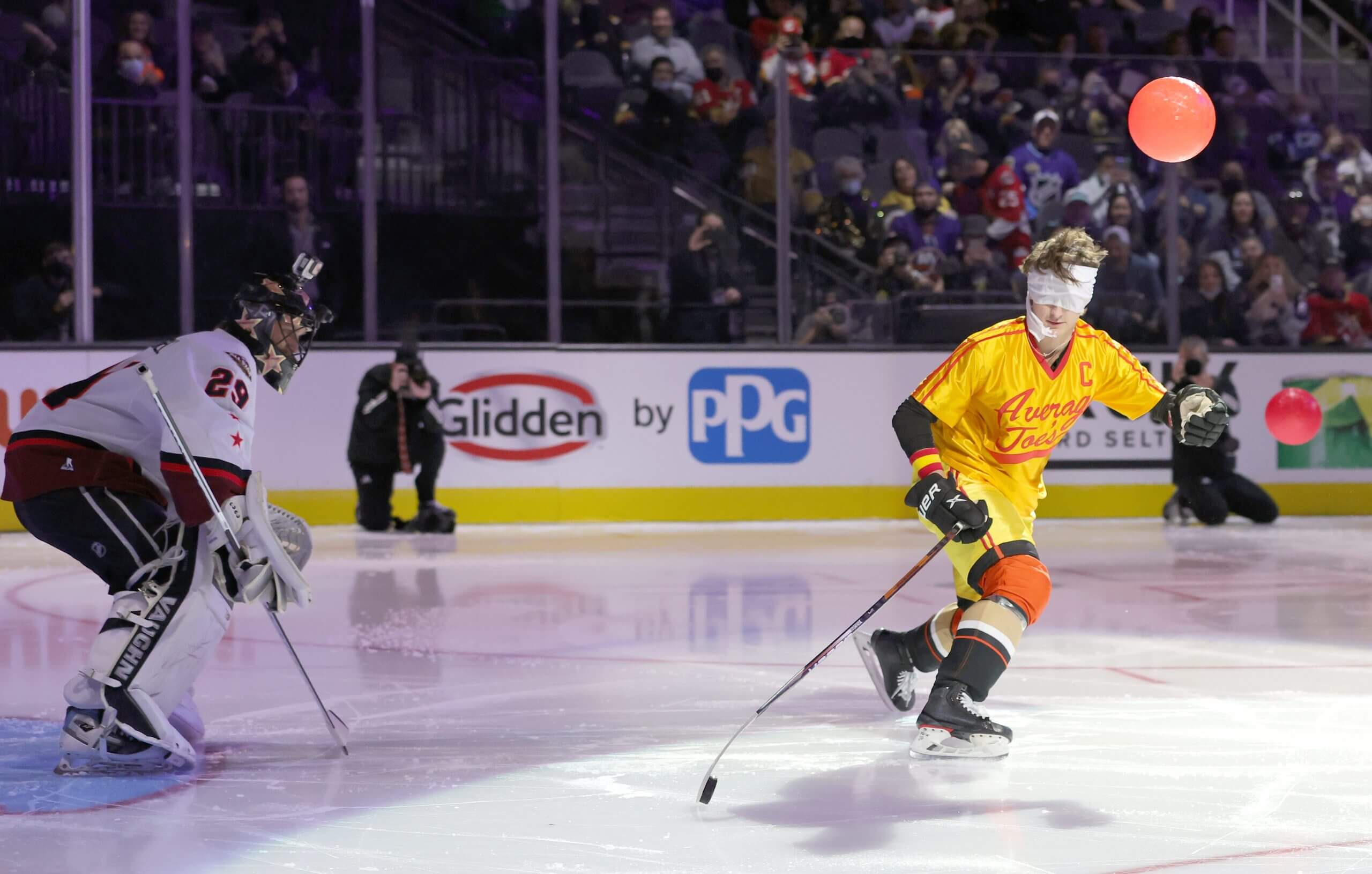
Trevor Zegras, dressed as the character Peter LaFleur from the movie ‘Dodgeball: A True Underdog Story,’ shoots the puck while blindfolded against actor Wyatt Russell in the Breakaway Challenge of the 2022 NHL All-Star Skills at T-Mobile Arena in Las Vegas in February 2022. (Ethan Miller / Getty Images)
The new generation’s opening salvo was Trevor Zegras. As a rookie with the Anaheim Ducks in 2021, the skinny center’s surfer-chic appeal — picture Jeff Spicoli on skates — and flashy trick plays made him a star amongst young fans and a villain to an older set.
Zegras’ easygoing personality went against the NHL’s staid grain. Ducks captain Ryan Getzlaf rolled his eyes as Zegras and teammate Jamie Drysdale did a pregame “Three Stooges” routine, smacking each other in the groin with their sticks and chest-bumping. Getzlaf, who retired after the 2022 season, joked that the routine was a sign it was time to move on.
Zegras was even more disruptive on the ice.
HOW DID TREVOR ZEGRAS DO THAT!? 😱 pic.twitter.com/CqbZPLCJVx
— ESPN (@espn) December 8, 2021
As a rookie, clips of Zegras flipping the puck over the net to teammate Sonny Milano went viral. An ESPN Instagram post of the alley-oop pass was reportedly viewed 32.1 million times within 48 hours of the play. At the same time, ESPN analyst and longtime coach John Tortorella criticized Zegras’ play, arguing that it wasn’t good for the game and that, in the past, players would be targeted by opponents if they tried it.
“It’s fun to watch, it’s really cool,” Tortorella said. “But I just think our game has gone so far away from what the game should be. A hard game. An honest game. It’s almost gotten too showman.”
After playing his 300th NHL game in December, Zegras stood in Montreal’s Bell Centre concourse, wearing gray long underwear and socks, greeting a fan who’d driven six hours to meet him. Vincent Dufour wore an Anaheim Ducks jersey with Zegras’ name on it. “We’ll have to get you a Flyers one,” grinned Zegras, who was traded to the Flyers last June. Dufour explained, through a French translator, that he actually wore two — lifting a black Ducks jersey to reveal a white one underneath.
Dufour made the journey in memory of his two younger brothers, Mavrick and Logan, who drowned in a fishing accident two years ago. The siblings were devoted fans of Zegras, spending hours studying the “Michigan” goals and alley-oop assists that drove the old guard mad. They studied Zegras’ highlights as obsessively as he studied Patrick Kane’s; Zegras claims to have seen every goal and assist of Kane’s 1,300-game career.
After Zegras’ rookie season — where he thrilled fans in the NHL All-Star skills competition, scoring in the Breakaway Challenge while blindfolded — he was chosen as one of the cover athletes for EA Sports’ NHL 23, alongside Sarah Nurse. His showmanship paid off despite skating for a team with a losing record and finishing 76th in league scoring.
“You grow up watching Patrick Kane and these amazing hockey players, and you think that you can do that,” Zegras says. “And why change your game when you get to the NHL?”
That defiance is the new baseline of NHL’s Gen Z.
YouTube virtuosos
Ask a rookie which player he idolized growing up, and he’ll dutifully cite Kane — before self-correcting, paying proper tribute to Crosby. It’s the NHL’s version of respecting Paul McCartney, but wanting to be Mick Jagger.
They grew up consuming the game in the frantic, quick-hit mode of media, watching highlights on YouTube and TikTok.
“I used to sit down on my computer with my sister and watch shootouts all the time,” said Frank Nazar, the Blackhawks’ 22-year-old center. “Just on repeat.”
In that media landscape, a young person might not watch an entire 60-minute game, but can binge-watch every single goal or assist of their favorite player’s career.
They play the game with a made-to-go-viral flair. Their development focused on individual ability. Most had private coaches for skating, shooting and puck control. They represent a collective upgrade — faster, sharper and more creative than any group before.
Alex Killorn, the Ducks’ 36-year-old veteran, is stunned by the degree of pure skill of players entering the league. Anaheim has failed to make the playoffs for seven straight years but currently sits at the top of the Pacific Division. Its recent success is largely due to its youngest players — Cutter Gauthier (22), Leo Carlsson (21) and Beckett Sennecke (20) — who lead the Ducks in scoring.
Killorn recently rewatched video from the Stanley Cup Finals in 2015, when his Tampa Bay Lightning lost to the Blackhawks, and was shocked by how slow everything seemed.
“The game has changed so much since then,” he says.
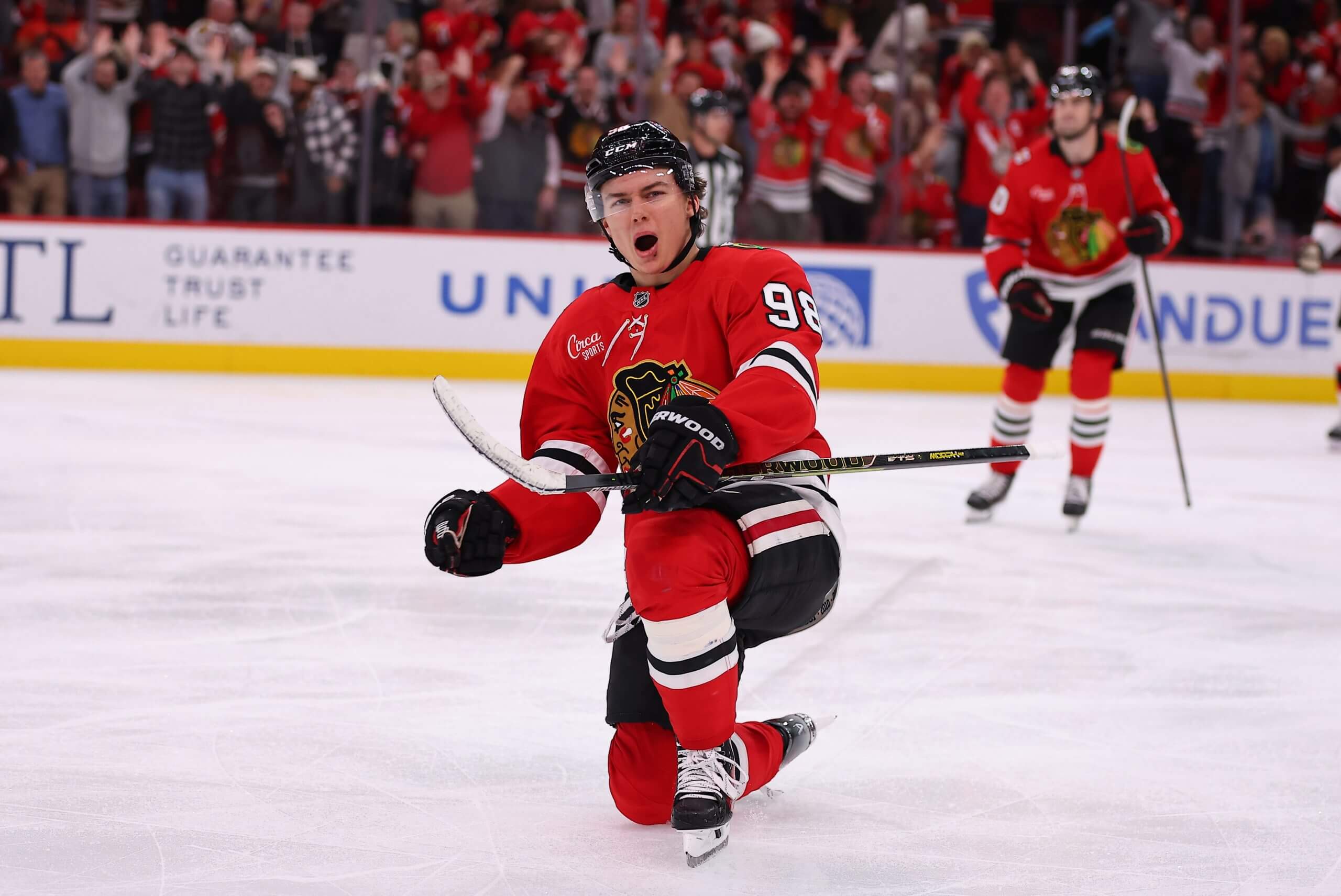
Chicago Blackhawks veteran Nick Foligno has offered advice to teammate Connor Bedard, pictured, the first overall pick in the 2023 NHL Draft, about the small but imperative details required at the game’s highest level but cautions, ‘I am not telling Connor what to do in his game.’
But Ryan Warsofsky, the Sharks head coach — the league’s youngest, at 38 — views those changes as a mixed blessing. Across the league, young players arrive with more skill, but they often have less in-game IQ than rookies had in the past.
“A decade ago when a guy was growing up through youth hockey and college or junior, they learned how to play the game,” Warsofsky says. “Hockey sense was taught early, and skills were taught late — and now hockey sense is taught late.”
It’s harder for coaches, Warsofsky says, but it’s just the evolution of what players have become. A rookie isn’t afraid to play with swagger.
“There’s a line of this cockiness that they have with them,” Warsofsky says. “And I think that’s good.”
With that confidence, players are much more willing to question, challenge instructions, and push back on critiques. To Foligno, that shift is not defiance. It’s knowledge. The players study their clips. They know their analytics. They want evidence with instruction.
“There’s so much information at their fingertips,” he says.
In his capacity as Blackhawks mentor, Foligno often spoke with Connor Bedard, the first overall pick in the 2023 NHL Draft, about the small but imperative details required at the game’s highest level, balancing puck possession against taking risks on offense. Bedard’s unique ability makes him a threat when attacking on the strong side of the net and trying to score on the goalie’s short side.
“It’s a hell of a play,” Foligno said. “But if it doesn’t hit, it’s going around the boards, and they’re usually taking off the other way.”
“But I can score there,” Bedard assured him.
“I know you can,” Foligno told the 20-year-old. “But when you don’t — and no offense, it doesn’t hit every time — it’s going around the other way.”
He paused.
“But listen,” Foligno says. “I am not telling Connor what to do in his game.”
The Warriors’ orbit
Macklin Celebrini was 12 when his father, Rick Celebrini, became the director of sports medicine and performance for the Golden State Warriors. The move took him from playing minor hockey in Vancouver, where he spent his early years — and, he said, there was a rink every two minutes — to playing for the Jr. Sharks program in the same multiplex arena that he now practices in as an NHL star. The culture around the game was much lighter in the Bay Area than in Canada, where playing the sport at an elite level meant making it a young person’s primary focus, under an enormous degree of pressure.
“It’s their kind of passion,” Celebrini says. “And down here there’s so many different options … There’s more attention spread out.”
As an adolescent in the Bay area, Celebrini spent a lot of time at the Warriors practice facility with his father, getting close to an NBA team filled with household names.
Celebrini would play pickup games on the team’s practice court. He’s cited the Warriors’ winning culture as something he hopes to foster with the Sharks. But with the Warriors, Celebrini also had an up-close look at how NBA players carried themselves. He got to know Draymond Green and Gary Payton II — two players known for their mix of personal flair and self-assurance – particularly well.
It’s easy to draw a line between the time Celebrini spent around the NBA and his identity as an NHL star.
But it’s not just Celebrini. Other young stars are doing the same. Matthew Schaefer, the NHL’s youngest player, is already one of the league’s most beloved personalities.
The first overall pick in the 2025 NHL Draft recently became the youngest defenceman to score more than 50 points in a season.
But for all Schaefer’s precocious success, he’s become just as popular for the mix of aw-shucks charm and wry confidence he carries. In interviews, the 18-year-old has playfully joked with Hall of Famers like Chris Chelios about his well-known pregame sauna routine and offered to pay for a nose job for popular bit player–turned media personality Paul Bissonnette.
When an Islanders fan pulled off a shoe and asked him to sign it, Schaefer’s shocked response — “Put your shoes on!” he said in disbelief, before scribbling his name on the dirty Nike — drew a torrent of online adoration: “Love this kid, he has brought life back to the isles” … “Obsessed with you Schaef!!!”…. “Surprised this kid is old enough to drive….”
That playful swagger carries across the league. The age of youthful silence is over. The new generation is not afraid to enjoy what they do — and show it.
“I mean, obviously, hockey’s fun,” says Schaefer. “And I don’t want to change anything about my personality. … You have to make it fun when you come to the rink.”
The league has leaned into the same mentality. A formal attire dress code was relaxed this year to allow players to wear whatever they want to the rink on gameday. Earlier this year, the NHL had to issue a warning about league safety regulations after several teams — like the Sharks and Ottawa Senators — decided to go buckets off during warmups.
The Sharks have implemented a tarps-off policy for the team’s player of the game, who must go shirtless while wearing a shark-tooth necklace while doing postgame media scrums.
Away from the ice, the Tkachuk brothers, Matthew and Brady, recently launched their own podcast, “Wingmen,” where they share unvarnished, behind-the-scenes banter. Hockey stars are crossing into the world of celebrity gossip. Jack Hughes, the cracked-tooth Devils forward, went TMZ-viral when he started dating pop star Tate McRae.
But even the small, seemingly inane moments capture fans’ attention.
During warmups, Celebrini pumps his fist in victory after playing rock-paper-scissors with kids along the glass. He drops the gloves with a 5-year-old cancer survivor during a team practice. He gently taps Toffoli on the cheek with his stick before the puck drops.
“I started playing hockey as a kid because it was fun and because I loved to do it,” Celebrini says. “Just because there’s people talking about you now … You can’t really put too much pressure on yourself.”
Last year, the sports apparel company 500 Level noted the rising popularity of the young Sharks’ magnetic personalities and launched T-shirts depicting Celebrini and Smith as the characters played by Will Ferrell and John C. Reilly in the bro-com film “Step Brothers.” The players have since worn the shirts together.
Behind a shirt commemorating Ovechkin’s all-time goal record, it was one of the company’s best-selling NHL items last year — and has remained a top-five seller since.
“These younger guys are just having fun,” says Jon Wheeler, the partner and sales director of 500 Level. “And a lot of that fun is trying to get over the pressure of being the franchise player now.”
In Chicago, an entire franchise teeters on Bedard’s shoulders, with his youthful teammates propping up that expectant weight. For all the fun on and off the ice, that shared reality lingers over young talent across the NHL.
When a billion-dollar team looks to you as the future, there is little room for failure. Any player who doesn’t live up to the millions their contracts guarantee is quickly deemed a bust. And lucrative contracts are being handed to players earlier in their careers than in the past.
Before the season, the Ducks gave 23-year-old Mason McTavish a six-year, $42 million contract extension. The Blackhawks signed Nazar to a seven-year, $46.13 million extension.
Those contracts will be dwarfed by Carlsson and Bedard when their entry-level deals expire at the end of the season, as the NHL’s salary cap rises. Celebrini is eligible for an extension on his entry level deal at the same time.
“I don’t want to think about the number,” Sharks GM Mike Grier joked with reporters in March.
The new fraternity
When Foligno invited his Blackhawks teammates over for dinner this season, the players spent most of their time playing with his children — 12, 10 and 8 — laughing at viral clips of Chimpanzini Bananini, a Roblox-born nonsense meme. Foligno and his wife, Janelle, looked on from the kitchen.
“What is happening right now?” he said.
Chicago is one of the youngest teams in the NHL, with nearly a dozen contributors under 25. Foligno adapted to the new order by learning their language. He picked up slang, using words like “aura” and “sty,” sounding like a dad at the wheel of a minivan.
As an old man in hockey-years, Foligno embraced his age and his role as one of the NHL’s big brothers. Sure, the kids can be annoying: “My kids talk like my teammates. I go home and I get it on both ends,” he says. “I’m like, ‘Oh, my God, just stop. Stop!’” But he also understands the insecurities they hide within their confidence.
“They know they’re good at hockey,” Foligno says. “That’s the only thing they know.”
In hockey’s past fraternities, comfort was granted over time. In this era, it’s assumed on arrival. And players like Foligno, who see where the league is heading, have adapted.
For a former player like Matt Martin, who announced his retirement a few days before the Islanders selected Schaefer first overall, that shift is a means to engender confidence, not break it. It’s an evolution, rather than an erasure of the past. And the youngest players take over in ways the league has never experienced, the old guard is eager to help them along.
That means a lot to a player like Schaefer, who turned 18 in September. He grew up in a very close family, which has endured tragedy. His mother, Jennifer, died from breast cancer two years ago. Navigating his first NHL season while living with Martin’s family has helped him avoid feeling overwhelmed, or too far from home in southern Ontario.
“You can play the worst game of your life, but then you come back and you’re with the kids, and you’re instantly just happy because you see a smile on their face,” Schaefer says. “There’s a lot more to life than making a bad play.”
For the Sharks’ youngest players, Tyler Toffoli’s kitchen has provided a particular comfort, even when his teammates are taking all his wheat and ore. Michael Misa lives with Toffoli and his wife, Cat. During a recent family chicken parm night, Misa invited fellow rookie Sam Dickinson, who lives alone. “I figure he doesn’t want to eat by himself,” Misa said.
Sometimes, the Sharks take that family bond on the road. Last season, Smith and Celebrini asked Toffoli to have a sleepover in their hotel room during a road trip in Colorado.
“I slept on the cot, so my back was a little sore,” he said.
When the Sharks issued bobbleheads commemorating the slumber party, neither Celebrini nor Smith could figure out which head belonged to them.
“That looks nothing like you,” Celebrini said, showing the figurines to Smith, in a video for the team’s TikTok page. He fiddled with a separate figure, alone in a cot: “Toff looks like he’s 84.”
Toffoli isn’t the only one who gets ribbed for his age. Ryan Reaves — arguably the NHL’s toughest fighter through his career — was recently chirped by a teammate two decades younger than him for turning 39.
As a young player, Reaves waited for veteran teammates to take the first spots lining up in the team dining room. Now, team meals are first-come, first-served.
Toffoli recalls allowing veterans to ride elevators before younger players.
When both players were younger, they’d wait for veterans to leave the building before getting a massage after practice. If a veteran caught them on the table, “there’d be hell to pay,” Reaves says.
Now when they arrive for practice, young players who have just been called up are already getting their hamstrings loosened up by the team masseuse.
“What the f— is going on here?” Reaves recently wondered.
Where old hierarchies remain, they’ve softened. The Ducks’ long-standing fantasy football league is restricted to players who have been around awhile. McTavish, the group’s youngest member, was waitlisted for years before joining the 10-player league, which he won this year. “I wasn’t humble,” he says of the $5,000 win. “I gotta take it.”
But there are still some areas where the veteran experience has advantages. The kids might rule “Catan” and win fantasy leagues, but they play poker with the same risk and speed as they play hockey. Reaves finds opportunity in the balance. “Now I make half my paychecks off these guys,” he says.
It’s the way of the NHL now. It’s a young man’s game and a young man’s league. As Celebrini and Smith stream “Entourage,” they might note the obvious parallel: Money plus fame equals influence and power.
“The younger guys are the guys who are getting paid,” Reaves says. “They’re running the teams now.”