
Last week, the newly launched California Post ran an opinion piece headlined “California’s unfinished wildlife ‘bridge to nowhere’ tops $100M.” The authors, both with the conservative think tank the Manhattan Institute, dedicated roughly 750 words to attacking the Agoura Hills wildlife crossing northwest of Los Angeles for two key reasons: Costs are higher, and the completion date is later than initially estimated when the project was first announced five years ago.

None of this was new information, and all of it had previously been reported by various local, state and national news outlets over the past few years. But the opinion piece added sharp new language to describe an inflation-fueled price increase and one-year timeline extension, calling the Wallis Annenberg Wildlife Crossing (the largest such crossing in the world) a “jobs program for environmentalists,” a “patronage program” and a “multimillion-dollar bridge to nowhere.”
And crucially, it also left out key details about the project’s updated timeline and price increase.
Article continues below this ad
Within 24 hours, the wildlife crossing — the result of a yearslong, bipartisan effort to protect endangered mountain lions and restore habitat connectivity in California — had become a flash point in America’s ongoing political and cultural divide, fomenting online rage across social media.
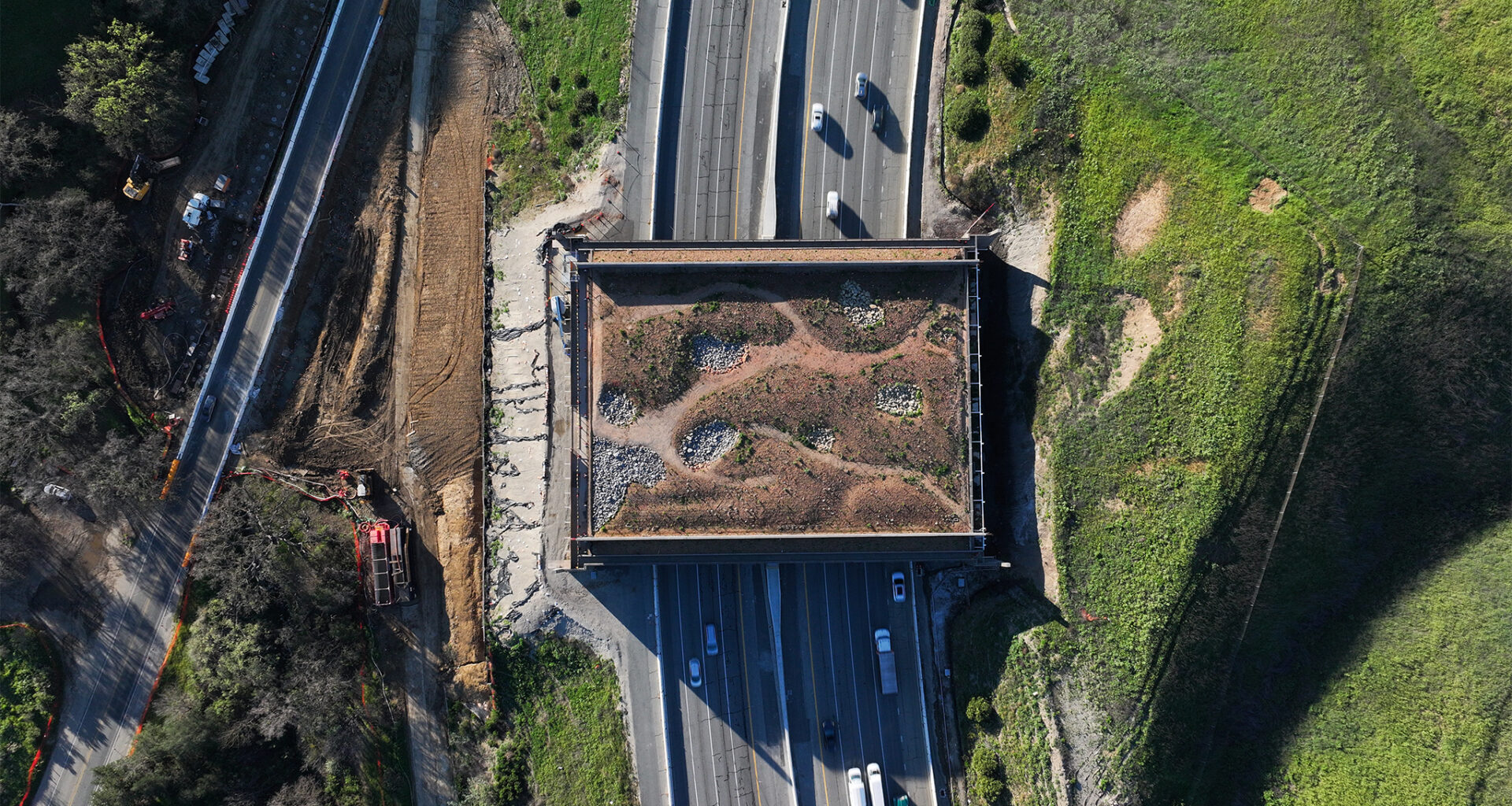
In an aerial view, the Wallis Annenberg Wildlife Crossing crosses 10 lanes of U.S. Route 101 on March 7, 2026, in Agoura Hills, Calif.
Kevin Carter/Getty Images
The California Post’s editorial board put out its own piece, describing the bridge as part of a “list of failed California projects.” Right-wing influencers and conservative social media accounts like End Wokeness and Libs of TikTok reshared misinformation about the bridge, with some accusing the state of trying to bring more mountain lions into residential areas. U.S. Secretary of Transportation Sean Duffy even weighed in to criticize the bridge for being unfinished, as did billionaire developer and former LA mayoral candidate Rick Caruso. Fox News reported on the new outrage surrounding the bridge, further stoking the flames.
Article continues below this ad
Make SFGATE a preferred source so your search results prioritize writing by actual people, not AI.
Add Preferred Source
Beth Pratt, a longtime conservation and wildlife advocate in the state who played a major role in organizing efforts to build the bridge, became the target of much of this online outrage. Pratt, a regional executive director at the National Wildlife Federation and president of the Wildlife Crossing Fund, said she’s received threats of violence over the story. She’s turned over threatening voicemails to local law enforcement, and the National Wildlife Federation is considering new safety protocols for upcoming public events.
Pratt, who often wears mountain lion-emblazoned sweaters and leads hikes that retrace the harrowing multiday journey of P-22, a famous LA mountain lion who crossed multiple freeways to reach Griffith Park, has received an endless stream of online vitriol over the past week. Replies to Pratt’s X account and messages sent to her National Wildlife Federation email call her a bimbo, a c—t, a bitch, a lunatic and a fraud. Angry men have left messages threatening to hunt her down if she doesn’t return the state funding used on the bridge.
Beth Pratt poses with the wildlife crossing construction behind her in Agoura Hills, Calif., on March 5, 2024.
Ashley Hayes-Stone/SFGATE
“People of course have every right to be critical about anything. People have the right to ask questions. People have the right to think that this is not where they want their tax dollars to go,” Pratt said, adding that most of the public money used on the project came from funds that were required to be spent on conservation specifically.
Article continues below this ad
“But that’s not what happened here. This was instead misinformation and false information that turned into snowballing that had very little to do with the project itself. And the other side was this hate machine directed at myself.”
It’s what Daniel Villaseñor, deputy secretary for communications at the California Natural Resources Agency, calls an engineered “coordinated outrage cycle.” The cycle starts with a “‘report’ from a think-tank-funded outlet,” Villaseñor wrote on LinkedIn last week — in this case from City Journal, a conservative-leaning urban policy magazine published by the Manhattan Institute. “A provocative story is published with no new reporting — just a repackaging of months‑old facts already reported in the mainstream, now framed with a partisan agenda,” Villaseñor added. “The goal isn’t journalism; it’s narrative seeding.”
The next step is amplification by a “major partisan media outlet,” according to Villaseñor, which happened when the Rupert Murdoch-owned California Post (a new offshoot of the New York Post) republished the City Journal piece. From there, right-wing influencers shared snippets of the piece with even less context, and after online outrage grew, the Trump administration posted its own reaction. Finally, Fox News ran a story about the Trump administration’s reaction to the story.
“This is their playbook — it’s not an accident. Understanding the mechanics can help us combat the right-wing rage machine,” Villaseñor wrote.
Article continues below this ad
Makala Gibson’s notes shows the planting locations of various native vegetation at the Wallis Annenberg Wildlife Crossing in Agoura Hills, Calif., on Tuesday, Jan. 20, 2026.
Myung J. Chun/Los Angeles Times/Getty Images
The wildlife crossing near the Los Angeles and Ventura County border in Agoura Hills is considered by many to be the crowning achievement of years of advocacy over habitat connectivity and wildlife in Southern California. When the project was first announced in 2021, it had an estimated completion date of 2025. But construction was delayed by record rain and flooding in 2022 and 2023, and in 2024, a new 2026 completion date was estimated. “We announced [the delay] in 2024 and there has not been any delay since,” Pratt said.
The City Journal and California Post pieces left out this crucial detail: that the bridge is on track to open later this year, making it sound like the bridge was just an expensive piece of forgotten and unfinished infrastructure permanently abandoned over the freeway.
Article continues below this ad
“‘Bridge to Nowhere’ usually refers to something that’s been sitting there. This is not a bridge to nowhere. It is an active construction site that we will be celebrating the ribbon-cutting for later this year,” said Pratt, who called the characterization of the project “absolutely disingenuous.”
Landscapers plant and water native vegetation at the Wallis Annenberg Wildlife Crossing in Agoura Hills, Calif., on Tuesday, Jan. 20, 2026.
Myung J. Chun/Los Angeles Times/Getty Images
And those who want to see construction progress themselves can check out the available livestreaming feeds of the project site, Pratt noted.
“[The piece] is almost in this brand of ‘We’re exposing this controversy,’” Villaseñor told SFGATE. “And when you actually look at the facts behind what they’re presenting, there really is no controversy. They talk about this project as this ‘bridge to nowhere’ and a ‘boondoggle.’ In my book, a boondoggle is not something that has a completion date for later this year and is only in the fifth year of construction.”
Article continues below this ad
Reached for comment, co-author Christopher Rufo said that the California Post opinion story “is completely accurate and has not been contested in any serious way.” Rufo and co-author Kenneth Schrupp did not respond to specific questions about any of the story’s omissions, including the wildlife crossing’s upcoming completion date. Instead, they disparaged Pratt further.
“Pratt sent a rambling screed blaming the weather for her failures and ranting about ‘biodiversity collapse,’ and, of course, we could not include all of it,” Rufo told SFGATE in an email. “The substance of Pratt’s critique, as far as it was intelligible, was about as serious as the stuffed animal she carries around the construction site.”
Back in 2021, the project’s estimated total cost from Caltrans was $92 million. That price tag held steady until last year, when increasing construction costs impacting the second stage of the project increased the cost to around $114 million, or an increase of around $21.5 million.
The project has always represented a unique public-private partnership, and it kicked off with a $25 million grant from Wallis Annenberg and the Annenberg Foundation. The rest of the funds have come from some other philanthropic sources and from the state, with most of the state funding coming from specific pots of money that are earmarked specifically for conservation projects, such as funding approved through bond measures (this means that for the most part, state dollars used for the crossing couldn’t otherwise be spent on roads or housing or education). In January, the California Transportation Commission allocated $18.8 million for the crossing, with funds coming directly from a program focused on mitigating environmental impacts of transportation facilities.
Article continues below this ad
Heavy equipment is used to build the tunnel portion of the Wallis Annenberg Wildlife Crossing in Agoura Hills, Calif., on Tuesday, Jan. 20, 2026.
Myung J. Chun/Los Angeles Times/Getty Images
The California Post and City Journal framed this increase in cost as an example of an over-budget project, “with taxpayers on the hook,” though it’s actually in line with the inflation and price increases sweeping the nation during the Trump administration. The National Highway Construction Cost Index, a figure calculated by the Federal Highway Administration, has increased by 67% since 2021. Across the country, this is resulting “in fewer projects delivered than initially anticipated,” the American Association of State Highway and Transportation Officials wrote in a memo to Congress last year.
“Anybody who knows the price of eggs has gone up knows that inflation hit last year,” Pratt said. “[The authors] left out of the article the absolute factual statistic that we offered, which was that the federal government’s own numbers say that since 2021, roadways or construction projects have gone up by 60%. It was not that we were spending lavishly to increase this project.”
And, as the largest wildlife crossing in the world being built over one of the state’s busiest freeways, it’s “not comparable” to crossings built elsewhere that are smaller in scope and in less busy areas, Pratt said.
Article continues below this ad
The state also isn’t plodding forward with dozens of $100 million wildlife crossings all over California. Last year, the state completed four crossings “with an average price tag of $16 million,” according to the California Natural Resources Agency. Over 30 others are in progress with an average price of $15 million.
A view of the Wallis Annenberg Wildlife Crossing as still under construction in Agoura Hills, Calif., on Feb. 13, 2026.
Anadolu/Getty Images
“The Annenberg Wildlife Crossing is the most ambitious project of its kind in the world with a much larger scale — it does not represent the average cost of our work to build more wildlife connectivity,” the state agency wrote in a post on X, in response to posts from conservative influencers comparing the price tag to a $15 million overpass in Colorado.
“I keep coming back to the facts. And the facts are this is a decades-long, fully vetted project. The facts are that the headlines we are seeing are not based on anything new or anything of substance, and it was an attempt to politicize a project that has been widely supported,” Pratt said.
Article continues below this ad
“All the nonfactual headlines in the world are not going to change the moral compass of this project, which is to preserve wildlife in the Santa Monica Mountains.”