
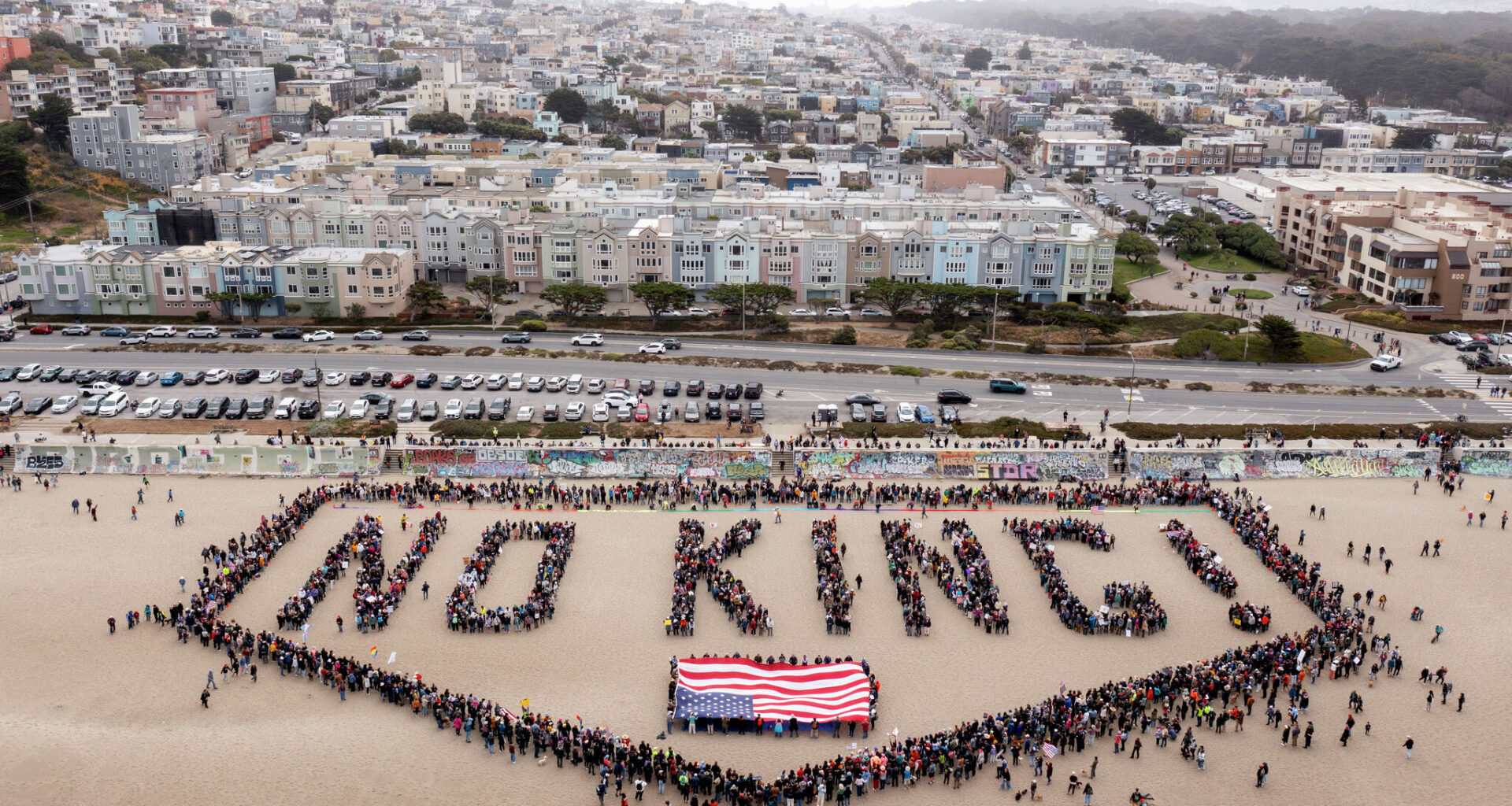
A human banner at Ocean Beach during the No Kings protests in San Francisco on June 14, 2025.
Santiago Mejia/S.F. Chronicle
When No Kings Day returns to the Bay Area for a third time on Saturday, it could set a record for the biggest one-day protest in U.S. history.
It’s also likely to extend an unenviable trend for an American president usually fond of boasting about crowd sizes: If protester numbers are any indication, Donald Trump is one of the least popular presidents in modern history.
Article continues below this ad
No Kings organizers said Thursday more than 3,000 events are planned across the U.S. for Saturday’s threequel — including some 320 in California — and expected that figure to keep climbing amid widening frustration with the Trump administration’s handling of the economy and penchant for self-induced crises.
“To put that in perspective, there are only about 3,001 counties in the whole country. It is enormous,” said Lisa Gilbert, co-president of Public Citizen, the Ralph Nader-created consumer advocacy nonprofit that is one of the groups behind No Kings. “It’ll be the single-largest day of protest in American history.”
The last No Kings Day, on Oct. 18, 2025, drew several million people across 2,700 events in what was either the largest or second-largest one-day demonstration in six decades. The other — the Women’s March on Washington — also happened under Trump’s watch.
San Francisco Chronicle Logo
Make us a Preferred Source to get more of our news when you search.
Add Preferred Source
Organizers note that the last No Kings event occurred before federal immigration agents killed Renée Good and Alex Pretti in Minneapolis, before the government shutdown that has filled airports with stranded travelers and reassigned ICE agents, and before the president’s surprise attack on Iran, which has widened into a regional conflict and risked a global energy crisis.
Article continues below this ad
Protesters gather along Market Street to take part in the second nationwide No Kings protest in opposition of the Trump administration in San Francisco on Oct. 18, 2025.
Stephen Lam/S.F. Chronicle
Gilbert said all those things are likely to drive turnout to an event whose name is a rebuke to a view shared by many democracy scholars that Trump has sought to obliterate checks on his power from Congress and the courts.
“The backbone for why they’re there is not wanting a king in America, which is one of most patriotic, nonpartisan ideals we have,” Gilbert said. As for people’s specific reasons for attending, she said they “can have a million different reasons because, unfortunately, this administration is doing so much that people find horrifying.”
While estimating crowd size remains an evolving and inexact data science, Trump has presided over some of the largest displays of public opposition ever measured in the U.S.
The 2017 Women’s March, held a day after Trump’s first inauguration, drew 3.2 million to 5.3 million people to more than 650 marches, according to the Crowd Counting Consortium, a Harvard Kennedy School and University of Connecticut collaboration that produces granular data about U.S. protests and demonstrations in the Trump era.
Article continues below this ad
The Black Lives Matter demonstrations that erupted after George Floyd’s murder in May 2020 may represent the largest sustained protest in American history, with an estimated 15 million to 26 million people participating in demonstrations that lasted into August, according to a New York Times analysis.
The consortium also showed that the 2018 March for Our Lives and #Enough walkouts that occurred in response to the Parkland school shooting hold the record for the most protest locations on a single day, occurring in more than 4,400 distinct locations. The first Earth Day, on April 22, 1970, holds the record for most participants, around 10 million to 20 million people, though social scientists disqualify it because the actual demonstrations were limited and much of it encompassed educational workshops at schools.
A growth industry
Harvard Kennedy School professor Erica Chenoweth, director of the school’s Nonviolent Action Lab, and their research team at the consortium have been early to counter what they’ve described as a prevailing misconception that grassroots resistance to the second Trump administration was muted compared with Trump’s first go-round in office.
Though the Women’s March may still hold the one-day record, a steady, diverse proliferation of events — including the Peoples’ March two days before Trump’s second inauguration, the DOGE-focused Hands Off protests in April 2025 (919,000-1.5 million participants) and the first No Kings protests last June (2 million-4.8 million participants) have drawn increasingly large audiences across a broader geography of locations.
Article continues below this ad
The findings about the level of grassroots resistance over the past 14 months has been an overlooked phenomenon that runs counter to the narrative that drove the first year of Trump 2.0: that the administration faced little opposition, particularly from Congress, corporations and powerful institutions such as elite universities, law firms and media conglomerates.
“While media attention is often focused on actors acquiescing to Trump’s demands, in the streets the popular protest movement continues to push back against the administration with notable persistence over time,” Chenoweth and their coauthors wrote in August 2025.
Protesters march on Market Street toward Civic Center for the No Kings protest in San Francisco on Oct. 18, 2025.
Manuel Orbegozo/For the S.F. Chronicle
The Ash Center for Democratic Governance and Innovation at Harvard Kennedy School, matching consortium data with county-level data from the 2024 presidential election and U.S. Census data on county populations, concluded that the first year of Trump 2.0 has brought out the most geographically widespread protests in American history.
The Ash Center, Harvard’s research hub on democracy, previously reported that the protest movement under Trump 2.0 has operated at a faster, larger clip than under Trump 1.0 and “is overwhelmingly (and even historically) nonviolent.”
Article continues below this ad
Data journalist G. Elliott Morris, author of the Substack newsletter Strength in Numbers, and Atlanta news outlet the Xylom crowdsourced their estimate of between 5 million to 6.5 million participants at the second No Kings in October, which was below organizers’ claim of 7 million participants at more than 2,700 events, a figure Morris noted “may be a bit optimistic (but is not impossible).”
Organizers say 150,000 people attended San Francisco’s No Kings march in October.
According to a Chronicle analysis of consortium data, a project to document the size of U.S. demonstrations by the Harvard Kennedy School and the University of Connecticut, October’s No Kings drew roughly 3.1 million to 4.1 million participants. Some 300 protests did not have a recorded estimated crowd size so they were excluded from the analysis.
People march during the No Kings Day protest in Oakland on Oct. 18, 2025.
Yalonda M. James/S.F. Chronicle
San Francisco’s march will start at noon at Sue Bierman Park and include a community organizing fair at Fulton Plaza.
Oakland’s march will begin an hour later at 1 Frank H. Ogawa Plaza and end at the Lake Merritt amphitheater with a rally headlined by Live Free Rev. Mike McBride, a local community organizer, and Valarie Bachelor, Oakland director of the ACCE Institute, which is focused on racial and economic justice.
‘Who’s ready to throw down?’
Joseph Raff, a volunteer with Indivisible East Bay, a lead organizer of the Oakland No Kings, said the planning for Saturday’s event started as soon as the national coalition announced a date around the end of January. He said he received a group text from the East Bay leadership team asking, “Who’s ready to throw down?”
Raff said each event requires a lot of logistical planning, with a coalition of groups coordinating with one another and local government on setting march routes, closing streets and establishing safety plans.
“These have been massive events,” said Raff, and Saturday’s is shaping up to be bigger than the one in October, which drew about 20,000 people.
One example of the heightened interest: Participation in the Mighty Marching Chorus, a volunteer choral group, grew from nine participants at the first No Kings to 18 at the second and is on track to number around 300 singers at the third.
Berkeley resident Jennifer, who declined to provide her last name, dons an Uncle Sam costume as she marches during the No Kings Day protest in Oakland on Oct. 18, 2025.
Yalonda M. James/S.F. Chronicle
“A lot of these things are happening independently,” Raff said. “We’ve reached a point where these things are self-organizing.”
Raff got involved with Indivisible East Bay about a year ago and was quickly put to work on planning the Hands Off rally. A former engineer and fine-dining cook, the 30-year-old said he moved to California from the East Coast in August 2024. When Trump won reelection, Raff said he found himself thinking about what was coming and “ways to stand up against that.” He knew his adopted home of Oakland had its challenges, but what was happening on the federal level felt more urgent.
“We’re all doing this as volunteers, part time, in between our day jobs and families and everything else that’s going on,” said Raff, who works at a consumer goods company. “Most of us have not been involved in anything of this scale before.”
On the other side of the spectrum is the red, rural speck of Alturas (Modoc County), population 2,700 and mostly Republican, said Sarah Merrick, who is planning the local No Kings rally as co-leader of Modoc Indivisible, which she founded in February 2025.
“We don’t even have a Democratic Party up here,” she said, chuckling.
The 73-year-old Merrick said she hadn’t been political since the Vietnam War, when she was in college. But “all of the antics Trump was up to” compelled her to go online, learn about Indivisible and plan a meeting, at which 17 people, mostly senior citizens, showed up.
Rep. Jared Huffman gets a tour of Modoc Indivisible’s truck signage from Sarah Merrick of the group as he meets with future constituents in Alturas, Calif., on Jan. 28, 2026.
Carlos Avila Gonzalez/S.F. Chronicle
The group’s first event, its Hand Off rally, attracted maybe 50 people to the lawn in front of the Veterans Hall on Main Street. She said 70 people showed up to their No Kings event at the same location, but that she “bailed out of” hosting No Kings 2 because of all the threats she was receiving, including in-person.
“I chickened out, I did,” she said. “For some reason, I’m not afraid this time.”
On Saturday, they’ll be congregating in an empty lot that locals refer to as “the four corners” near the intersection of North Main Street and Highway 299. There’ll be a band, balloons, snacks and water, and they’ll raffle off an air fryer and bicycle.
“We hope it’s a fun gathering time,” Merrick said. “We don’t really have any big speakers. I’m usually the emcee for it.”
Merrick said the police department told her to phone in a reminder about the event so it can dispatch extra patrols on Saturday. She said their security detail amounts to three volunteers, two on the younger side, who will be wearing security vests and body cameras. So will Merrick.
“If anything happens, we want it on video,” she said. “So I’m expecting some opposition, but I’m also expecting more excitement.”
Emma Stiefel contributed reporting.