
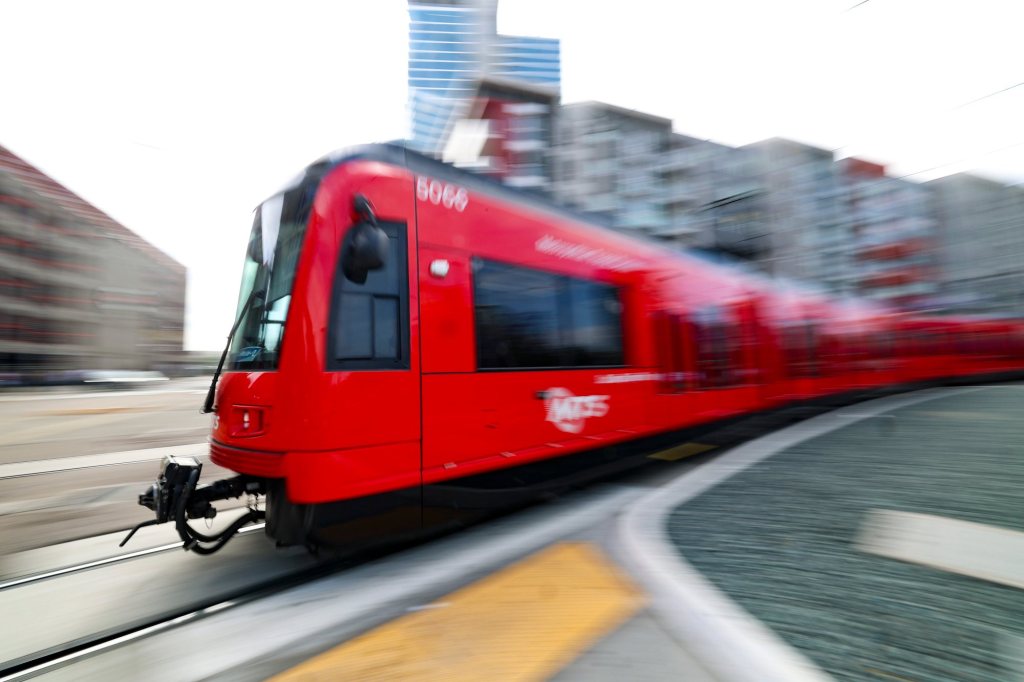
San Diego County transit officials are considering raising fares to help the cash-strapped Metropolitan Transportation System.
It comes at a time of economic uncertainty as thousands of county workers use the trolley or buses to get to jobs, often far from where they live because of high housing costs. MTS also has its own struggles with ridership drops, which it has tied to the federal immigration crackdown and lower-income transit users making fewer leisure trips.
The proposal would likely raise one-way fares from $2.50 to either $3 or $3.50 and monthly passes from $72 to $90 or $100, transit officials said.
Raising fares to $3.50 would make San Diego commutes more expensive than those in every other transit system in the nation that’s considered comparable, an MTS analysis found.
Question: Should MTS raise fares?
Economists
Alan Gin, University of San Diego
NO: Raising the MTS fare would disproportionately affect low-income people, who are more likely to use public transit. It would come at a time when people with low incomes in San Diego are already stressed due to high housing costs and high prices in general. And it’s not certain that raising fares would increase revenue for the system. Higher fares could cause a big drop in transit usage, which could cause revenue to fall. In economic terms, it depends on the price elasticity of demand.
James Hamilton, UC San Diego
YES: San Diego’s Metropolitan Transit System has not increased fares in 15 years while costs have risen substantially. I would try to go with the more modest increase to $3 rather than $3.50 but also increase fares for youth and seniors. We have made progress in reducing fare evasion but should try to do more, making sure we are taking advantage of the latest digital technology.
Norm Miller, University of San Diego
YES: The new fees are still much cheaper than owning a car or parking in dense urban locations. At the same time, it may hurt ridership a little. Keep in mind that those with higher incomes would not use the system even if it were free unless it saved them time, their most precious commodity. The only way that would work is with increased frequency of runs (reducing waiting time) and adding routes that included locations like the airport.
David Ely, San Diego State University
YES: Both the service cuts and higher fares now being considered to close MTS’ large budget gap will be painful for riders and may diminish ridership. However, without fare increases, the reductions in services would need to be much larger than if higher fares can also contribute toward closing the budget gap. Given the spike in gasoline prices, ridership on public transportation is likely to rise so a modest increase in fares could be sufficient.
Ray Major, economist
NO: MTS is a completely failed system that doesn’t work for San Diego residents as an alternative to driving. This results in most buses and trolleys running nearly empty. The majority of the people who do ride public transportation have no choice. They are primarily the poor or seniors in our communities. Raising the fare to $3.50 is a 40% increase in transportation costs for the people who can least afford it and is unconscionable.
Kelly Cunningham, San Diego Institute for Economic Research
YES: Gradually increasing fares seems a necessary attempt to cover for generally rising costs, although higher fare prices further discourage trolley and bus ridership. Fares will likely never be high enough to cover all mass transit costs without the massive public subsidies being granted each year. Private transit alternatives could offer better options to consider (ride hailing, self-driving vehicles) that could relieve congestion and allow for a better focus on making roads safer and cleaner for everyone.
Executives
Bob Rauch, R.A. Rauch & Associates
NO: MTS faces a $500 million deficit, and fare hikes barely dent it. San Diego’s low‑income ridership is highly price‑sensitive, so higher fares shrink demand, revenue, and ultimately service. That cycle only fuels future tax measures. With gas prices high, transit should be capturing riders, not losing them. The smarter move is restructuring fares to protect vulnerable riders and grow long‑term demand.
Austin Neudecker, Weave Growth
NO: Raising fares when ridership is already down will simply push more people away. Public transit should be a tool for connecting workers to jobs, attending events, reducing congestion, and cutting emissions. Instead of increasing prices, MTS should focus on boosting ridership through accessibility, reliability and safety. Expand enforcement against fare evasion and misuse, then consider lowering fares. Build a system that people use and benefit from the broader impacts.
Chris Van Gorder, Scripps Health
YES: It’s an unfortunate reality that costs continue to rise, so MTS only has a few choices: Raise rates, reduce service or find other efficiencies and cost reductions to continue the service as is. I don’t see a successful outcome of another effort to raise taxes on the public to sustain another service that cannot sustain itself. This is what those of us in business must deal with every day.
Jamie Moraga, Franklin Revere
NO: Raising fares won’t fix the problem. MTS doesn’t need higher prices; it needs accountability. A fare hike to $3.50 would make San Diego commutes more expensive than every comparable transit system in the country, according to MTS’ own analysis. Years of fare evasion and the fare forgiveness program encouraged nonpayment, leaving lasting financial issues. Instead of burdening paying riders, it’s time to fix mismanagement, make cuts, and restore trust before charging more.
Phil Blair, Manpower
YES: As difficult as it is to manage supply and demand with price elasticity when expenses far exceed demand, something has to be done. The two choices are cut service or increase price. With gas prices continuing to increase, bus transportation, even with its increased rate, may become a more reasonable option.
Gary London, London Moeder Advisors
NO: I am genuinely confused how raising fares to a declining rider base solves their fiscal problem. The core problem is that the system does not appear to be adequately serving its targeted client base. Perhaps MTS leadership might explore ways to expand their reach through non-rail, (eventually) autonomous services, utilizing a broader fleet of vehicles. Maybe it’s also time to establish partnerships with Waymo, Tesla and Rivian to accomplish that.
Not participating this week:
Caroline Freund, UC San Diego School of Global Policy and Strategy
Have an idea for an Econometer question? Email me at phillip.molnar@sduniontribune.com. Follow me on Threads: @phillip020