
 Photos by TOMOKO NAGAI / Rafu Shimpo
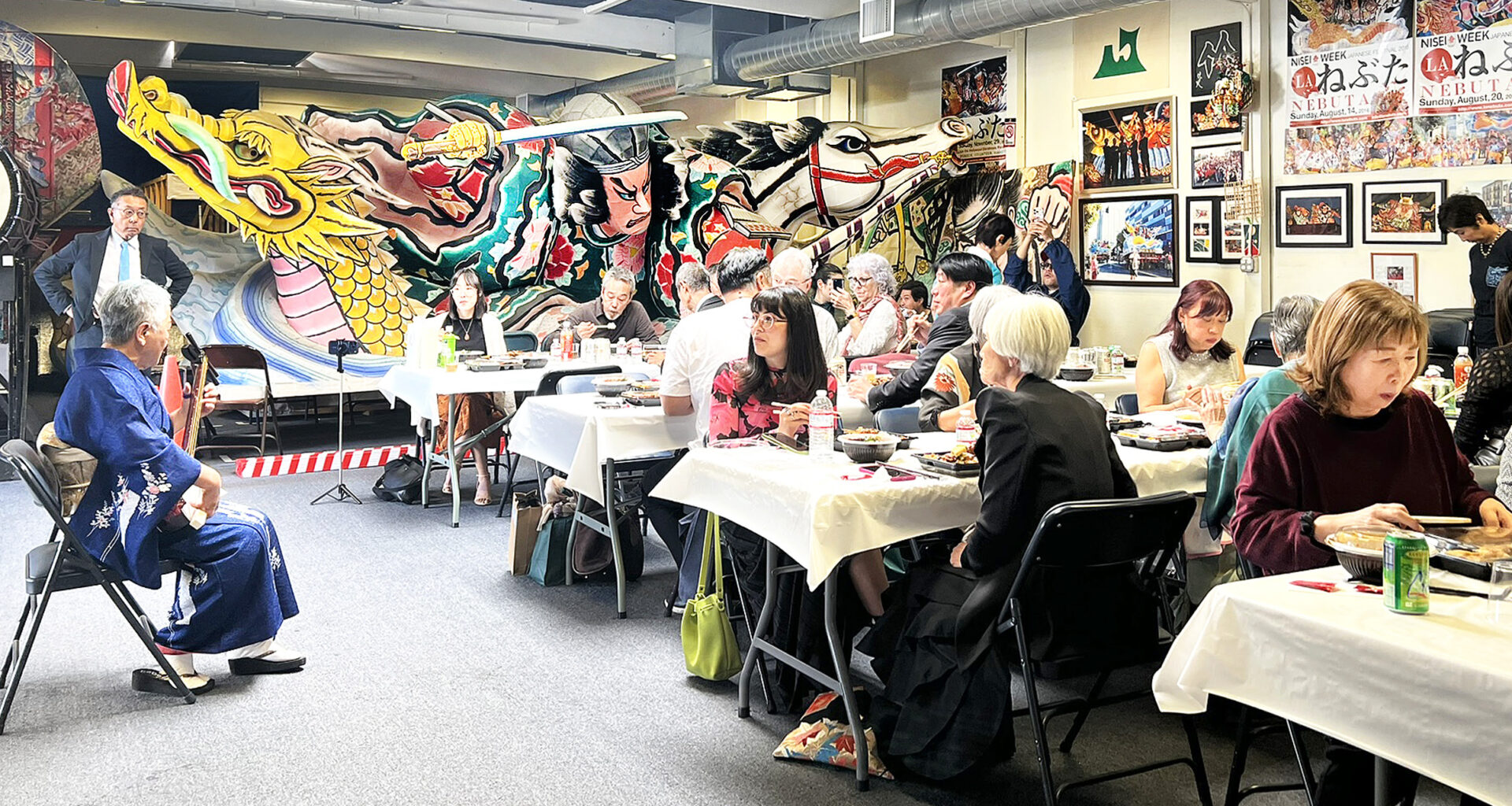
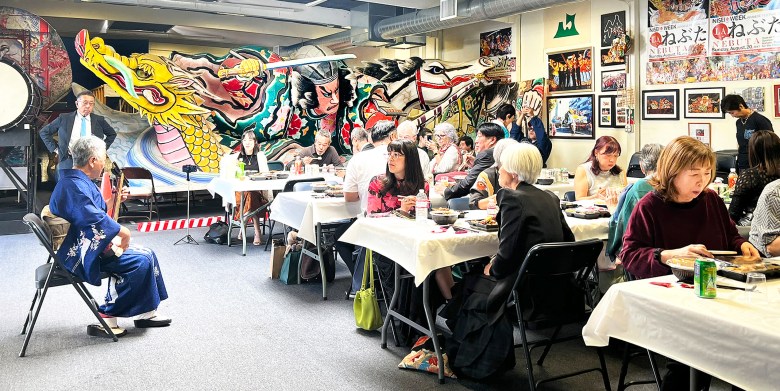
Aomori Kenjinkai and Nebuta Bayashi Hozonkai hold a joint New Year’s party, filled with music and fun, at Kenjinkai Hall in Little Tokyo. The Nebuta floats in the background are waiting for this summer’s Nisei Week Parade to celebrate the 20th year since their debut in Los Angeles.
Aomori Kenjinkai, Nebuta Hozonkai Hold New Year’s Gathering
By TOMOKO NAGAI
RAFU STAFF WRITER
A joint New Year’s celebration was recently held at the Aomori Kenjinkai Hall in Little Tokyo by the Southern California Aomori Kenjinkai (Aomori Prefectural Association) and Nebuta-Bayashi Hozonkai (Nebuta Festival Music Preservation Group).
Featuring performances such as jazz, taiko drumming, shamisen and hula, the event brought members together in friendship while renewing their commitment toward a major milestone: the 20th anniversary of the Nebuta float in Los Angeles this summer.
The gathering opened with a toast by Toshiaki Toyoshima, president of Nebuta-Bayashi Hozonkai, who expressed hopes for a healthy and joyful year ahead.
The Aomori Kenjinkai is one of the few prefectural groups in Southern California that maintains its own hall. Inside, wooden plaques bearing members’ names line the walls, and two large Nebuta floats — constructed from washi paper and wire, just like those used in Aomori’s famous Nebuta Festival in Japan’s Tohoku region — are carefully stored.
The Nebuta Festival in Aomori is one of Japan’s most celebrated summer events, known for its massive illuminated floats and energetic music. In Los Angeles, that same spirit comes alive each year during the Nisei Week Parade, where the Nebuta floats move through the streets as a vibrant expression of Japanese matsuri culture.
This year marks the 20th year since Nebuta first appeared in Los Angeles. Toyoshima noted that special plans are being considered for the upcoming Nisei Week festivities to commemorate the occasion.
Approximately 20 participants are expected to travel from Aomori, and both Nebuta floats will be featured in the parade. While no new float will be created this year, the focus will be on strengthening the musical performance. The parade is scheduled for Aug. 15 — one week later than usual — allowing participants to avoid conflict with Aomori’s Nebuta Festival, held during the first week of August.
Organizers also hope to increase local participation in both the musical ensemble and the “haneto” dancing, encouraging a lively and successful parade.
Akira Kimura, president of the Southern California Aomori Kenjinkai, explained that the association serves as a liaison in collaboration with the preservation group. While membership growth is not easy, he emphasized the group’s continuity: “As long as people from Aomori are here, the association will continue.” He added, “We are grateful to gather each year in good health.”
Attendees enjoyed Japanese bento and seafood bowls while watching a variety of member performances. A highlight was the Nebuta music performance, which drew strong attention from the audience and filled the venue with warm energy.
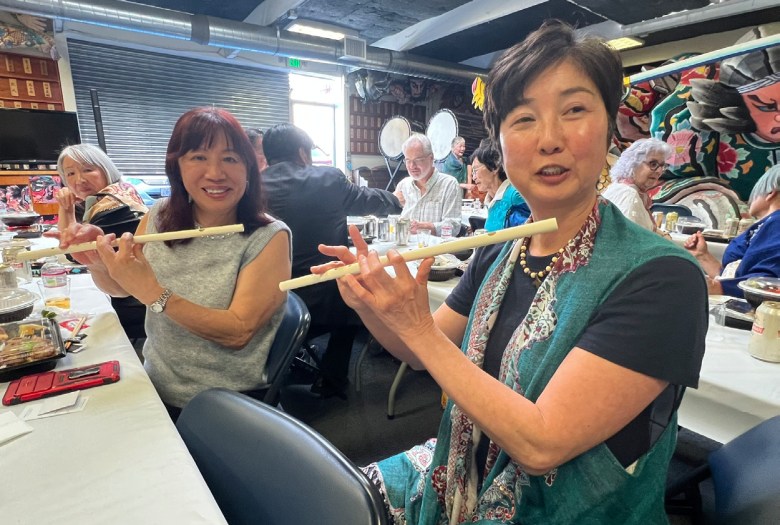
A beginner-friendly initiative was also introduced: simple flutes made from water pipes were offered for $10, and participants had a chance to try them. To further lower barriers, an online “super beginner” flute workshop via Zoom was announced.
Calligrapher Kuniharu Yoshida, though not originally from Aomori, spoke of his deep passion for festivals: “I love matsuri festivals, and I look forward to going back to Japan every year.”
He teaches calligraphy in Los Angeles and produces 400 to 500 works at the start of each year as part of his training. He distributed omikuji (fortune slips) written in kanji, sparking lively conversations among participants about meanings and readings of the characters.
 TOMOKO NAGAI / Rafu Shimpo
Flutes hand-made from water pipes provide reasonable access to Japanese fue.
The event concluded with everyone joining in Nebuta music, chanting “Rassera, Rassera!” in unison.
Haruko Nakatsu, who joined the group just last year, said, “When I heard the Nebuta music, it stirred my soul.” Having recently moved to Southern California from another part of the U.S., she said discovering Nebuta here made joining the group an easy decision.
The New Year’s gathering served not only as a reaffirmation of shared heritage but also as an open gateway welcoming new participants. Excitement is building toward the summer celebration.
An Open Invitation
Practice sessions for Nebuta music are held at the hall on the first Saturday and third Sunday of each month from 1 to 3 p.m., as preparations have begun for the Nisei Week Parade in August.
There are no special requirements to join. “Anyone with enthusiasm is welcome,” organizers emphasized. “We want people to simply come and experience it.”
Participants can join the music section — playing taiko, flutes, or kane (bells) — or take part as haneto, energetic dancers who jump and move alongside the floats. While physically demanding, the haneto role offers a unique opportunity to be an active part of the parade rather than just a spectator.
Participation in Nebuta is open to everyone, not only those from Aomori. The emotional power of festival music resonates widely, evoking a shared sense of excitement rooted in Japanese culture. Organizers encourage everyone to join a practice session and experience the spirit first-hand.
Contact: aomori.calif@gmail. com
Articles for you