
The mother of two teenagers is on the go “nonstop” from 1 a.m. until 7 or 8 p.m.
In that span she works the early shift at the San Diego International Airport as an agent with the Transportation Security Administration, then picks up her children from school and drives them to their after-school sports practices, then takes care of the rest of the adulting as a single mother of two.
The worker, who didn’t want her name used because she was not authorized to speak with reporters, has been doing this all without a paycheck, because a partial federal shutdown has halted funding to the agency that employs her, the Department of Homeland Security. Her last paycheck of around $500, which she said was half of what she usually takes home due to insurance and other deductions, landed Feb. 14.
“I have teenagers. And they eat a lot,” she said.
She has made it work, for now. “But to be honest, the next couple of weeks, it’s going to be a stretch.”
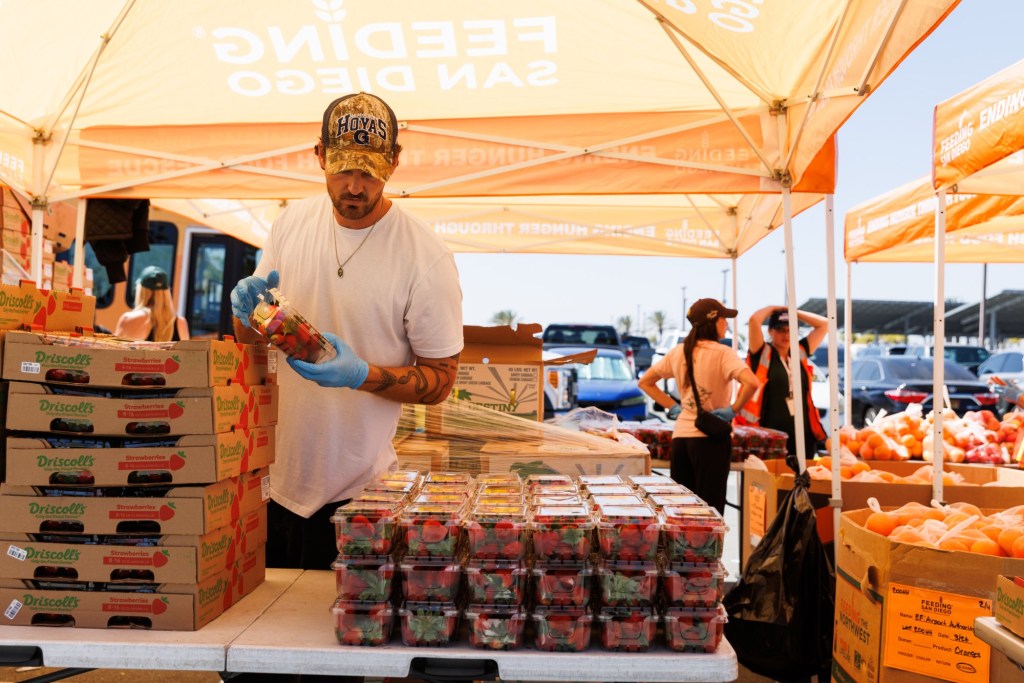
The worker stopped by the airport’s employee parking lot on Thursday to pick up food at a distribution hosted by Feeding San Diego, a food rescue nonprofit that gives San Diegans nutritious pantry items and fresh produce, in partnership with the San Diego County Regional Airport Authority.
The nonprofit is handing out food to federal workers who have been unpaid for weeks due to the partial government shutdown that began Feb. 14 after Democrats and Republicans in Congress failed to agree on reforms in the wake of immigration enforcement actions in Minneapolis that resulted in the deaths of two U.S. citizens in January, Renee Good and Alex Pretti.
Under orange tents that shaded the goods from the steady midday sun, the nonprofit’s workers and airport volunteers had set up bags of fruit, large heads of crispy cabbage, cartons of strawberries and other fresh produce, ready for on-the-go pickup between noon and four that afternoon.
Dry goods included Kirkland brand canned chicken breast, spaghetti, enriched rice, a bag of dry beans, four cans of tuna, low sodium vegetable soup, rolled oats and a family-sized bag of multigrain cereal.
“They’re showing up to work, they’re not being paid,” said Carissa Casares, the nonprofit’s director of communications and content. “They’re doing the right thing. They’re not asking for a handout.”
Casares said Feeding San Diego set up the distribution point to meet a dire need among federal workers. The nonprofit last week also dropped off food at a TSA office in Liberty Station, Casares added.
“We’ve had some TSA employees come through already,” she said, “and there’s a lot of, ‘I’m hanging in there,’ or ‘This is really hard.’ And a lot of thank you’s. ‘Thank you for being here. I really appreciate this.’”
Casares said the lengthy shutdown last fall set the framework for food distribution now — by allowing the nonprofit to make connections with federal agencies with impacted workers then, and again now.
“This shows that we’re a trusted nonprofit, that we’ve earned that reputation in the community as an emergency response organization. And that when there is a need, we can be that source,” Casares said.
The TSA worker, who is 48 and has worked at the agency for more than 20 years, left with strawberries, oranges, beans, rice and a head of cabbage. “Staple foods that we need,” she said. This was her first time at a food distribution event, adding, “Every little thing helps.”
The children’s father, she said, “doesn’t help at all, so I’m doing this by myself.”
To make ends meet with no income and three mouths in her household, the worker has been tapping credit cards.
“Luckily, I have good credit,” she said. She tried not to use the cards, but “in this situation, you know, I don’t have a choice.”
She also tapped her emergency fund and so far has been able to keep up on rent.
“This is their fourth shutdown,” the worker said, thinking about her teenage children.
“When I get paid, I’m going to have to pay that back, and then just try, little by little, to try to get my credit cards paid off. And then try to reintroduce my savings,” she said.
She has been thinking about looking for a new job — maybe with a hospital — because government jobs are no longer secure, she said.
To other workers, she strongly recommended building up an emergency fund. She had a different message for the nation’s lawmakers.
“(They’re) fighting like children. They need to work together,” she said. “We put them in there so they can do their job. If they can’t do their job, then there’s no reason for them to be there.”