
A version of this story appeared in CNN’s What Matters newsletter. To get it in your inbox, sign up for free here.
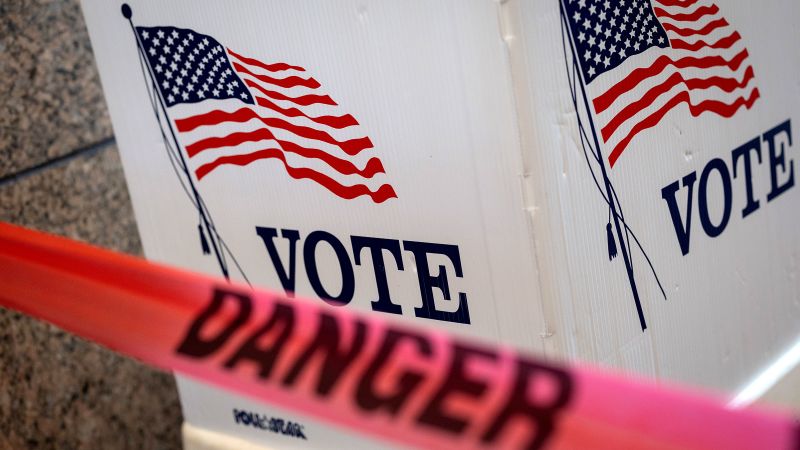
Voters in the biggest blue state could theoretically be choosing between two Republican candidates for governor in in November — a wacky but not impossible outcome of the state’s nonpartisan primary system.
The issue is not that there’s no viable Democratic candidate, but that there may be too many.
Under the state’s election rules — approved by voters in 2010 — the top two candidates in the primary, regardless of party, appear on the ballot in November.
It’s possible that the many Democrats, none of whom has consolidated support, could split the primary vote enough for two Republicans to get the most votes on primary day, June 2.
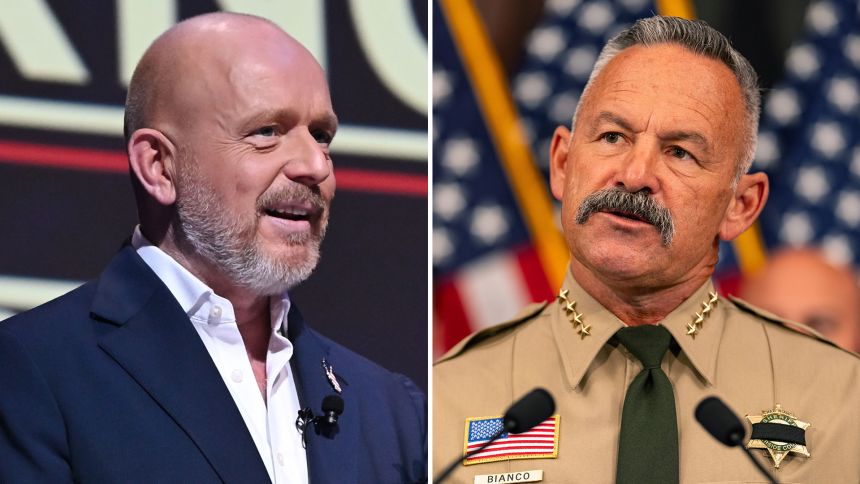
Republicans appear to be consolidating their support between two options. Steve Hilton is a British immigrant and former strategist in UK politics who has since become a conservative media personality in the US. Chad Bianco is the mustachioed sheriff of Riverside County who made national headlines recently when, in a move sure to get Trump’s attention, he seized ballots from election officials for a November special election. He said the move was necessary to investigate fraud allegations, but did not elaborate or give specifics.
California’s Democratic party and Gov. Gavin Newsom have called on candidates with lower poll numbers to drop out of the race, but only one did.
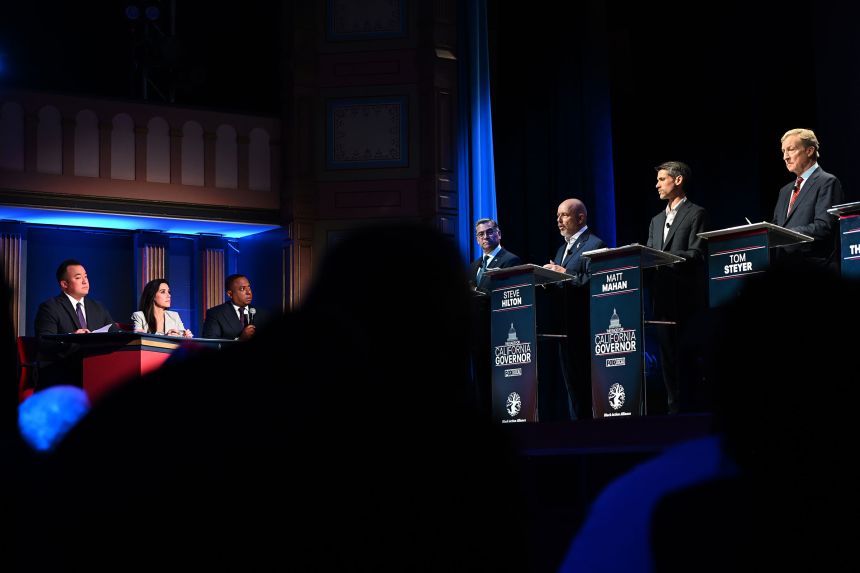
A debate planned to take place at the University of Southern California this week was canceled when only four Democratic candidates – all of whom are White – made the cut. Those candidates include Rep. Eric Swalwell, former Rep. Katie Porter, wealthy former presidential candidate Tom Steyer and San Jose Mayor Matt Mahan.
Multiple candidates of color did not meet polling and fundraising thresholds set by USC and were set to be excluded from the debate, including former Los Angeles Mayor Antonio Villaraigosa, former Health and Human Services Secretary and California Attorney General Xavier Becerra, former State Controller Betty Yee and California Superintendent of Public Instruction Tony Thurmond.
It was not a good look for Democrats, who have made appealing to minority voters a key part of their message at the state and national levels.
The stakes are incredibly high, since there is no recourse for Democrats if they fail to get a candidate on the ballot. There is, for instance, no write-in line. The end result would be a Trump-aligned governor in a state that voted against Trump by more than 20 percentage points in 2024.
“Just imagine what that would mean,” said Swalwell during an interview Thursday with CNN’s Kasie Hunt. “That would mean Donald Trump would have a Western White House.”
But Swalwell also said he’s the “momentum” candidate and that he’s not thinking about getting out of the race.
There is precedent for Democrats being locked out of a race they likely otherwise would have won. Rep. Pete Aguilar today is a member of the Democratic leadership in Congress. But he failed in his first congressional race because he was the top vote-getting Democrat in a crowded field. Two Republicans got more votes.
I talked to CNN’s Elex Michaelson, LA-based anchor of “The Story Is,” who has been following this story. He told me it’s not just the top-two primary system that is to blame for Democrats’ problem.
“There are a lot of things happening at the same time to sort of create a perfect storm,” he said. Top-tier California Democrats, like former Vice President Kamala Harris and Sen. Alex Padilla, for instance, passed on the race.
“You’re left with a field that does not have any person that has been able to galvanize support so far,” Michaelson said. Then there’s the fact that some of the candidates who have not gained traction are older and might be in the final race of their lives; they’re not interested in getting out.
The irony here is that the top-two primary system was supposed to give more people access to a candidate of their choice on Election Day and to open the primary to voices outside the two dominant parties.
More often than locking out Democrats on Election Day, it has led to races that feature two of them pitted against each other. The idea is that they will have to do more to engage centrist or even Republican voters.
There have also been multiple instances of Democratic candidates trying to elevate a Republican in the primary to avoid having to run against another Democrat.
“Those are the kind of games that you have with this top-two system,” said Paul Mitchell, a Democratic political consultant in Sacramento and owner of the firm Redistricting Partners. “It’s kind of just wackadoodle. And so it’s — I think it’s ripe for a second look right now.”
Democrats in California made the move last year to temporarily throw out another good government initiative — nonpartisan congressional maps — meant to more fairly represent Californians in Congress and weaken the power of parties in elections. In 2010, the same year voters adopted the top-two primary, they also adopted a special nonpartisan commission to take power over drawing congressional lines away from politicians.
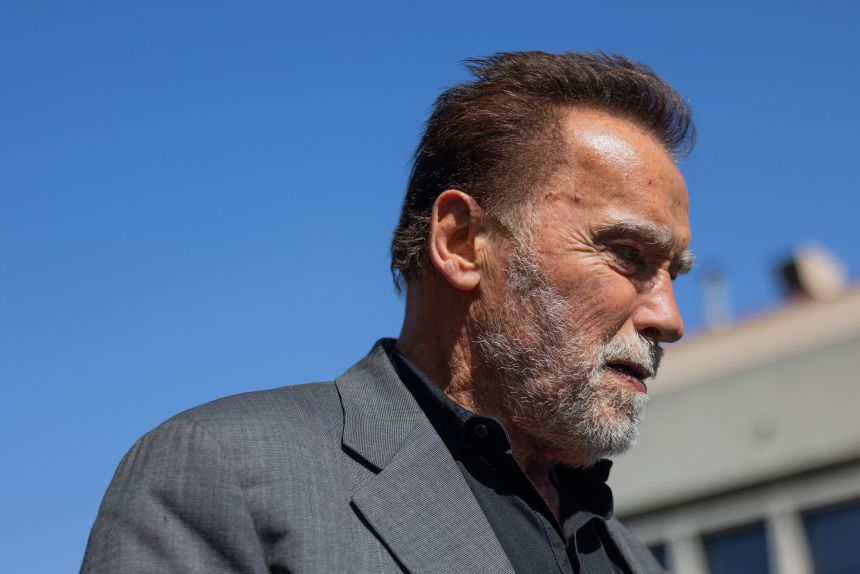
Both ideas were pushed by former Gov. Arnold Schwarzenegger, who modeled himself as a centrist Republican.
“His vision was that, you know, we’ve got to incentivize centrism, incentivize a system where you have to talk to the opposition,” Michaelson said.
Bringing gerrymandering back
The idea is jarring in the Trump era, which is why California Democrats asked voters last year to set those nonpartisan maps aside so that they could maximize Democratic seats and offset the gerrymandering undertaken by Republicans in states such as Texas.
It still seems unlikely that this nightmare scenario for Democrats will come to pass. There are two months of campaigning left, and there is time for state and even national Democratic elders to endorse one candidate or another.
If a Republican is elected, however, the likely outcome is that Democrats would almost instantly start the process of trying to recall the new governor. There have been multiple recall attempts in California in recent years. Newsom beat them back. Schwarzenegger became governor after the only successful recall effort.