
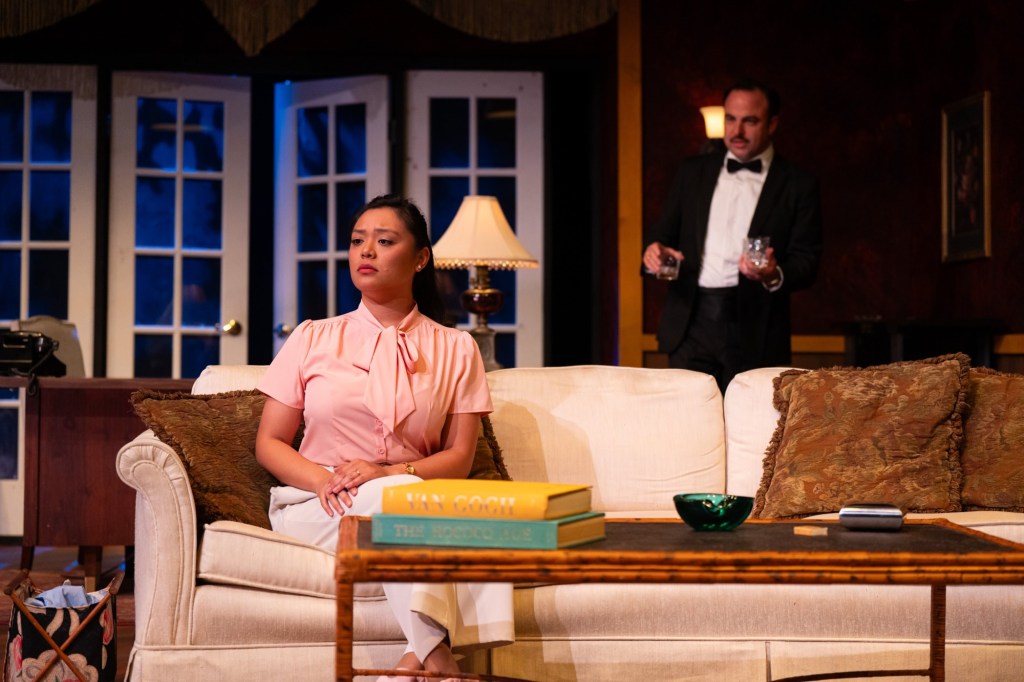
By the connotation of its title, “Dial M for Murder” might be surmised as a murder mystery. But in version now running at City Lights Theatre in San Jose, there is no murder to solve, but an attempted one to probe. Money and jealousy are the root of the play’s evils, with more deadly sins released in a world of posh, uppity arrogance.
Mark Anderson Phillip’s direction moves toward a firmer journey in a more interesting second act. Loose ends and compelling payoffs await after a subdued and slow-ish first frame that struggles with a balance between dark brooding and uneven lull.
Frederick Knott’s original play is the source material for this updated version by Jeffrey Hatcher, which was originally a 1954 film from Alfred Hitchcock. Tony Wendice (George Psarras) is the quintessential unhappy louse of a book publisher, formerly a British novelist. But now, he is working overtime to author the murder of his unfaithful wife Margot (Gwynnevere Cristobal), locked in a scandalous affair with cigarette-puffing Maxine (Maria Marquis).
There is zero reason for Tony to get his precious hands full of deathly grime, so he reaches out to an actual murdering type. Enter Lesgate (Drew Benjamin Jones), who agrees to do the deed after some coaxing, a lathered up appeal to the ego that is so blatant it borders on insulting.
While Tony coddles his own bruised ego, there is clearly a greater reason for the cruel hijinks, which comes in the form of some significant cash. Margot has raked in the coin in her successful career, and a simple clean offing of one on whom no love is lost can ensure Tony will enjoy years of lounging with lots of savory bourbon by his side.
The strength of the production is the solid cast; the actors make it quite clear each character has an intention of engaging with deadly sins, or must actively fight against them. Psarras spends the majority of his time slinking through space, scanning the highly detailed living room of opulence for the next steps of Tony’s grisly plan (the varied set design, which includes some ingenious touches with translucent walls, is by Ron Gasparinetti) .
That plan ultimately goes awry, with Margot surviving the attack, smartly staged in a way that doesn’t completely ratchet up the violent tension, keeping the audience in an appropriate level of comfort while not compromising the narrative. The result puts Tony on the radar of Scotland Yard’s Inspector Hubbard (Nick Mandracchia), and immediately thrusts Tony into a defensive posture.
The play strengthens in the second act, which is a combination of exquisite action and narrative malarkey. It is an odd choice to make much of the denouement revolve around a simple plot line of a key, in the same problematic way Othello’s murderous deeds are informed by a scarf. They are campy choices that keep the action light while still incorporating tension, the tone of the world assisted mightily by Justin Kelley-Cahill’s deft lighting plot.
Despite the issues with the production, namely the too-tame suspense at times, this is a sharp cast of veterans. Cristobal and Marquis both smoothly convey the taboos of intimate female relationships in a period-style framework. Marquis exploits the control she possesses in her more confident hands, a match and cigarette serving as a metaphor for something more explosive. Cristobal’s arc can use a mite more variance overall, but her playing of Margot’s inner-torture from having to live with the literal shards of blood on her neck is effective.
Mandracchia’s Hubbard is a game changer, one keenly aware of the negotiating power he possesses — a winning game is his with the right amount of patience. And the bumbling nature of Lesgate, with Jones playing the internal conflicts sharply, comes with succumbing to the horrid nature of what money can bring.
The avenue where tension is rich and decadent is on display here. That being said, there is hope that the production can satiate an audience almost as much as Tony is satisfied by his favorite dark liquor. Despite the future he crafted for himself, he sits and stares ahead — stone-faced, silent and strangely satisfied.
David John Chávez is a former chair of the American Theatre Critics/Journalists Association, a 2020 O’Neill National Critics Institute fellow, and a two-time juror for the Pulitzer Prize for Drama (2022-’23). @davidjchavez.bsky.social
‘DIAL M FOR MURDER’
Adapted by Jeffrey Hatcher, presented by City Lights Theater Company
Through: April 12
Where: City Lights Theater, 529 S. Second St., San Jose
Running time: 2 hours, 20 minutes with an intermission
Tickets: $31-$75; cltc.org