
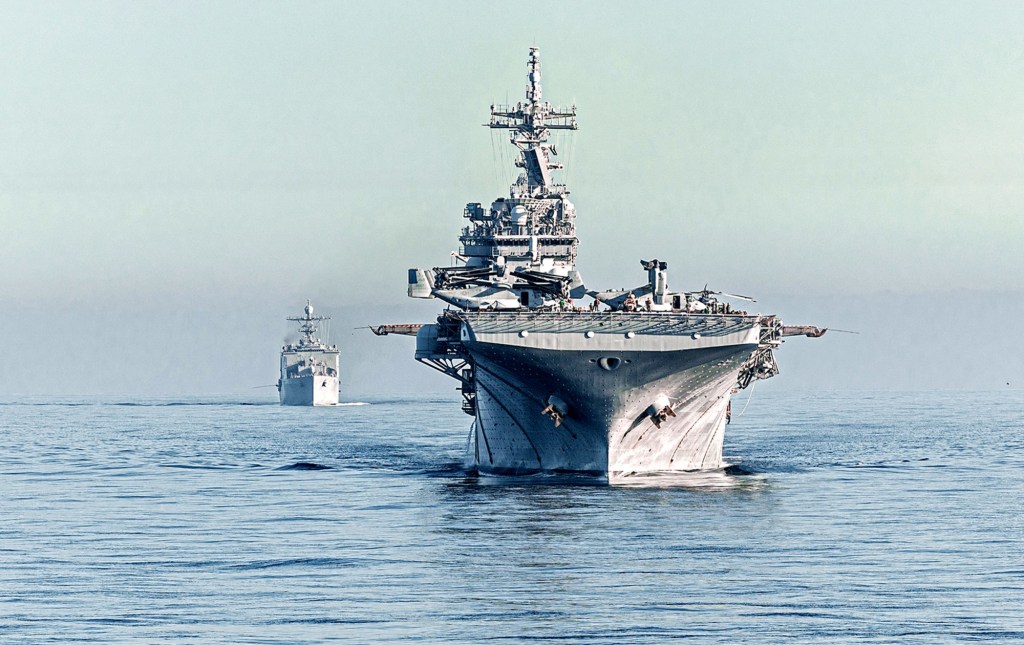
Three San Diego warships and the 2,200-plus Marines they carry dutifully trained off Camp Pendleton in recent months, barely visible against the misty horizon.
Their anonymity may soon come to an end in waters 8,000 miles away.
In mid-March, President Donald Trump ordered the USS Boxer Amphibious Ready Group, known as an ARG, to transport Camp Pendleton’s 11 Marine Expeditionary Unit, or MEU, to the Middle East, possibly to become part of a ground war against Iran.
Military families near Camp Pendleton understand why. Marines are the “first to fight,” as the saying goes. And Navy families know ships like Boxer — which dodged an enemy drone in the Middle East in 2019 — sometimes have to “surge” in a quick minute.
But the broader public likely knows little about this type of task force, which is revered in the military for its power, speed and agility.
In short-hand, it’s called an ARG-MEU. The term refers to rapid-response teams composed of three or more amphibious warships that can transport Marines globally and deploy them almost anywhere without the use of the ports and airfields of the countries they are attacking.
These teams can also linger off an enemy’s coast for months, set up to conduct assaults by air, sea and land, using everything from $110 million fighter jets to modest landing craft.
Further, they can establish forward operating bases onshore, as Camp Pendleton’s 15th MEU did in southern Afghanistan in 2001.
The teams can also provide humanitarian relief. But the primary purpose of an ARG-MEU is to project power, often while serving as independent operators, with limited self-defense equipment.
“A MEU embarked on a three-ship Amphibious Ready Group is the most versatile, flexible and lethal global response force the United States has to offer,” Marine Corps Commandant Gen. Eric Smith said in a speech last year, according to Breaking Defense news.
The San Diego task force now en route to the Middle East is composed of three bulky and brutish vessels. Two of them — the USS Portland and USS Comstock — primarily put Marines and their equipment ashore.
The group’s focal point is the flagship, Boxer, an 844-foot amphibious assault ship that has spent most of its roughly 30 years of service operating out of San Diego. The Golden Gator, as it’s known, also puts Marines ashore. And it has a major hospital.
But it’s chiefly a small aircraft carrier that features many air assets, notably F-35B stealth fighters that can fly 1,200 mph.
The U.S. F-35Bs that are already in the Middle East have been destroying Iranian air defense systems and infrastructure.
Boxer also has heavy-lift and attack helicopters, as well as MV-22B Osprey, fast, long-range tilt-rotor aircraft used to transport troops and equipment, and to evacuate the wounded.
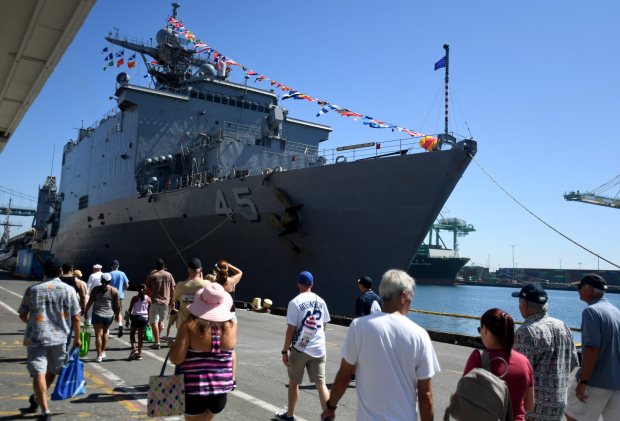 Guests walk toward the USS Comstock during LA Fleet Week in San Pedro on Aug. 30, 2019. (Brittany Murray, Press-Telegram/SCNG)
The Trump administration is considering ordering Marines to storm into the Persian Gulf and take over Kharg Island, Iran’s principal oil export terminal and a vital cog in its economy. A raid would also aim to help broadly reopen the Strait of Hormuz to shipping.
ARG-MEUs are expressly designed for such missions.
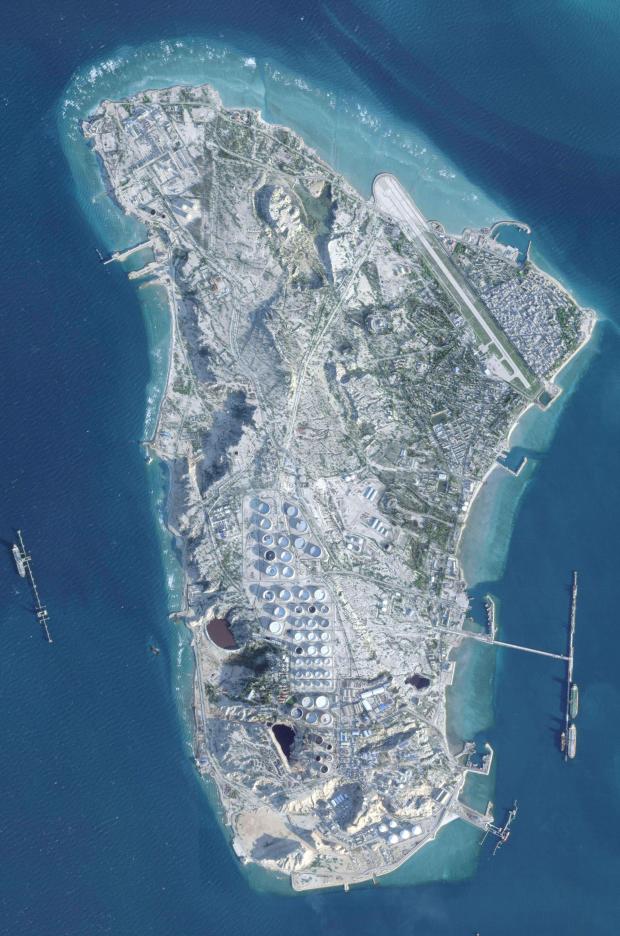 In this satellite photo from Planet Labs PBC, Iran’s Kharg Island is seen on Feb. 26, 2026. (Planet Labs PBC via AP)
It is not clear whether the Boxer group would lead the way if such a raid is approved. Another U.S. Navy-Marine task force from Japan just arrived in the region sooner. It’s possible that both would be used if the U.S. does not reach a peace agreement with Iran.
This involves great risk.
Retired Adm. James Stavridis, the former Supreme Allied Commander of NATO, has repeatedly told the news media that Iran could launch a counter-attack, killing a lot of U.S. troops. Such an attack could involve ballistic missiles, which are very difficult to knock down because of their speed and trajectory.
The Boxer has defensive weapons, including Rolling Airframe and Sea Sparrow missiles. But Stavridis, among others, has called such an invasion a “high-risk, little-reward” venture.
Such an event might not be far away.
The Boxer group will likely reach the Middle East about a week into April.