
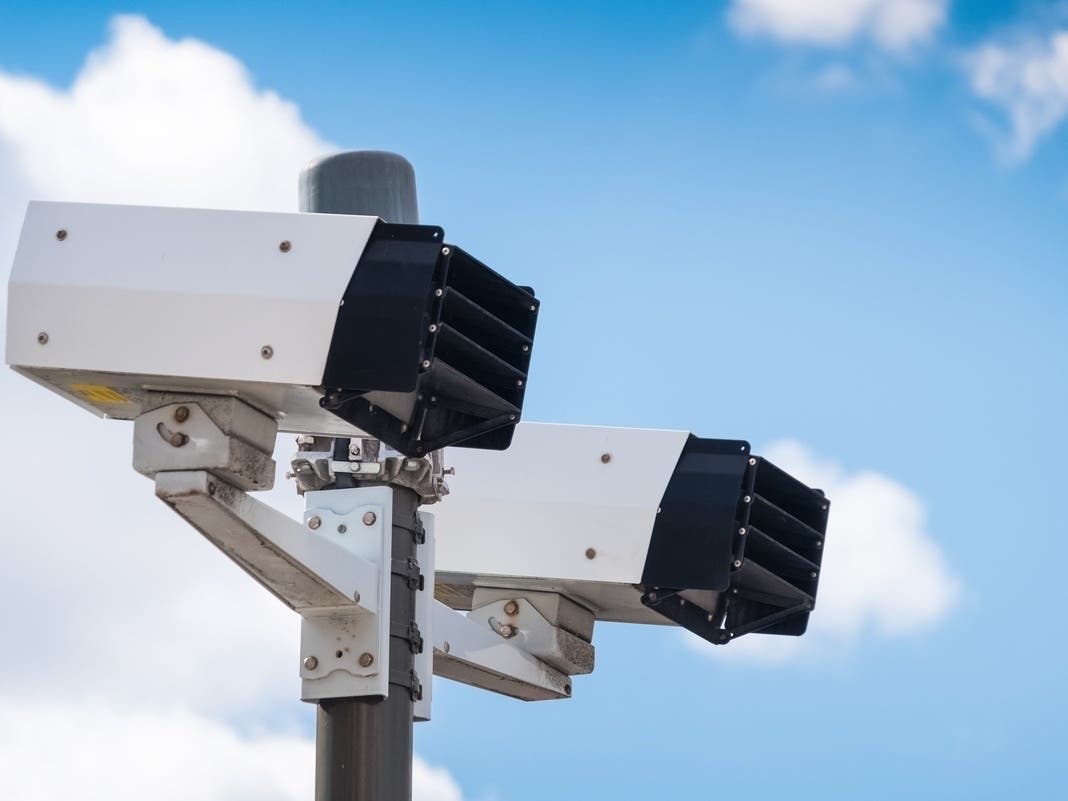
Speed cameras will soon be ready to snitch on led-footed drivers in at least four more California cities this year as the state’s pilot program continues to grow following what officials say was a successful launch in San Francisco.
With a series of laws passed in 2023 and 2024, state officials paved the way for dozens of cameras to be installed in seven cities: Los Angeles, San Francisco, Oakland, San Jose, Long Beach, Glendale and Malibu.
So far, only cameras in San Francisco and Oakland have begun issuing tickets. Officials in San Francisco say it’s working: Speeding decreased by 72% on average at 15 locations after cameras were installed last year.
Find out what’s happening in Los Angelesfor free with the latest updates from Patch.
But the number of cameras will soon explode across the state: Los Angeles became the latest city is give the final OK for the plan this week. Work is underway to bring cameras online in Long Beach, Glendale and Malibu in the coming months.
Meantime, a legal battle with the Trump administration has stymied efforts to install the cameras in San Jose.
Find out what’s happening in Los Angelesfor free with the latest updates from Patch.
Here’s a look at how the speed cameras work and more about each city’s plan:
How It Works
Per the California law, cameras can only be installed in state-defined safety corridors, school zones, and areas with a history of street racing or sideshows. They must also be placed evenly throughout different socioeconomic neighborhoods.
Once a city installs its cameras, a 60-day warning period begins. That’s when drivers will get notices when the cameras catch them speeding.
After that 60-day period is up, drivers will receive fines based on how far over the speed limit they were going:
11-15 mph over: Written warning for the first time, $50 for repeat offenders16-25 mph over: $100 fine26 to 99 mph over: $200 fine100 mph over: $500 fine
The effort is intended to serve as a pilot program through 2032 to measure the impacts and best practices before more speed cameras are installed throughout the state.
Los Angeles
As California’s largest city, perhaps it’s no wonder that Los Angeles would also have the state’s highest number of speed cameras.
As many as 125 cameras will be installed across LA this summer as part of a plan approved by the City Council on Tuesday.
For comparison, San Jose — the second-largest city in the program — expects to install 28 cameras.
 A map showing a proposed list of 125 locations across the city where cameras could be installed. (LADOT) San Francisco
San Francisco’s 33 cameras have been issuing citations since August.
The city issued more than 400,000 warning notices from March to August. Officials haven’t released data about fines yet, but said they plan to do so early this year.
Authorities say the cameras are working.
A study published in October by SFTMA looked at 15 key locations before and after cameras were installed. Speeding decreased by 72% on average at the locations.
Before the cameras were installed, average speeds at 12 of the 15 locations were higher than the posted limit. After the cameras were installed, the average speed in all locations dropped below the posted speed limit, according to the study.
SFTMA pointed to other positive changes:
A speed camera installed on Geneva Avenue between Mission and Carter streets was among the factors credited in the location seeing the lowest number of injury crashes recorded on the corridor in more than a decade.A speed camera and other changes on Franklin Street between California and Bay streets helped injury crashes drop in the corridor by half compared to 2014. 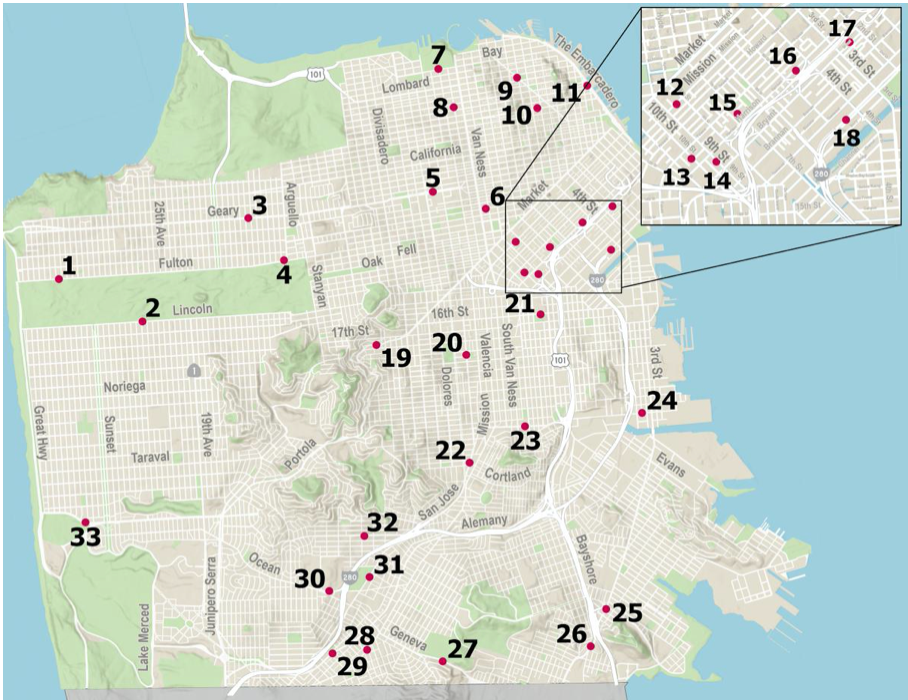 Locations in San Francisco (SFMTA) Oakland
Oakland’s 18 speed cameras went live in January. The locations account for 60% of severe and fatal collisions in the city.
In the first month of the program, 70,000 warnings were issued with the cameras’ help, The Oaklandside reported.
The real impact will be soon be felt by drivers, as the cameras began issuing fines on March 15, according to the city.
There’s been some hiccups: One camera issued unnecessary warnings because it was set to 25 miles per hour instead of the posted 30 miles-per-hour speed limit. City officials said the issue was fixed within two days, according to The Oaklandside.
Officials said the warning period helps iron out bugs like that one.
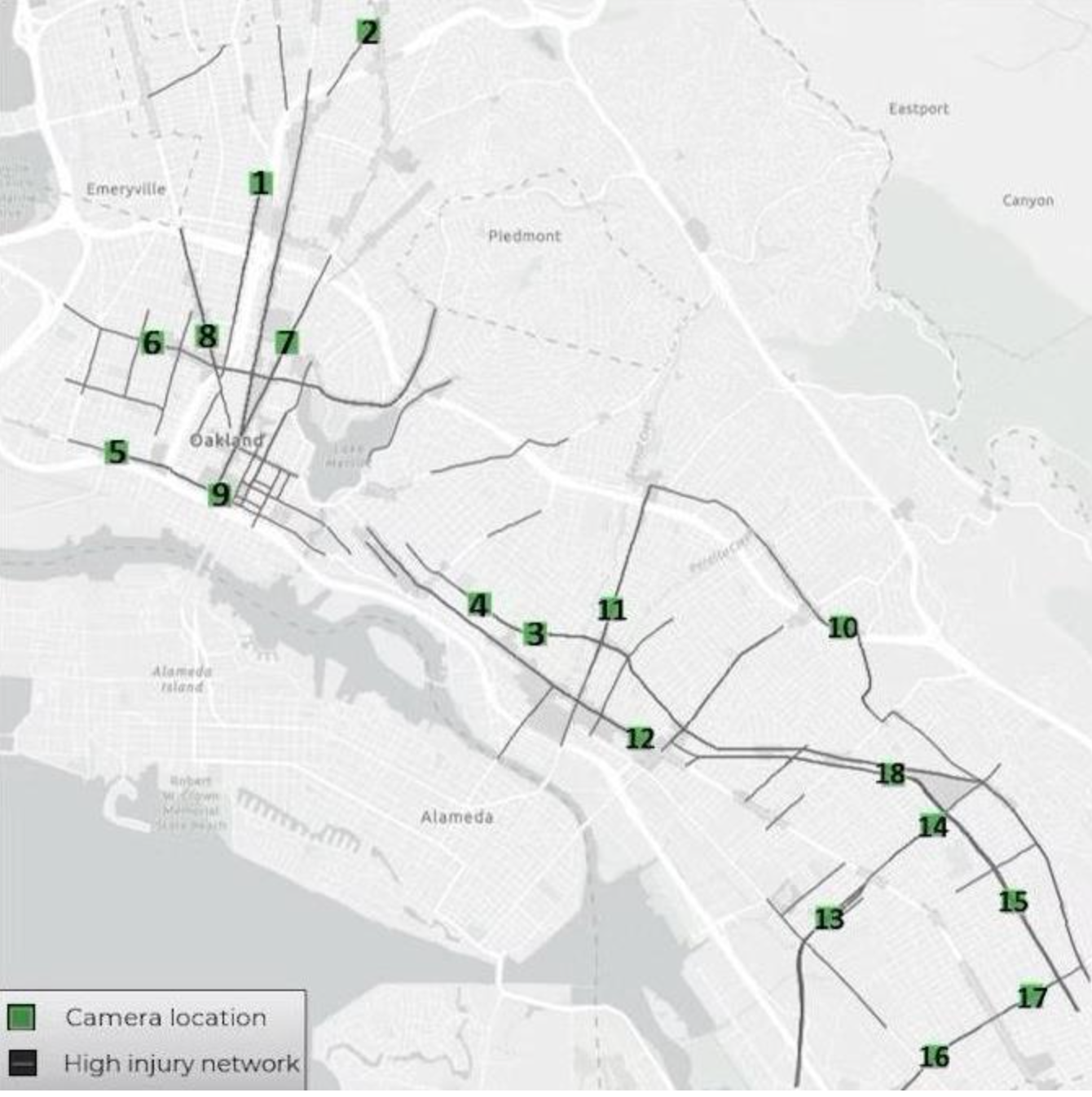 Camera locations in Oakland (City of Oakland) San Jose
San Jose has identified 28 proposed locations for speed cameras and planned to install them last year. But a legal battle over federal grant funding has stymied the rollout.
San Jose was going to use an $8.5 million federal grant from the Biden administration, but the Trump administration updated the terms and conditions of that grant.
The conditions “had nothing to do with traffic safety,” San Jose Mayor Matt Mahan told NBC Bay Area.
A lawsuit followed unsuccessful negotiations. The funds are being held until that’s settled, Mahan said.
“It’s really unfortunate that politics is getting in the way of public safety,” he said.
Meantime, the city installed cameras designed to catch people running red lights in the fall. The cameras began issuing citations in January.
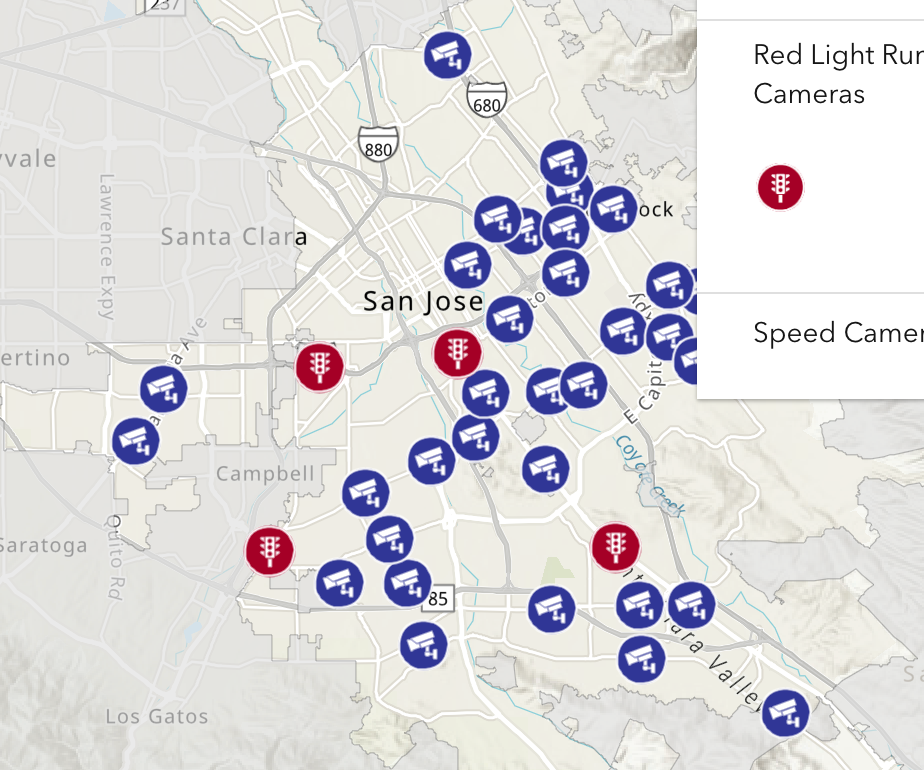 Proposed camera locations in San Jose. (City of San Jose) Long Beach
Long Beach has identified locations for 18 cameras, based on rates of street racing, speeding and pedestrian collisions, according to the Long Beach Post.
The cameras will installed by this spring. They’ll be activated in the summer, when the 60-day warning period will begin. In the fall, they’ll begin issuing tickets, according to the city’s timeline.
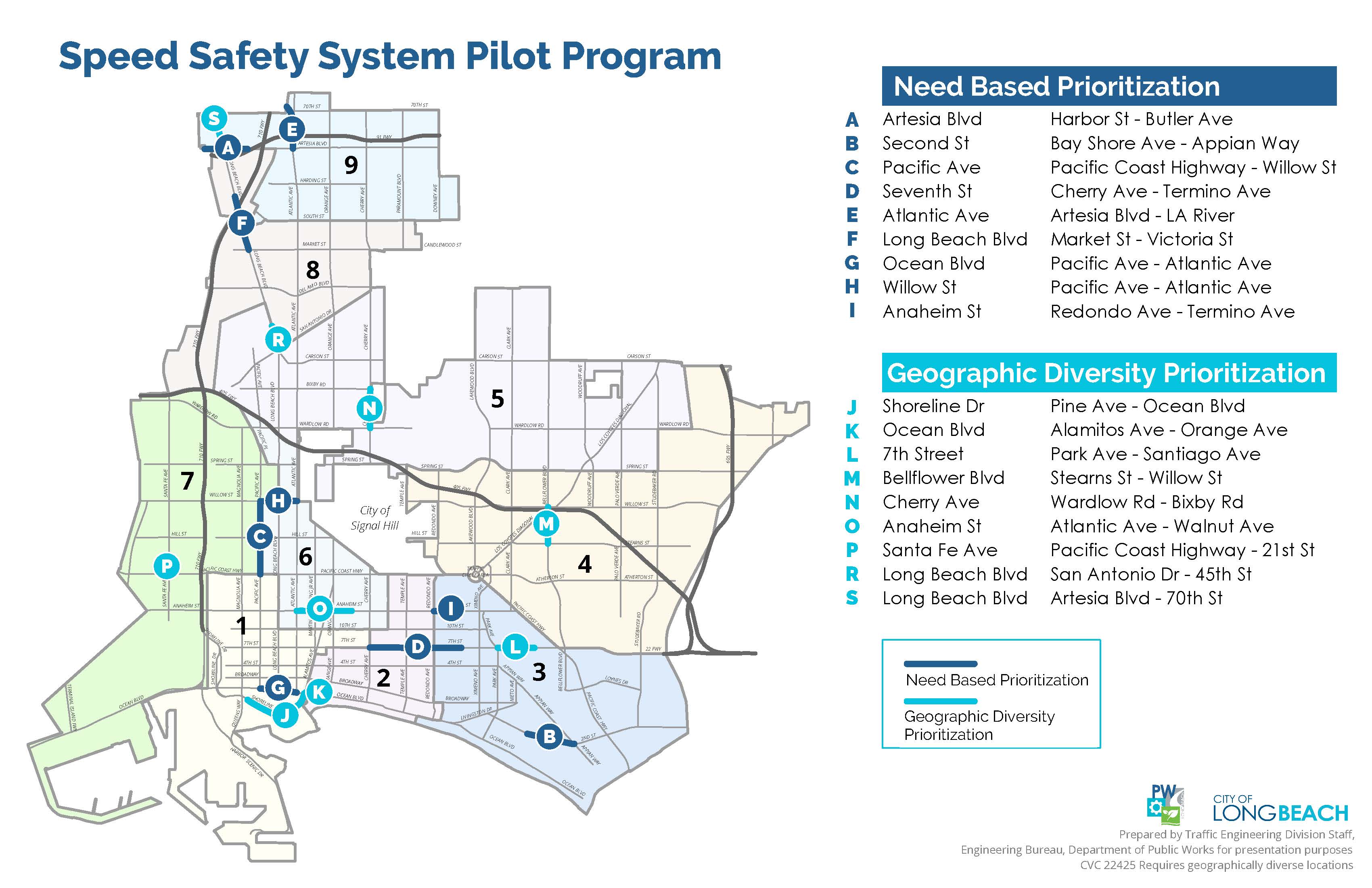 Long Beach has identified locations for 18 cameras. (City of Long Beach) Glendale
Glendale plans to install cameras at nine locations across the city. In December, it hired a contractor to install the cameras, according to the Crescenta Valley Weekly.
City officials expected to have the cameras installed this spring, with the warning period beginning in the summer, according to the city.
 Glendale plans to install cameras at nine locations across the city. (City of Glendale) Malibu
Pacific Coast Highway has been the site of several high-profile deadly crashes, and the city declared a Local Emergency in November 2023 following the deaths of four Pepperdine students. In September 2024, Gov. Newsom signed SB 1297, which authorized speed cameras along PCH.
Officials identified five locations for the cameras on PCH: Decker Canyon, between Guernsey Avenue and Morning View Drive, Latigo Canyon Road, between Carbon Beach Terrace and Carbon Canyon Road, and Tuna Canyon Road.
Officials previously said the cameras are expected to be installed in early 2026.
Patch staffer Michael Wittner contributed reporting.
Get more local news delivered straight to your inbox. Sign up for free Patch newsletters and alerts.