
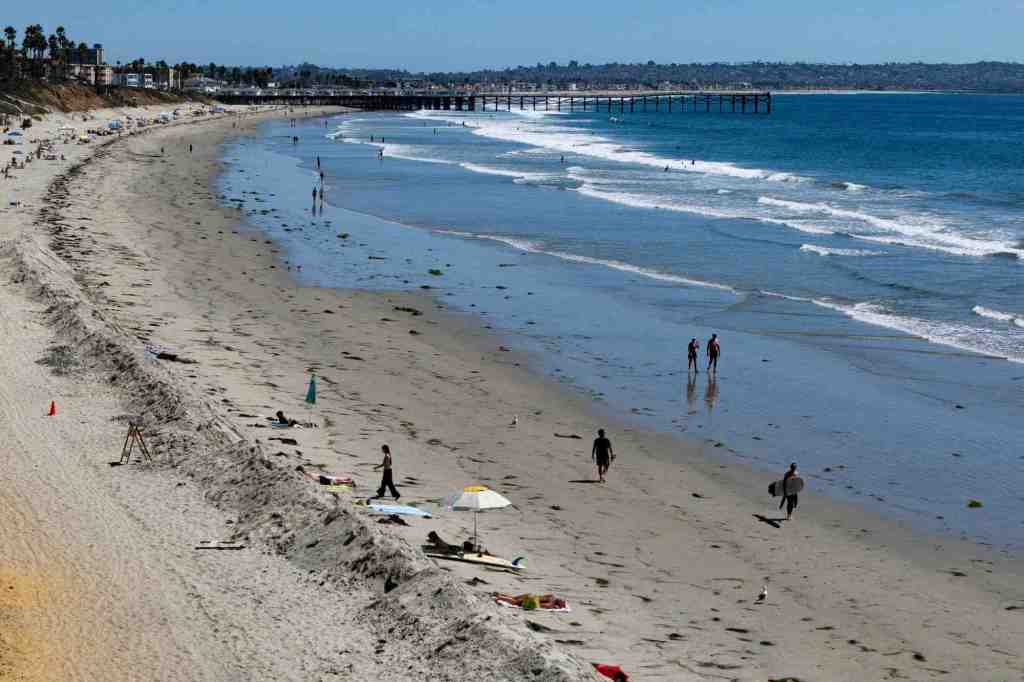
More than 32 years ago, Clive Bland went looking for help. He’d been stabbed.
Bleeding, the 40-year-old made his way from the sand of Tourmaline Surf Beach in Pacific Beach to his car parked in the lot. San Diego police told reporters at the time that the wounded man had driven up Tourmaline Street a block or so, almost to Mission Boulevard, before crashing into a parked car.
In the dark, he made his way to the front porch of a stranger. When a passerby found Bland slumped over about 4:40 a.m. Jan. 2, 1994, he was dead.
Police traced the scene of the crime to the sand, but the case eventually went cold.
On Friday, San Diego police homicide Acting Lt. Chris Leahy said in a news release that evidence collected years ago, coupled with forensic genealogy and other advanced techniques, recently helped investigators zero in on a suspect — a man who would have been 18 years old when Bland died.
Leahy said police arrested 50-year-old Santa Cruz resident Jeffry Brandenburg on Thursday on suspicion of murder in connection with Bland’s death. As of Friday, Brandenburg was in custody in San Diego Central Jail without bail. Jail records indicate he is slated to be arraigned Monday.
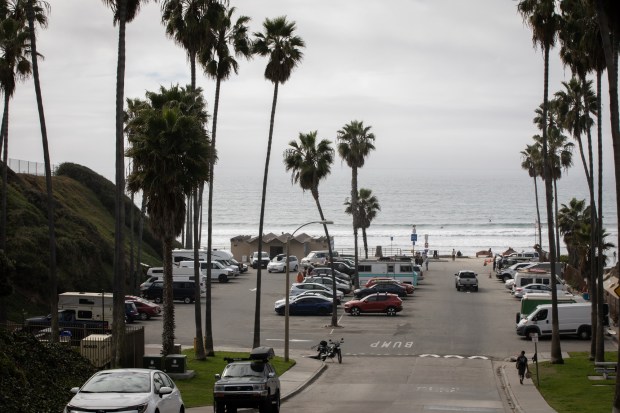 A parking lot near Tourmaline Beach on Feb. 6, 2025 in San Diego. (Ana Ramirez / U-T file)
In 1994, the Union-Tribune reported that a Pacific Beach man was headed to work around 4:40 a.m. when he spotted Bland slumped on a front porch. Police said a car with its lights still on was parked on the street.
The resident of the home had moved in just a day earlier and did not know Bland, who lived in San Diego’s Clairemont neighborhood.
In a news story highlighting the case earlier this year, ABC 10News San Diego reported that blood evidence indicated Bland had tried to ring the doorbell, which was out of order.
Murders hit historical highs in San Diego in the 1990s, and Bland’s 1994 slaying was one of 113 homicides that year. Last year, the city reported 40 homicides.
Leahy said San Diego police investigators worked closely with the District Attorney’s Office and the FBI during the investigation.
Genetic genealogy first gained national attention in 2018 after it was used to identify a suspect in the Golden State Killer case. With the method, expert genealogists try to match crime scene DNA to relatives who have uploaded their DNA in publicly accessible databases. A hit can help genealogists generate family trees, in hopes of putting a name to the mystery DNA.
San Diego police first successfully used genetic genealogy in 2019 to help close the 1979 homicide of a La Jolla woman killed in her home during what police suspect was a burglary gone bad. The suspect in that case was long dead when authorities uncovered his name.