
Luis Pedraza rides a blue line train from the Dublin/Pleasanton BART Station for the second leg of his commute from his home in Stockton to work in San Francisco. If BART closed the station, one option it has floated amid budget shortfalls,“I literally don’t know what I’d do,” Pedraza said.
Jessica Christian/S.F. Chronicle
Many mornings, stuck in gridlock along Interstate 580, Luis Pedraza watches wind turbines spin over rolling green hills and wonders: Is this grueling drive still worth it?
In September, the first-generation college grad landed his dream job at major accounting firm Ernst & Young’s San Francisco office. There was just one problem. Eager to stay with his widowed mother and help with rent, Pedraza felt he needed to keep living at the family’s mobile home — in Stockton.
Now grappling with round-trip commutes that run 180 miles and four-plus hours, the 28-year-old auditor is one of San Joaquin County’s roughly 30,000 “super-commuters” who trek at least 90 minutes into work. But it’s not just all the time in traffic that has him second-guessing his life decisions.
Article continues below this ad
With Bay Area companies ramping up their return‑to‑office mandates, the war in Iran sending California’s gas prices soaring, and a massive deficit casting doubt over BART’s future, commutes have become more punishing than ever. Pedraza fears that his daily sojourns over the Altamont Pass — those wind-swept, dry slopes Stocktonians simply call “the hill” — could soon become unsustainable.
“I’m definitely starting to feel some pressure to find a place closer to work,” he said.
Luis Pedraza makes himself a cup of tea before leaving his Stockton home by 6 a.m. to commute to his office in downtown San Francisco.
Jessica Christian/S.F. Chronicle
Dilemmas like Pedraza’s are increasingly common in San Joaquin County, which has long served as a sort of overflow zone for the Bay Area’s housing crisis. Over the past couple of decades, as Silicon Valley’s tech boom drove up the cost of living, tens of thousands of people flocked to this 1,400-square-mile swath of the Central Valley. They were trading brutal slogs along the I-580 corridor for bigger homes with bigger backyards.
San Francisco Chronicle Logo
Make us a Preferred Source to get more of our news when you search.
Add Preferred Source
In the process, San Joaquin County’s share of super-commuters spiked: from 6.9% in 2014, to roughly 10% in 2024, according to census data. Stockton now has the highest rate of super-commuters — 9.2% — of any U.S. city with more than 200,000 residents. Modesto, just a 30-mile drive south in Stanislaus County, ranks a close second at 8.6%.
Article continues below this ad
That’s no coincidence. Both Stockton and Modesto sit squarely in one of the country’s most-trafficked commuter belts, where relatively affordable housing meets a shortage of higher-wage jobs. The Altamont Pass represents that all-important bridge connecting the San Joaquin Valley’s McMansions to the Bay Area’s lucrative paychecks.
“Northern California has the most super-commuters because it has America’s greatest imbalance of jobs and housing,” said Karen Chapple, a UC Berkeley professor emerita of city and regional planning. “Before you can solve the super-commuter issue, you have to figure out that imbalance.”
Urgency is mounting. Public health research has linked long commutes to increased rates of obesity, high blood pressure, high cholesterol, back-and-neck pain, sleep issues, divorce, and depression and anxiety.
With all that in mind, San Joaquin County officials are trying to at least make super-commutes more bearable. They’re coordinating with outside agencies to expand such long-distance transportation options as the Altamont Corridor Express, subsidized vanpools and express buses.
Article continues below this ad
For people like Pedraza, the bigger concern is San Joaquin County’s chronically low supply of high-paying jobs. Perched just beyond the Bay Area’s eastern edge, this expanse of fields, orchards, subdivisions and big-box stores offers few opportunities for ambitious young professionals interested in industries such as tech and finance.
Luis Pedraza puts on his shoes in his bedroom as he prepares to leave the mobile home he shares with his mother in Stockton.
Jessica Christian/S.F. Chronicle
After graduating from the University of the Pacific in May with a master’s degree in accounting, Pedraza knew he’d have to job hunt outside of Stockton, where the median household income of around $79,000 per year is roughly half of San Francisco’s. His father had been a welder and his mother a cannery worker. To honor everything they had done to give him a chance at a better life, he wanted to maximize his earning potential and rise through the ranks at one of the Big Four accounting firms.
But Pedraza, whose dad died in 2021 of complications related to COVID-19, didn’t want to relocate. “The idea of leaving my mom at this time was too much for me,” he said. “It’s just sad I basically have to decide: be close to work or make way more money.”
Contrary to popular belief, low wage earners such as DoorDashers and Uber drivers comprise only a small fraction of super-commuters. A recent survey from ACE, which transports an average of about 2,500 riders each weekday from the Central Valley to the Bay Area, found that 79% of its passengers earn more than $100,000 a year.
Article continues below this ad
For many, super-commuting is about priorities.
Paul Krueger takes the 4:40 a.m. ACE train from Manteca to ensure he’ll arrive at his office near Oakland’s Lake Merritt by 7 a.m. A principal program manager for PG&E, he views those two-hour odysseys — which also include rides on a connector bus and BART’s Blue Line — as worthwhile sacrifices.
Though Krueger could afford a Bay Area home, he said it probably wouldn’t be big enough for his family to feel comfortable. In Manteca, his daughters both have walk-in closets, his wife has a home office, and his pets have plenty of yard space.
“Of course,” Krueger said, “it does help that I only have to go into the office once or twice a week.”
Pedraza isn’t always so fortunate. Depending on his clients’ needs on a given week, he might have to commute all five workdays.
Article continues below this ad
To swipe into Ernst & Young’s offices in downtown San Francisco by 9 a.m., Pedraza departs his North Stockton trailer park by 6 a.m. No amount of jazz playlists can stop him from glancing at his GPS, groaning as the ETA keeps getting pushed back.
After contending with gridlock on the Altamont Pass, Pedraza parks his 2007 Toyota FJ Cruiser at the Dublin/Pleasanton BART Station, where he catches one of those familiar white-and-blue trains into the city. Often, after getting off work at 6 p.m., he waits out rush-hour traffic at his girlfriend’s apartment in San Ramon before finally climbing back into his Toyota around 9 p.m. to make the 55-mile drive home.
Left: Luis Pedraza gets in his car to make the 1½-hour drive from his home in Stockton to the Dublin/Pleasanton BART station. Right: Luis Pedraza sits in traffic on Highway 580 westbound through the Altamont Pass in Tracy.
Photos by Jessica Christian/S.F. Chronicle
Top: Luis Pedraza gets in his car to make the 1½-hour drive from his home in Stockton to the Dublin/Pleasanton BART station. Bottom: Luis Pedraza sits in traffic on Highway 580 westbound through the Altamont Pass in Tracy.
Photos by Jessica Christian/S.F. Chronicle
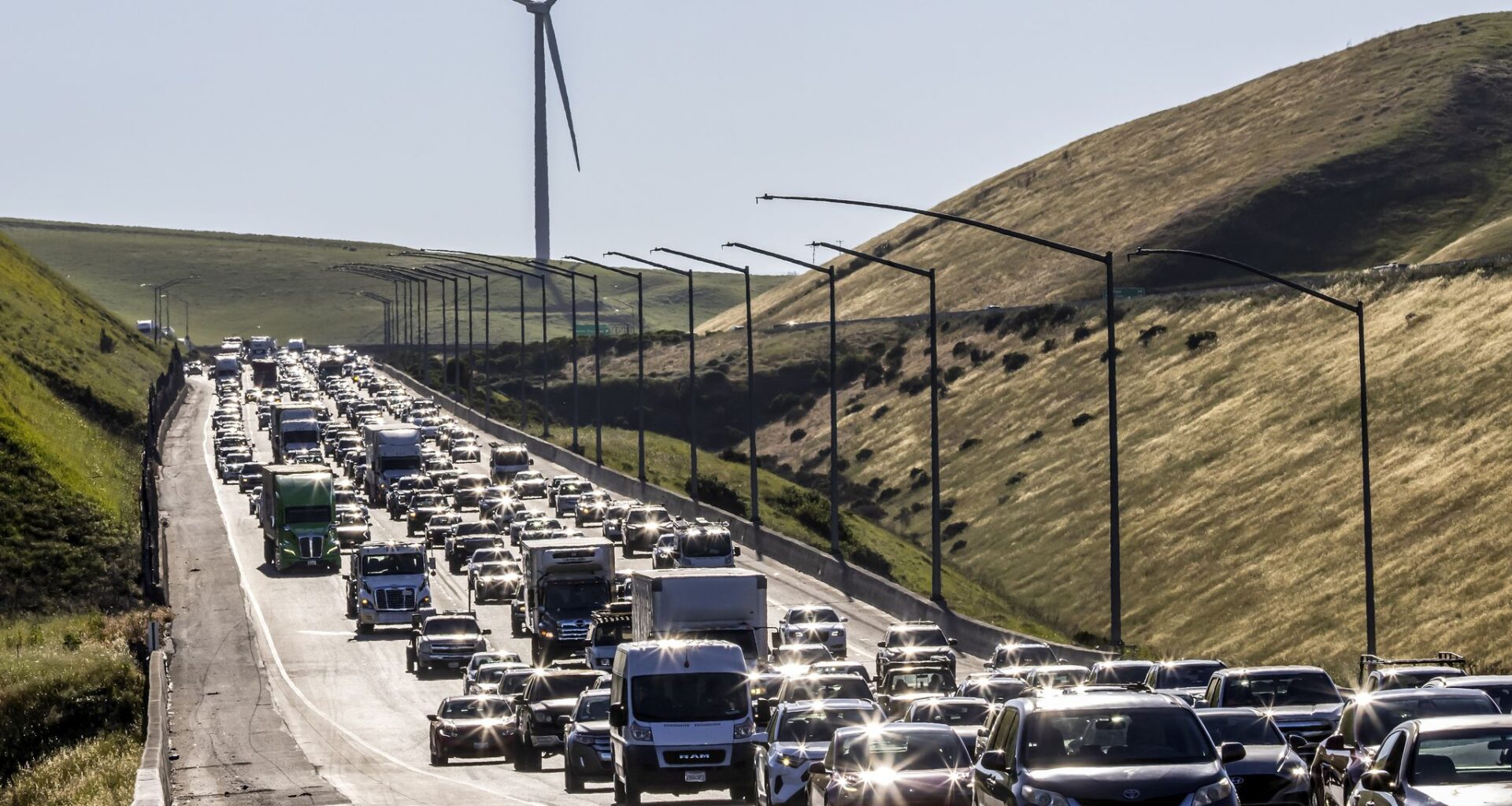
Traffic backs up on the Altamont Pass outside Livermore on a recent Monday. For many drivers, such congestion adds hours to their daily commute when they drive from the San Joaquin Valley to the Bay Area.
Carlos Avila Gonzalez/S.F. Chronicle
The longer Pedraza toils through these harsh commutes, the more he’s tempted to scour Zillow for Bay Area apartments in his price range. Gas prices are eclipsing $6 per gallon for regular unleaded at some local stations. Each round-trip commute drains about half of his tank, which takes around $80 to fill.
And things might get grimmer. If BART directors can’t save the 54-year-old system from fiscal collapse by passing a new sales tax in November, they could take drastic measures in 2027.
Their most sobering threat is the potential closure of 15 stations. That would include the Dublin/Pleasanton stop, which Pedraza and many other Central Valley commuters rely upon.
“I literally don’t know what I’d do,” he said, his voice heavy with dread.
Still, Pedraza recognizes that his situation could be worse. For more than 20 years, Ruby Dhaliwal has woken up at 1 a.m. each weekday to commute 74 miles from her home in Lathrop — 10 miles south of Stockton — to San Jose, where she works the early morning shift maintaining buses at the Santa Clara Valley Transportation Authority.
Now 61, she dreams of that monumental day — maybe in a decade, maybe in a year or two — when she can sleep through the wee hours of a weekday morning. It’s not just about wanting to feel well-rested. After so many missed breakfasts and cups of coffee with her husband and four children, she’s intent on making up for lost time.
“Nothing is more valuable than time, but I needed to help provide for my family,” Dhaliwal said. “I have no regrets.”
Not all of her neighbors can say the same.
While working remotely during the pandemic, many professionals uprooted their families to buy newer, larger homes in San Joaquin County. The honeymoon didn’t last long. With many Bay Area employers requiring workers in the office five days a week, gas prices surging with no end in sight, and BART bracing for scaled-back services, more and more commuters are looking for an off-ramp.
Luis Pedraza arrives at the Dublin/Pleasanton BART Station for the second leg of his journey to work.
Jessica Christian/S.F. Chronicle
Sarah Bergen, a Redfin real estate agent who works all over San Joaquin County, estimated that 90% of her pre-listing consultations are with fed-up commuters. One such client in Tracy recently sold his house for $90,000 less than what he’d paid for it brand-new a few years ago. He now rents a much-smaller home in the Bay Area.
“Reality is really starting to sink in for these people that they may have made a big mistake,” Bergen said. “A lot of them feel pretty stuck.”
To prevent a reverse exodus from the Central Valley, San Joaquin County officials must get creative. They are brainstorming everything from more transit improvements to new industries.
As part of a $154 million project with no definitive completion date, officials hope to make traversing the Altamont Pass smoother for its roughly 150,000 daily travelers. They’re adding extra lanes, installing new signage and modifying certain interchanges. They also plan to extend the ACE along two well-populated thoroughfares over the next half-decade: south from Lathrop to Merced, and north from Stockton to Sacramento.
“There’s definitely a huge demand for us to go to a lot more places,” said Marques Cook, senior marketing manager of ACE, which currently has only one Bay Area stop — Fremont — not in the South Bay. “The more we can help get people off the roads, the better it’ll be for everyone.”
Luis Pedraza crosses Market Street at Second Street in San Francisco. His round-trip commute runs 180 miles and four-plus hours.
Jessica Christian/S.F. Chronicle
But for San Joaquin County to shed its “bedroom community” label and give motivated professionals such as Pedraza more reasons to stay, officials must make the local economy much more than its current mishmash of warehouses, distribution centers and cold-storage facilities. That means turning this oft-overlooked stretch of cheap land into a hub of innovation.
Local leaders’ to-do list is lofty: Persuade big-name corporations to build offices there. Transform a slumbering downtown into a bustling business sector. Grow the infrastructure at Stockton’s gigantic port. And hope — maybe, pray — their government-funded coding academies produce one of the next great tech startups.
Stockton Mayor Christina Fugazi called bringing high-paying jobs the “No. 1 goal” of her City Hall tenure. A fourth-generation Stocktonian who spent about three decades as a teacher and administrator for her city’s largest school district, she is well aware of the toll long commutes take on a place’s sense of community.
While a vice principal at Stagg High School, she had many students whose parents would drop them off in front of the school around 5 o’clock each morning on their way into the Bay Area for work. Some of those teenagers might not see their folks the rest of the day.
“You have young people who get into trouble because what else are they going to do?” Fugazi said, referencing her city’s struggle with gangs and violence.
Luis Pedraza enters his office building at the accounting firm Ernst & Young in San Francisco, where he works as an auditor, by 9 a.m.
Jessica Christian/S.F. Chronicle
Pedraza managed to avoid that path. The son of Mexican immigrants, he studied hard in high school. He juggled part-time jobs at Walmart and a cherry-packing factory with a rigorous college course load. He paid out of pocket for the graduate-school tuition his merit-based scholarships couldn’t cover.
In a city where only about 20% of adults have bachelor’s degrees, he has a master’s and a well-paying job at a Fortune 500 company. Pastor Bob Margaron of the Love Them All Resource Center, who has worked with at-risk youth on Stockton’s south side for more than 30 years, called Pedraza’s story the kind that “could inspire the next generation of kids here who may be low on hope.”
The question is whether Pedraza will stick around long enough to share it with them.
Six months into his super-commute, he talks sometimes about trying to find an apartment in the East Bay with his girlfriend. That’s when he remembers: His mom would be heartbroken if he left Stockton.
“Who am I kidding?” Pedraza said. “I’m going to deal with these drives as long as I can.”