
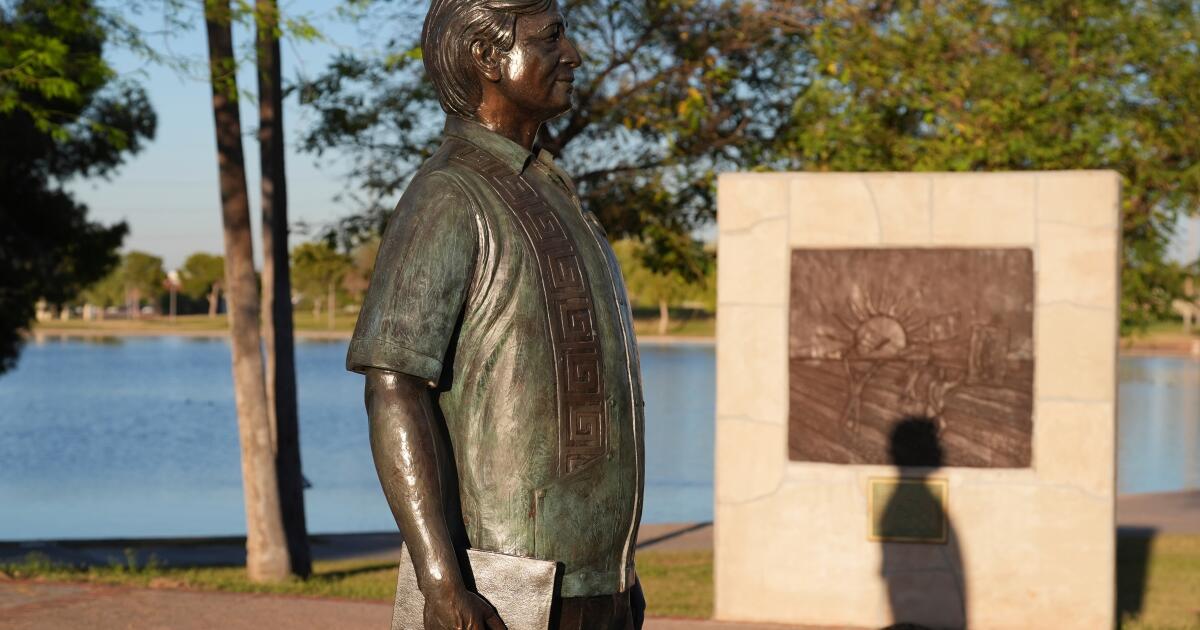
Ten days since sexual abuse allegations were disclosed in a chilling New York Times investigation against farmworkers rights advocate César Chávez, the race to erase his name and likeness from public life is moving at a breakneck pace.
Municipal governments and agencies from the Bay Area to Phoenix, Denver and Texas are removing statues, renaming his holiday (March 31) and cutting mentions from history classes and beyond.
While action has been quick in removing Chávez’s name, there has been plenty of debate on how best to move forward.
A similar process played out a few years back in Burbank, when a student-led investigation propelled the changing of David Starr Jordan Middle School to, coincidentally, farm labor leader Dolores Huerta.
Four years removed, the school’s former principal, Jennifer Meglemre, and a former Burbank Unified Board of Education member, Steve Frintner, have advice for those not sure how to navigate a controversial name change.
Burbank name change background
In early 2018, Jordan student Ixchel Sanchez Jimenez investigated her school’s namesake as part of a class project.
What she found led her and her mother, Laura Jimenez, to push for a name change in May 2018.
Jordan was known for being the founding president of Stanford University and a famed ichthyologist, or fish scientist.
But he was also a believer and supporter of eugenics, a system of controlled breeding and separation of certain people to increase the chances for desirable heritable characteristics. It was a belief espoused by the Nazis.
University of Vermont associate professor and historian Lutz Kaelber estimated that roughly 20,000 people in California deemed undesirable were forcibly sterilized until 1964 due to eugenics policies. Most were sterilized because they were believed to be mentally ill or mentally deficient.
The name-changing process
Burbank Unified set up committees to debate the topic, first to decide whether there should be a name change, and then what the new name should be.
The committees took input from students, teachers, administrators and community members.
Frintner said it was critical not to rush the decision and allow for thorough conversations.
“It’s important to make sure you’re giving people in the community a voice because they want to feel a part of this process,” Frintner said.
After agreeing to drop Jordan, Burbank Unified’s renaming process centered on a few considerations: should the school replace David Starr with another notable Jordan (Texas lawmaker Barbara Jordan), should the school be named after another individual or something less contentious like a tree or a street.
Those decisions mirror the current Chávez debate. Los Angeles is changing César Chávez Day to Farm Worker’s Day, while some advocates, including former farmworkers, are asking that Chávez be replaced with Dolores Huerta, the civil rights leader who fought alongside the man who allegedly raped her.
Resistance to change
Meglemre said resistance to the school name change came from all sides: from those not wanting to drop Jordan and others who did not want the school renamed for a living person.
“The discussions were about how people are flawed and we don’t want to get into a situation where something is named after a person still alive and something terrible ends up happening,” Meglemre said.
After three years of debate, hampered in part by COVID-19, the committee settled on Dolores Huerta. (César Chávez was never a top contender.)
“Almost all the schools in Burbank are named after a person and we wanted to continue that tradition,” Meglemre said.
Frintner said the district committees wanted to choose someone with Southern California ties and was either a minority or a woman.
Last piece of advice
Meglemre said that while there was heated debate and pushback from community members, after a couple of years, most people “moved on with their lives.”
Frintner believes more research is always a positive.
“My advice is make sure you’re doing as much background as possible,” he said. “You do want to honor people but you don’t want to be in a position where you’re having a hard time defending your decisions.”
You’re reading the Essential California newsletter
Sign up to start every day with California’s most important stories.
By continuing, you agree to our Terms of Service, which include arbitration and a class action waiver. You agree that we and our third-party vendors may collect and use your information, including through cookies, pixels and similar technologies, for the purposes set forth in our Privacy Policy such as personalizing your experience and ads.
The week’s biggest stories 
(Carlin Stiehl/For The Times)
No Kings ProtestsAnimal encountersTheft, fraud allegationsCrime, courts and policingWhat else is going onMust readsOther meaty readsFor your downtime 
(Juliana Yamada/Los Angeles Times)
Going outStaying inL.A. Timeless
A selection of the very best reads from The Times’ 143-year archive.
Have a great day, from the Essential California team
Jim Rainey, staff reporter
Hugo Martín, assistant editor, fast break desk
Kevinisha Walker, multiplatform editor
Andrew J. Campa, weekend writer
Karim Doumar, head of newsletters
How can we make this newsletter more useful? Send comments to essentialcalifornia@latimes.com. Check our top stories, topics and the latest articles on latimes.com.