
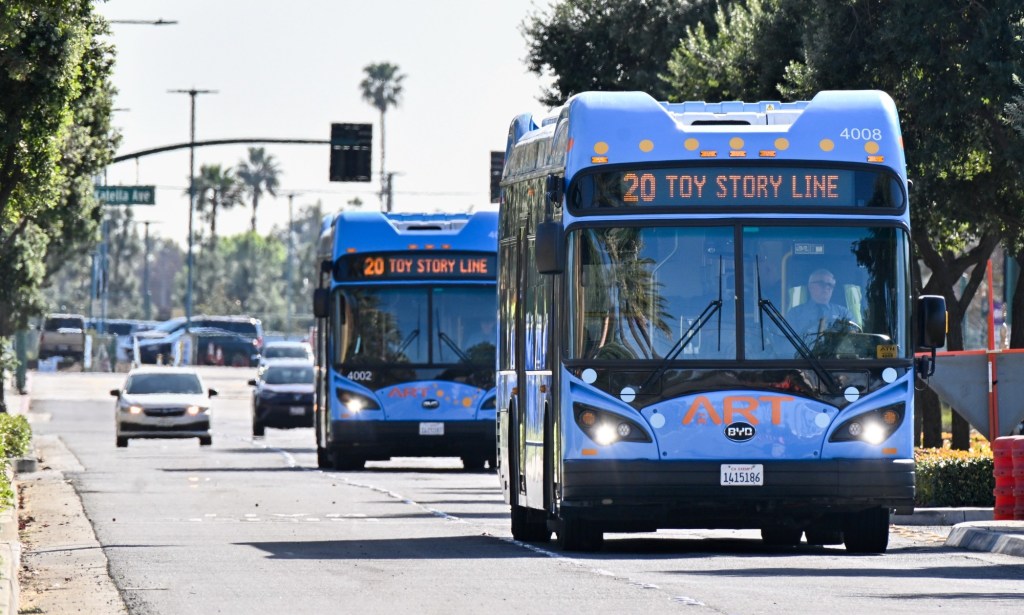
With the last day of operation for the Anaheim Transportation Network planned for Tuesday, how will the shuttle system’s more than 8 million annual riders get around the city’s popular resort district?
The network’s ART bus system has served the resort area’s hotels and Disneyland properties for years, as well as routes to the Anaheim Canyon Metrolink Station, the ARTIC station, downtown Anaheim and through the Platinum Triangle, but announced in January it couldn’t get its financial footing and would shut down March 31.
The Anaheim Transportation Network — it also ran the EVE, FRAN and Senior Wheels systems — launched in 1995 to provide a uniform transit system around the fast-growing resort area, which now draws more than 25 million visitors a year.
But maybe the answer for the future isn’t one system, but multiple solutions.
“You have the immediate, and then you’ve got near term, and then you’ve got longer term,” Anaheim spokesperson Mike Lyster said.
The immediate
ATN’s buses moving theme park-goers from the Toy Story Parking lot to the Disneyland Resort’s main gates represented about 83% of the transportation network’s total ridership for this fiscal year, or about 6.8 million riders.
Disney officials have said there will be continued shuttle service for their visitors, but as of Friday, they were not releasing details.
Also, the Disneyland Forward expansion of the theme parks includes a new parking structure that will make the parking lot obsolete in a few years.
The Orange County Transportation Authority has said half of the public agency’s bus routes travel through the city, shadowing 75% of ATN’s routes, with the remaining of the soon-to-be-extinct routes within walking distance of existing OC Bus stops.
“OCTA understands how important dependable transit service is for thousands of workers, residents and visitors in the Anaheim Resort area,” OCTA board chair Jamey M. Federico said in a statement ahead of ATN’s shutdown. “OC Bus has always been a safe, reliable and affordable option in Anaheim and the surrounding communities, and we welcome everyone on board.”
Several hotels serving the resort area are in the city of Garden Grove and its Garden Grove Tourism Improvement District, which will start a shuttle service of its own the last week of March. It is contracting with Parking Company of America.
The system will serve 10 hotels in Garden Grove, including the Delta Hotels by Marriott Anaheim, Great Wolf Lodge and Hyatt Regency. The tourism district, which collects up to 2.5% on nightly hotel stays, will contribute and guests using the shuttle will pay “a nominal fee, allowing multiple trips,” city officials said.
Near term
Anaheim officials, Lyster said, are having early discussions with operators about a “comprehensive or system-wide operator, some sort of successor to ATN.”
“But that’s certainly not something that’s going to happen by next week,” he said, and it’s just one possibility under consideration.
City councilmembers could be asked as soon as April to vote on buying two ATN properties with funds from the Anaheim Tourism Improvement District, which finances marketing and transit improvements around the resort area and Platinum Triangle with a 2% assessment fee collected on hotel stays.
The tourism district’s three-person transportation committee, made up of city, hotel and Disney representatives, decided to proceed with the process to buy the properties, which ATN board members also approved Wednesday at their meeting.
The properties —1354 S. Anaheim Blvd and 1213-1227 S. Claudina Street — collateralize $6.12 million in loans that the tourism district floated ATN in recent months to help alleviate its mounting budget deficits, so their purchase price is expected to be $6.3 million combined after accounting for the loan repayment. The lots would be city-owned, but used by the tourism district.
ATN has 74 vehicles in its fleet that will need to be unloaded. But their purchase is tied to federal grants that require they go toward public use.
The Orange County Transportation Authority “at this time (has) no interest in acquiring any of (ATN’s) assets,” agency spokesperson Eric Carpenter said.
The tourism district is in the early stages of considering the purchase of part of the fleet, which could likely be leased to a group of hotels, or go toward a new operator in the resort area, Lyster said, although nothing’s concrete. The purchases would be contingent on a City Council vote.
A few public agencies are interested in the buses, a transportation official said, and ATN will keep a handful of its staff on payroll until its assets are sold off.
And as of Friday, ATN officials said more than 70 of its bus drivers represented by the Teamsters Local 952 union were able to find jobs through other services offered by their employer, Parking Company of America.
ATN buses started rolling all those years ago to get hotel guests where they wanted to go without their cars on local streets. And in the years since, even more hotels have opened.
“We want to remain a high-quality tourism destination. We have an amazing convention center, an amazing resort destination, an amazing venue at OCVibe, Angel Stadium, and we just work well together,” said Wincome Hospitality Asset Manager and CEO Paul Sanford, whose firm manages The Westin Anaheim Resort. “It’s always been a magical group, and we want to keep it that way, so our challenge is to figure out how to do that and to not have a hiccup in the service.”
So a group of a dozen or so resort area hotels — including “some of the biggest,” Lyster said — are also working toward an independent shuttle system for their guests and are in the midst of selecting a provider.
Routes and specifics are still in the works, but Sanford is bracing for one detail that is pretty set: For hotels, “It’s going to be a lot more expensive.”
Hotels in the resort area paid into ATN based on the number of rooms. The transportation network, in hopes of surmounting its budget problems and offsetting rising labor costs, had increased last year what hotels paid annually by 5%, but did not want to go higher. Riders also paid a minimal fare.
“I’m told by vendors,” Sanford said, “that their costs could be as much as 50% to 100% more than ATN.”
Higher costs are expected for a smaller negotiating body, Lyster said, and “reflects that ATN was not covering its cost.”
The city of Anaheim last year considered taking over the struggling transportation network and signed a letter agreeing to explore the move. But officials said earlier this year the city was no longer interested in the takeover, and, instead, Lyster said the city is eyeing transit options to link multiple billion-dollar developments around Anaheim.
Long term
The $4 billion OCVibe development underway in and around the Honda Center — what developers hype as a new downtown for the county — is building 100 acres of restaurants, housing, offices, new concert venues, a dramatic Honda Center revamp and upgrades to the ARTIC station.
City officials have expressed interest in connecting the ARTIC station and OCVibe development in the Platinum Triangle to the resort area, with gondolas, trams and autonomous vehicles among the emerging transit options floated in recent years.
“We are at a stage right now where technology’s evolving, and we’re not sure which of those may be a viable alternative,” Lyster said, “but that’s another variable we have to look at as well.”
The resort area transit ecosystem is also expected to change in the coming years, with the $1.9 billion DisneylandForward expansion plan that promises to start construction later this year on a 6,000-space eastside parking structure, transportation hub and security screening area as a crucial first step.
DisneylandForward envisions then transforming the Toy Story lot into a mixed-use destination with hotels, retail, dining and entertainment.
There is so much to play out around the resort district now that the Anaheim Transportation Network is shutting down, “it’s a scenario where we have many variables there, which is why you can’t just solve for the long-term today,” Lyster said.
The most difficult part, he said, is “balancing” the planning.