
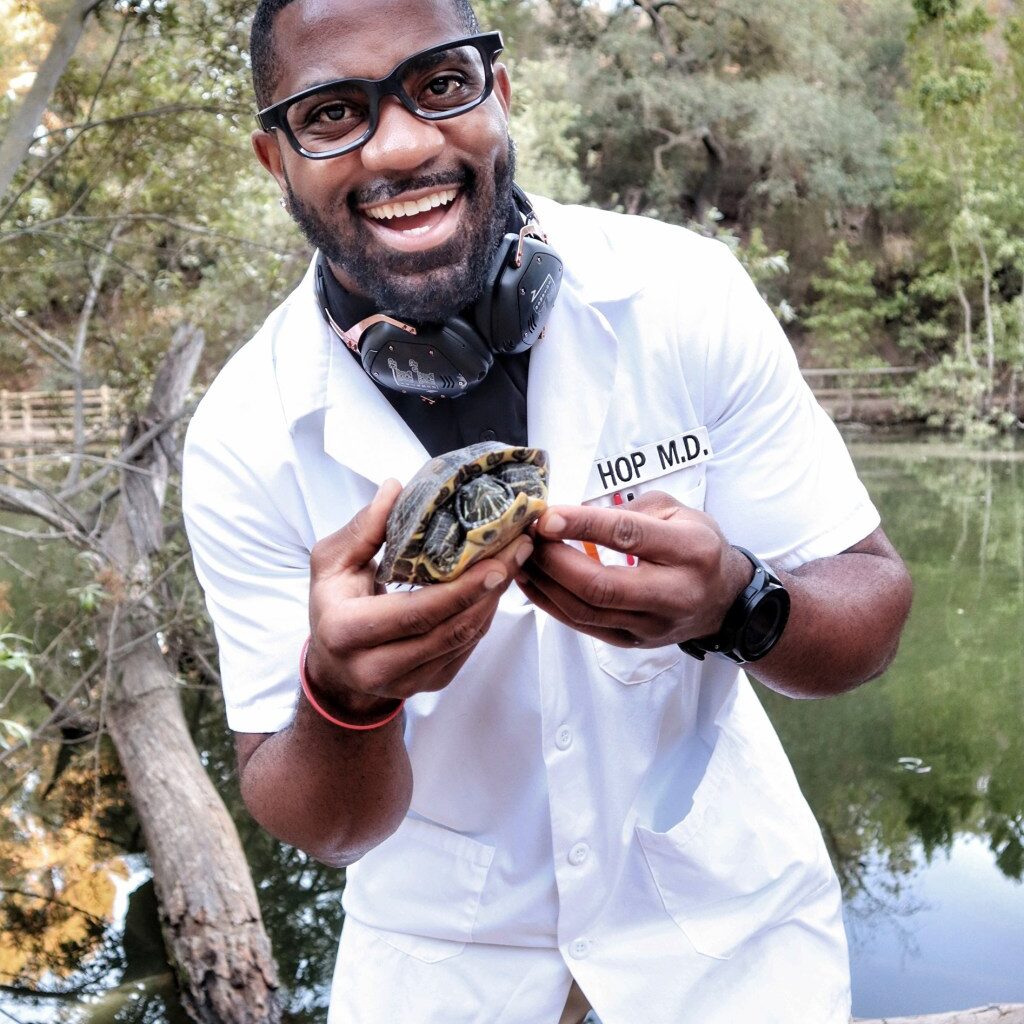
He was never afraid to get his hands dirty, to get up close and personal with any and every kind of critter and creature near his family’s home in Cameroon. And, Maynard Okereke’s mother supported her son’s excitement for wildlife and nature, even if meant having to shoot down some of his unusual requests for pets.
“There was a pond close to my house and I remember when I was around 7 years old, I’d catch frogs and snakes and salamanders, all sorts of insects; I just had this really big love for the natural world. I was very exposed to the outdoors environment, in nature, and that’s really where I fell in love with science,” he says. “I had these fact cards about wildlife that my mom bought me when I was little and they had all of these interesting, fun facts about animals. They were in pamphlets that I’d get in the mail every week or so, and I had this huge binder collection of all of these facts about animals and I used to memorize everything from scientific names to mating habits and locations and all sorts of interesting features about different organisms. That’s really what grew my love for science, just being fully immersed into the natural world and just having this love for nature.”
Unfortunately, there were unsupportive voices in his life as he got older and began studying at the college level, insisting that he should pivot away from his love of wildlife biology because there were no Black wildlife biologists anyway. He earned a degree in civil engineering from the University of Washington in Seattle, but he wanted to encourage minority kids to pursue studies and careers in STEM (science, technology, engineering and math) rather than doubting them the way he’d been doubted.
He eventually returned to sharing his love of science, technology, engineering and math through his online content, and became committed to encouraging young minority kids to continue cultivating a love of science. He started creating videos about science that were focused on it being quirky and fun, back in 2016, and posting them online. His following grew and people began calling him the “Hip Hop MD” even though he’s not a medical doctor. Today, he’s an award-winning science communicator creating educational science content on social media through his Hip Hop Science platform. He’s also channeled his love and excitement for science into a book, “Zombie Spiders and Asteroid Blasters: 16 Incredible Ways that Scientists are Changing the World,” and will be at the Central Library in San Diego at 4:30 p.m. Thursday to talk about the book, lead a science demonstration, answer questions, and sign copies of his recent work.
Q: What’s the premise of “Zombie Spiders and Asteroid Blasters” and what was the inspiration for this book?
A: The book is an exploratory children’s book. It’s really geared for ages 8 through 12, but I always say it’s a great all-ages book, which is one of the things I love about it. The focus of it is highlighting scientists that are doing unique research work in different areas of science, technology, engineering and math. I interviewed 16 different scientists that I found fascinating and who are doing some really cool, kind of quirky, off-the-wall research that you wouldn’t typically hear about, or typically even believe was actually happening. I talk a little bit about their journeys, what inspired them to get into the work that they’re doing, about myself as an animated character going through all these little fun facts, kind of taking you on this exploration about their work. Then, we do a Q-and-A with each of the scientists, learning about what inspired them to do their research, why they got into it, what their passions are, and what things they enjoy doing outside of science. I really love that portion of the book because it really gives students an insight and perspective, kind of mentorship or advice for young readers who may have an interest in an area they may not know how to get into, or maybe facing challenges on their own and it helps them to read about how others have overcome barriers and overcome obstacles. The scientists in the book also come from very diverse backgrounds — people of color, female scientists — so it’s a very relatable book. One of the big things on my platform that I love to highlight is representation in STEM and getting more Black and Brown voices involved in STEM fields. That was an area where I wanted to make sure that I highlighted Black scientists within the book, as well; they’re doing really cool and fascinating research, but overall, it’s a great read. Adults have been telling me how they love reading the book, as well, and just learning about some of the quirky, crazy science facts that are in there. It’s really an immersive way to be able to dive into, not only unique science facts, but also the genius minds behind these areas of research.
Q: In some examples on your website, you introduce young readers to the field of necrobotics by talking about the idea of zombie spiders. What are necrobotics and how did you learn about this area of study?
A: That’s one area that actually inspired this book. I did a video about this research work that I found out about where this engineer had started this whole new field of necrobitics using dead organisms as robots. About three years ago, I made a reel on my Instagram page about this area of research and I thought it was just incredibly fascinating. To this day, it’s still one of my favorite videos that I did, and that’s really the inspiration behind this book. When I learned about it, I was like, “This is crazy! Like, scientists are actually doing this work.” This is a brand new field and this is a young scientist who, at that time, had just begun her program in engineering and had this creative idea of possibly using dead organisms as robots, creating an entirely new field of necrobotics. For me, it was just a really cool way to not only learn about something amazing like that, but showcase how creativity plays such an important role in science — being able to think outside the box, think differently, to look at something and make observations. I mean, we’ve all seen a dead spider curled up in the corner of our room somewhere, but to actually look at that and then think, “Oh, I can turn this into a tool,” to me, is just really fascinating. It aligns with everything else in the book as far as unique research work, unique ideas, creative ideas where scientists are thinking outside the box and trying something new that could possibly have a really amazing impact on our planet for the better. That project, the necrobotics, is helping us explore nanotechnology, being able to utilize small instruments as robots, and it’s now possibly being used to create things that can use these tools for nanoparticles. It’s really just game-changing research that’s going to have an amazing impact on humanity and our planet.