
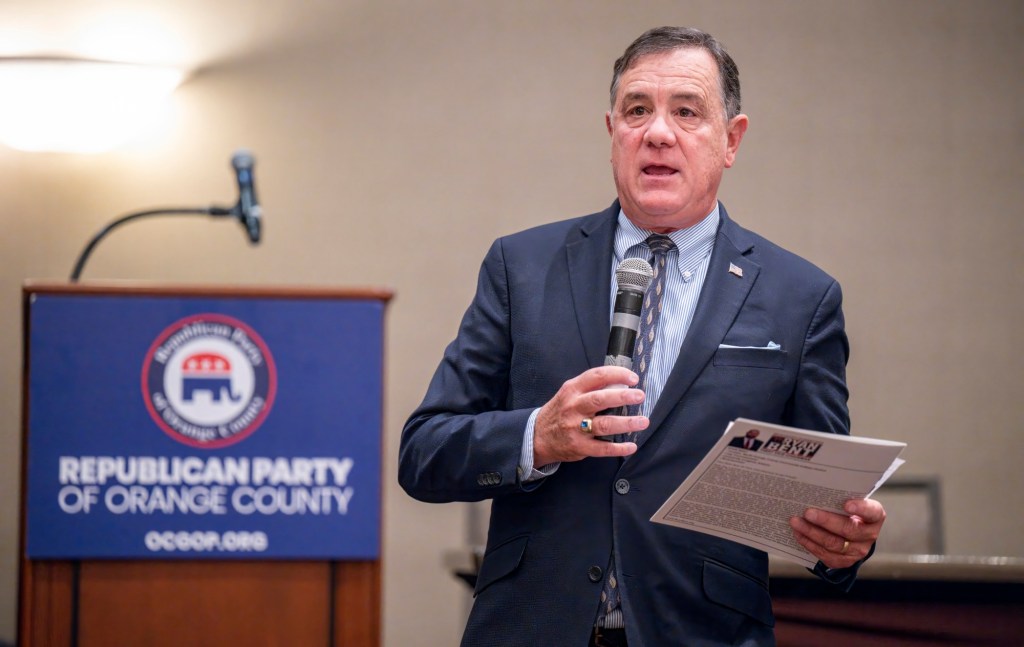
Democracy depends on fair elections. That is why, after the governorship, the Secretary of State’s office is the most important in California. In 2022, incumbent Democrat Shirley Weber was elected with 60% of the vote, defeating Republican Robert Bernosky’s 40%.
On the June 2 primary ballot, Weber faces three challengers. Two represent the Green Party: Gary N. Blenner, a teacher, and Michael Feinstein, a former mayor of Santa Monica. The third is Republican Don Wagner, an Orange County supervisor and former mayor of Irvine.
Under the state’s top-two primary system, Wagner and Weber will likely face off in the Nov. 3 general election. I interviewed Wagner recently as he traveled to speak at the Heritage Palms Republican Club.
“I will tell you, I am not blind to the fact I’m a Republican in California, and that makes it a challenge,” he said immediately, before I could even ask. “It’s like, okay, I can see a path, and I’m willing to work it. Republicans fall out of bed and get 40% on the statewide ballot.” Closing the gap to 51%, he said, “is a challenge.”
Wagner believes what is “resonating” are “voter ID and election integrity issues.” He is employing a novel approach: pairing his campaign with the California Voter ID Initiative 2026, a measure championed by Assemblymember Carl DeMaio’s Reform California group. Earlier this month, the campaign submitted 1.3 million signatures — well above the 875,000 required to qualify.
While CalMatters suggests Democrats will attempt to link the initiative to Donald Trump’s national “SAVE America Act,” Wagner remains nuanced. He supports the act, though he thinks it has been “loaded with extra sections involving immigration enforcement, which ought to be cut.” Polling remains a hurdle; a February Morning Consult survey found Trump’s approval rating in California sits at 37%, mirroring the 38% of the vote he received in 2024.
Wagner contends his record proves he can work with Democrats and independents. During his time in the Assembly (from 2010 to 2016), he noted that he passed more bills than any other Republican in his second and third terms. Furthermore, his roles as mayor and supervisor have been technically nonpartisan. Nevertheless, the “Trump Phenomenon” remains a defining force in the current political climate.
The fate of the Voter ID measure may ultimately depend on the financial influence of public-employee unions. While unions are expected to oppose the ID initiative, they are also preoccupied with the Local Taxpayer Protection Act, a measure backed by the Howard Jarvis Taxpayers Association. It, too, recently submitted 1.3 million signatures.
Additionally, the union-backed “California Billionaire Tax” may split the electorate’s attention. However, with billionaires funding their own opposition, unions may have to reconsider how they allocate their resources.
A UC Berkeley poll released March 19 showed California voters nearly evenly split on Voter ID: 44% in favor and 45% opposed. Notably, support was strongest among Spanish speakers (59% to 24%), while English speakers opposed it (44% to 41%).
“At every stop, I talk about Voter ID, number one, and then just general election integrity issues, number two,” Wagner said. He criticized Weber’s oversight of voter rolls, promising to coordinate with every county registrar: “I will visit every county registrar of voters and say, ‘What are you doing to clean your rolls?’”
To that end, he supports Assembly Bill 1764, introduced in February by Assemblymember Kate Sanchez, R-Rancho Santa Margarita, which would authorize the Secretary of State to work with the Social Security Administration to identify those no longer eligible to vote because they’re dead.
The Secretary of State also handles business registrations. Wagner advocates for cutting the $800 annual LLC fee—even for a new taco stand —arguing that such high costs suppress “opportunity.”
Regardless of the election’s outcome, Wagner is highlighting fundamental issues regarding the mechanics of representative government.
John Seiler is on the SCNG Editorial Board.