
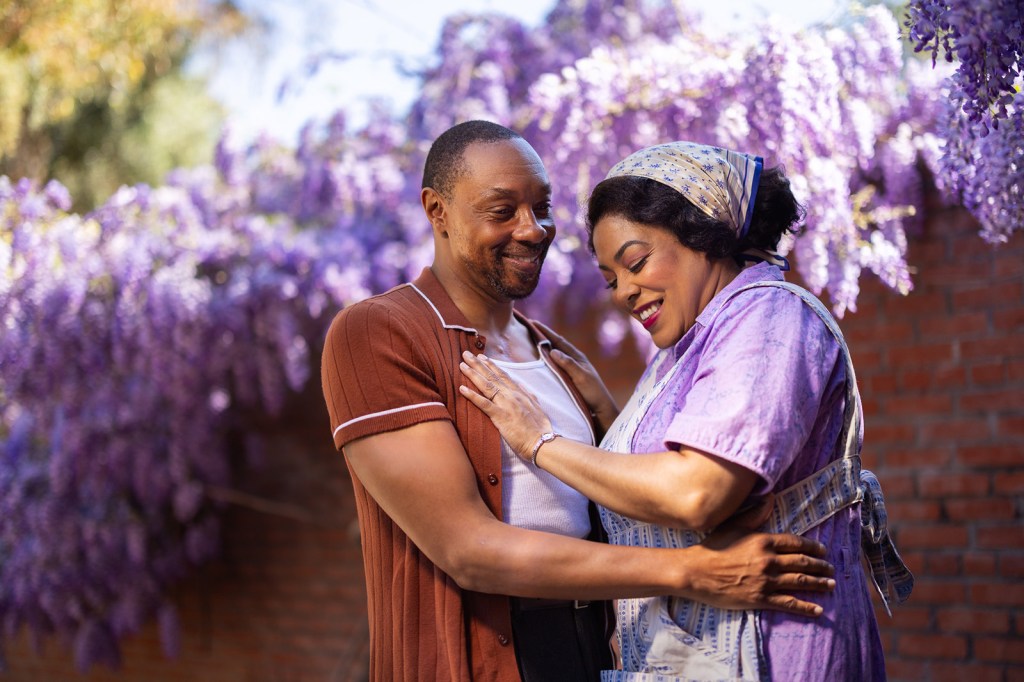
August Wilson wrote “Fences,” the sixth play in his 10-part “Pittsburgh Cycle,” in 1985. The story of a working-class family and its patriarch’s hopes, dreams and frustrations is set in the 1950s. Yet “Fences,” which won Wilson the Pulitzer Prize for Drama, could just as well be a tale of today’s times.
Dorian Missick, who’s portraying family breadwinner Troy Maxson in the Old Globe’s production of “Fences,” cites the play’s “generational struggles that we are still dealing with to this day: a dad wanting his kids to do better and sometimes leading them down the exact road he was trying to keep them off of; infidelity, and outside-of-marriage babies. What’s beautiful is that August has taken the story of this particular family and made it universal.”
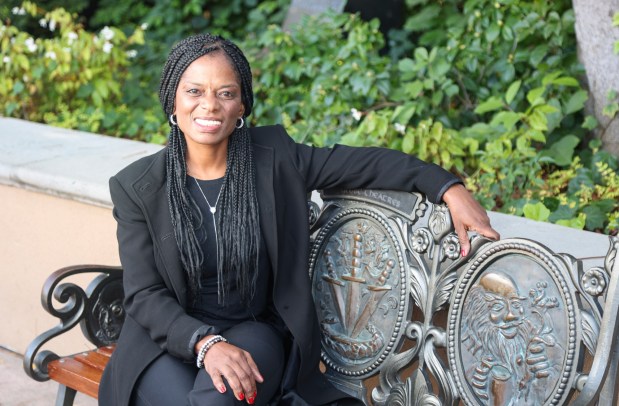 Delicia Turner Sonnenberg will direct August Wilson’s “Fences” for The Old Globe this spring. (Eduardo Contreras / The San Diego Union-Tribune)
Playing Rose, Troy’s wife Rose is played by De’Adre Aziza, who last performed in San Diego in La Jolla Playhouse’s world-premiere production of “Redwood” two years ago.
“For this Black family in 1957,” Aziza said, “there was political uncertainty. They were trying to make their way in an America that was just starting to hear the cries for civil rights. We’re seeing a lot of that today in a very different America, but yet the same in some ways.
“People will definitely see this slice of life about a family doing their best and the flaws that we all have as human beings.”
Delicia Turner Sonnenberg is directing “Fences” at the Globe, as she did last year with the hriller “Deceived” and before that Alice Childress’ “Trouble in Mind” in 2022 and Dominique Morisseau’s “Skeleton Crew” in 2017.
“Fences” was last staged locally in 2008 by Cygnet Theatre in its former Rolando space, a co-production with San Diego Black Ensemble Theatre. Sonnenberg directed that production as well, which starred Antonio TJ Johnson and Sylvia M’Lafi Thompson as Troy and Rose.
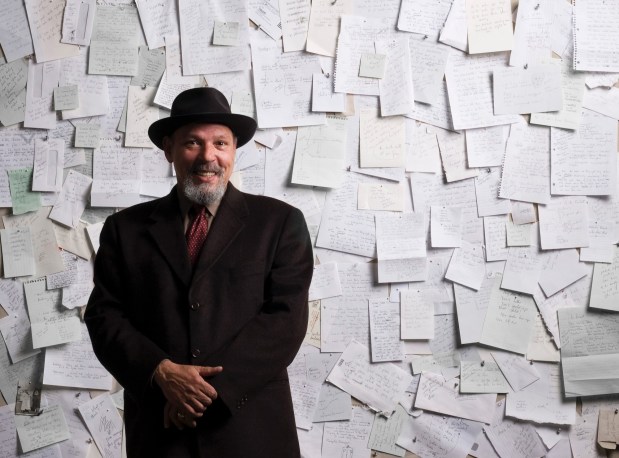 Playwright August Wilson, who passed away in 2005, wrote the play “Fences” in 1985. It will be presented at The Old Globe in April. (David Cooper)
In Wilson’s narrative, Troy is a onetime Negro League baseball star whose potential path to the Major Leagues was waylaid by the color barrier. In its aftermath, and with a prison record for committing murder during a robbery, he has become a trash collector. He’s a man caught between a disillusioning and violent past and complex relationships with his wife of 18 years, his teenage son with Rose, Cory (Omari K. Chancellor), a son from a previous marriage (Mister Fitzgerald), and a younger brother who was injured in World War II (Donathan Walters).
“He’s got a lot of emotional fences in order to protect himself,” said Missick, referencing Wilson’s title. “It’s a way to ward people off. The idea that someone (his wife Rose, who feels the marriage slipping away) could be using a fence to keep someone in is not a concept that he fully grasps until it’s too late.”
Aziza regards Rose as “a strong woman who makes a choice to settle down into tradition. She loves Troy’s strength and his larger-than-life energy. She didn’t know she’d be quite so consumed by it. She made a choice to choose a man as confident and as large in spirit as Troy and felt like he would make a safe place for her, and it was, for 18 years.”
“It takes a strong woman to take on that role and say, no matter what, this is what I’m going to do in this marriage.”
Aziza has drawn on her personal history in playing Rose.
“All of my characters I pull from the women in my family,” she said. “Strong women who really did not play games. They were not timid women at all.”
Fences” is one of the 10 plays that make up Wilson’s American Century Cycle, with each play about the Black experience set in a different decade of the 20th century. Three of these cycle plays — “Two Trains Running,” “The Piano Lesson,” and “Joe Turner’s Come and Gone” — had pre-Broadway tryouts at the Globe from 1988-1991. The plays are characterized by their uncompromising portrayals of the Black experience and the playwright’s dexterity of language.
“August was a poet and a playwright,” said Missick, “and it’s clear in the writing (of ‘Fences’). The dialogue is poetic in the way that Black people have been poetic since Day One. It’s a generational rhythm that we all have and one that we speak and we understand.”
Structurally, “Fences” is a lean work, Missick said. “There’s no fat. You have to pay close attention to what every character is saying, because there’s no conversation that doesn’t have a payoff or significance to the greater themes of the play.”
“Fences,” Missick said, is also a play that offers connections.
“What I love about stories that are so culturally specific,” he said, “is that what you end up realizing is that we’re all people trying to do our best in this world with the tools that we’re given, and we don’t always land in the greatest spaces, even when we are trying our best.”
“You can find yourself in this play. We don’t have to look like you or be from someplace you’ve never been.”
August Wilson passed away in 2005 at only 60 years old. Were he to somehow walk into this “Fences” rehearsal room, “I would say ‘thank you,’” Aziza said, “because since I was a little girl I have loved August Wilson. I saw ‘The Piano Lesson’ on Broadway when I was little and I identified with the people on stage and that rich text. I hear it in my family members. I appreciate having this classical text now, as a professional actor, when I can speak in a vernacular that feels like home to me.”
Missick offered that “I would definitely thank him as well, but I think based on his writing he seems like the kind of dude I could sit down and have a couple of beers with. So I’d invite him to my local cigar bar and say, ‘I want to pick your brain about some things, man.’ I feel like we’d really get along.”
‘Fences’
When: Previews, Saturday, April 3, through April 8. Opens April 9 and runs through May 3. 7 p.m. Tuesdays, Wednesdays and Thursdays; 8 p.m. Fridays; 2 and 8 p.m. Saturdays;, 2 and 7 p.m. Sundays
Where: Old Globe Theatre, 1363 Old Globe Way, Balboa Park, San Diego
Tickets: $40 and up
Phone: 619-234-5623
Online: theoldglobe.org