
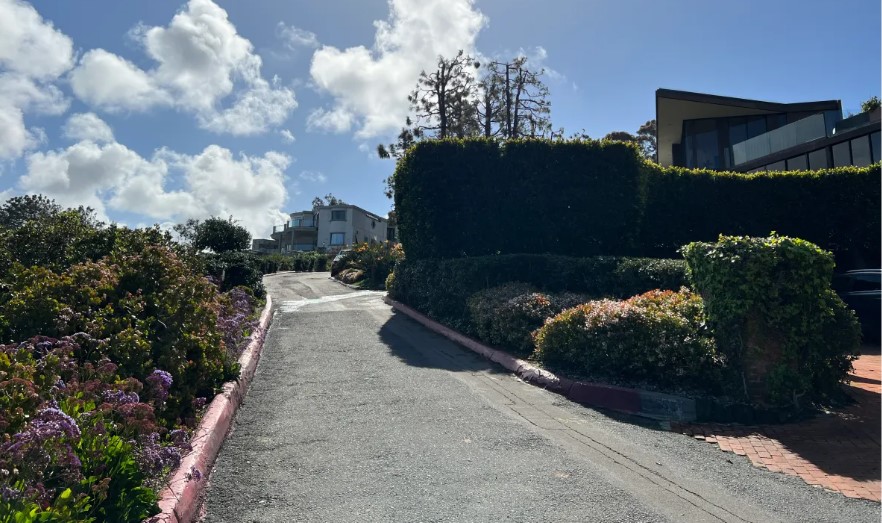
A lawsuit pertaining to La Jolla’s Coast Walk looks for an answer to a question that technically has been unresolved since the 1800s.
The suit was filed against the city of San Diego in Superior Court in September by a trio of limited liability companies, or LLCs, managed by Coast Walk residents Teall and Carolyn Edds. It seeks a definitive ruling on where property lines begin and end and where the public right of way is so the Eddses can remodel and add to the rear of their home at 1585 Coast Walk and link the adjacent property (which they also own) to it.
Coast Walk is a small street with only a few houses that runs parallel to and is accessed from Torrey Pines Road. It fronts the entrance to the publicly accessible Coast Walk Trail.
The Edds’ legal counsel, Robin Madaffer, said “The point of the lawsuit stems from the fact that there is a dispute between the city and the property owner about the exact location of the right of way and what is public vs. private. That really is the crux.”
She said her clients’ position is that the public right of way is the paved area that connects Coast Walk to Coast Walk Trail, based on a map from the 1880s and the fact that it has been improved by the city of San Diego and is used by the public.
“The city believes it extends beyond the paved area and toward the Edds property,” Madaffer said. “That creates an uncertainty about where the property boundaries are. The city doesn’t know and the surveys are inconsistent.
“When the city was making maps, they made assumptions about where highways and utilities would go, but throughout La Jolla, the city didn’t take up what was drawn. So we’re dealing with things that could have been resolved back then.”
City representatives did not have an immediate comment.
The suit followed an application for a coastal development permit to build on the Edds’ property that has yet to be approved because of the boundary line question.
The La Jolla Community Planning Association narrowly supported the proposed project in 2023. But soon after, the city offered different rulings unfavorable to the Eddses as to where the boundaries are and where the couple could develop.
“We reached a point where we have no choice but to agree to disagree with the city and have the judge make a decision,” Madaffer said. “We have been working with the city for years but still do not have approval of the coastal permit. The city cannot grant the CDP because of these opinions.”
But issues that surround the project are causing concern for others in the area.
An objection was filed against the plan by neighbor Kristin Churchill, who told the La Jolla Light that the Eddses “are taking a restrictive view of what the public has the right to access.”
She added that Torrey Pines Road and Coast Walk would be impacted during construction and once the project is complete.
“The project would limit access from Torrey Pines Road,” Churchill said. “It should be available for people to access.”
She took her concerns to the La Jolla Traffic & Transportation Board during its March 18 meeting.
“I think this should be alarming to both the public [and] to this committee,” she said. “And I ask that perhaps we put it on next month’s agenda so we [can] explore further and see if there’s anything this committee can weigh in on or do.”
While waiting for the litigation to be settled, the Eddses put up signs along the paved area and the trail telling pedestrians there is no beach access and to stay away from the bluff edge.
The signs also state that “Right to pass [is] by permission and subject to control of owners.”
Some say that gives the impression the area is not open to the public.
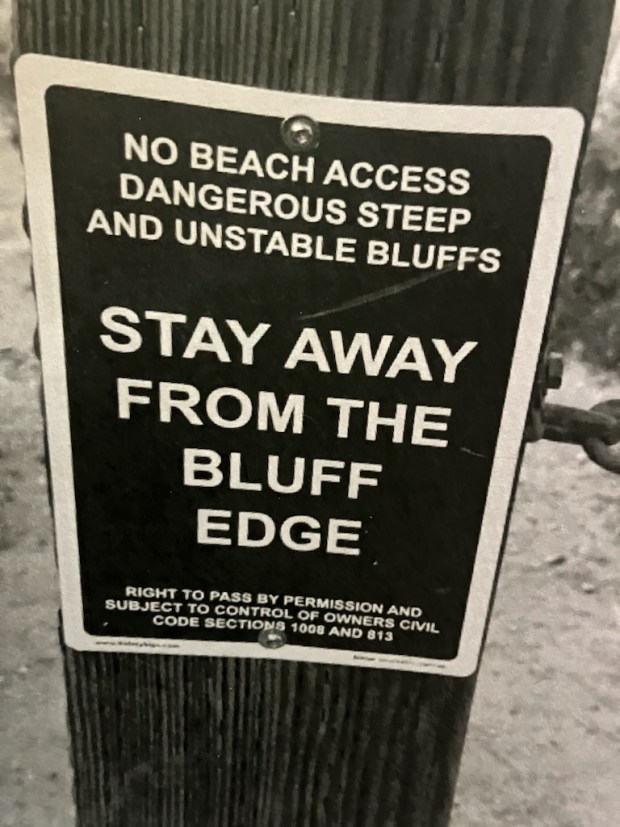 Signs have been posted on Coast Walk that some people believe give the idea the area is not open to the public. (Melinda Merryweather)
Local resident Melinda Merryweather said at the March 23 La Jolla Parks & Beaches meeting that “there are signs being put on Coast Walk … with no permit from the city” that she’s concerned give the impression the trail is partially private.
Churchill said one of the signs is in front of her property, “which looks like I put it in. I taped over the [right to pass by permission] part, but someone took the tape off.”
Madaffer contended “those notices are allowed by state law. It puts the public on notice that they are using that land with permission. From a legal perspective, it is important for liability issues or should someone get hurt.”
She added that the signs “do not change anything about who is allowed to access that area. When people noticed these signs had been put up, people said it was an attempt to limit public access. The signs make it clear that access is allowed.”
Rather, she argued, her clients want access to be improved and are willing to assist with that.
“But before someone makes that kind of investment, we just need … to settle the dispute by a judge with no vested interest one way or the other,” Madaffer said.
A hearing date for the lawsuit has not been set. ♦