
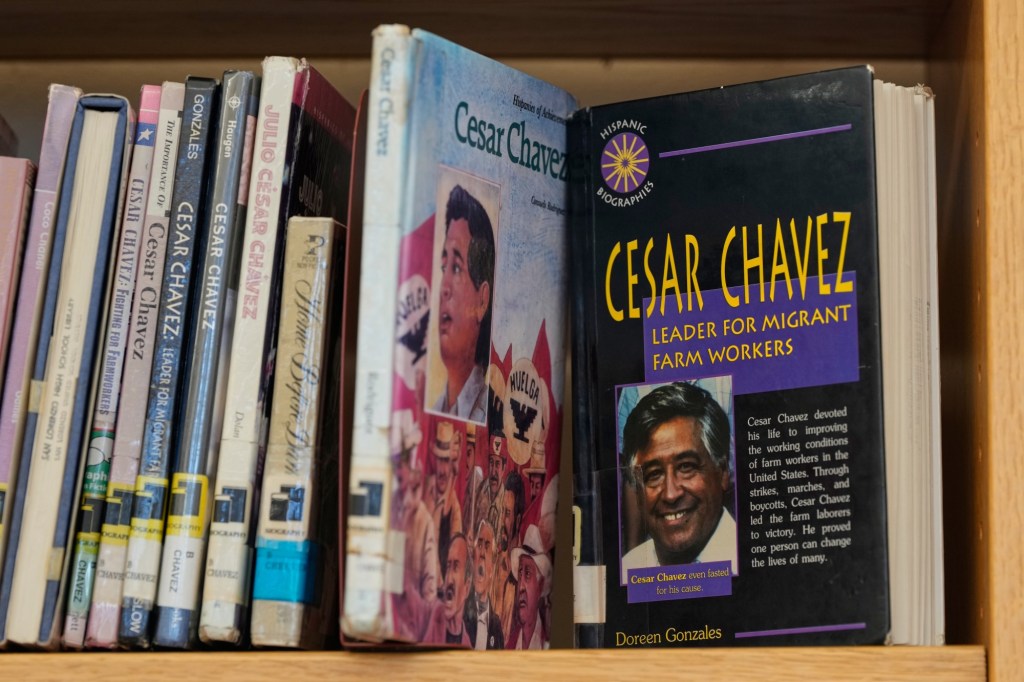
For social studies teacher Brian Tabatabai, it began like any other school day.
His El Monte High School students filed into class. But soon, Tabatabai’s devices lit up with unexpected news: Cesar Chavez, the late Latino labor rights leader, had been accused of sexual misconduct.
RELATED: Cesar Chavez sex abuse scandal is a blow for many Latinos, immigrants and labor rights advocates
The New York Times published its explosive investigation about decades worth of allegations against Chavez on Wednesday, March 18, detailing sexual assault and rape the leader was accused of committing against women — and girls as young as 12. Dolores Huerta, a co-leader of the farmworkers movement alongside Chavez, soon alleged that she had been raped by Chavez twice in the 1960s, and that he fathered two of her children that were adopted to other families.
For Tabatabai, it was clear that the allegations needed to be addressed with students right away.
“I knew that it was going to be all over their social media,” the teacher said Thursday, March 26. “I knew that there were going to be a lot of different opinions and so I wanted my students to be informed.”
Across Southern California, some schools and universities reacted quickly to the news, taking steps to effectively eradicate any hint of his presence from their campuses, websites and other materials. Many said they had already begun discussing how to handle lessons on Chavez’s role in the farmworkers movement.
As for Tabatabai, he sat students down to begin to recontextualize the legacy of Chavez, who until that day had been regarded as an unshakeable icon in California history.
That conversation, Tabatabai said, was just the start of what will be a long-term reframing of how educators teach about Chavez and the farmworkers movement — something teachers across the state already have begun to reckon with since the allegations arose.
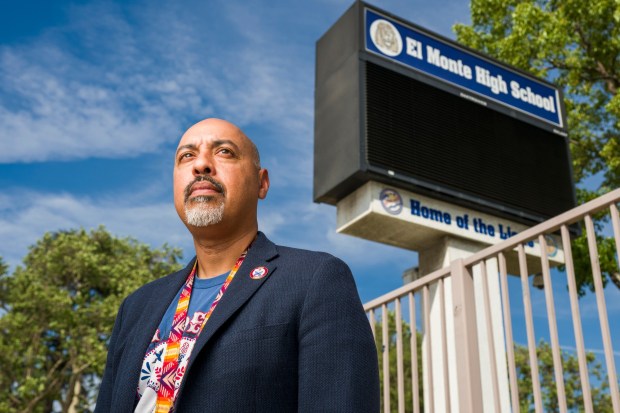 Brian Tabatabai, an ethnic studies teacher at El Monte High School, is seen Friday, March 27, 2026. Tabatabai and other educators are looking at how to reframe how they teach about the Cesar Chavez after the allegations of sexual assault and rape against the late labor leader. (Photo by Leonard Ortiz, Orange County Register/SCNG)
“… In ethnic studies, we do teach about gender roles, we talk about patriarchy, and machismo in the Latino community,” he said, “and I think he’s going to end up being part of that unit.”
The allegations against Chavez rocked Southern California, where his legacy has been extensively memorialized with murals and statues, on government buildings and in the names of parks and schools. He had a statewide holiday on March 31 but it was promptly renamed recently as Farmworkers Day. Chavez was also a key figure within California’s educational curriculum.
In the Torrance Unified School District, an administrator told teachers to leave Chavez’s name out of lessons for now.
“Please continue to recognize the efforts, historical struggles and contributions of California farmworkers in your instruction, where appropriate, but refrain from including Cesar Chavez in your instruction,” wrote Scott McDowell, the district’s director of state and federal projects.
The letter urged teachers to answer students’ questions about Chavez with “an age-appropriate response, and then move on.” It said there was no need to “remove references to Cesar Chavez from your textbooks.”
In a Thursday, March 26, statement, the Torrance district emphasized something that other school districts also said: that its lessons and materials are based on the California History-Social Science Framework, which lays out what students should learn on myriad subjects.
The first mention of Chavez, according to documents on the California Department of Education’s website, is listed in the guidelines for fourth grade — when the lessons focus on California history. Other mentions appear for ninth and 11th graders.
Those guidelines, though, don’t mandate that educators focus on Chavez. Instead, his life and legacy are viewed as a jumping-off point that teachers can use to discuss the farm labor movement and the role of immigrants in it.
Tabatabai, the El Monte High teacher, said that’s exactly how he’s used Chavez in his lessons: to begin a broader conversation about the farmworkers movement and other prominent figures like Huerta and Larry Itliong, who began organizing farm laborers in the 1930s. The goal, he said, is to make sure students understand that civil rights movements are made up of more than just one figure.
“I actually think in terms of the curriculum, it’s going to improve what we teach, because one thing that I think most folks and the curriculum doesn’t really emphasize is the solidarity of Filipino and Mexican migrant farmworkers,” Tabatabai said.
History, he said, can begin to move away from the legacy of “one great man,” and instead focus on the thousands who came together to change society.
“When you understand it through that lens, then it also empowers the students to say, ‘Hey, we can also organize in these ways,’” Tabatabai said. “’We can also mobilize people into a movement. We don’t have to wait for this great man of history to show up.’”
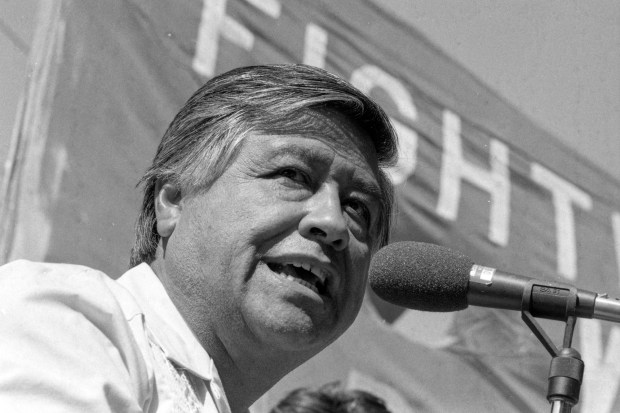 Educators across the state are considering how to teach about late labor leader Cesar Chavez, seen Sept. 26, 1984, in San Francisco, in light of sexual misconduct allegations that became public this month. (AP file photo by Eric Luse/San Francisco Chronicle via AP)
To that effect, the state Department of Education said in a Friday, March 27, statement that it is compiling a list of resources to help educators move away from teaching about Chavez specifically, to instead focusing on the broader farmworker movement.
But for some, including those at Osceola Street Elementary School in Sylmar, instruction has already begun to shift, Principal Jose Velasquez said.
“We honor the farmworkers — that’s who we always should honor, because of what they do for us in providing a safe and just food supply system,” he said Thursday, March 26. “So that commitment to that message is what my teachers did.”
At the elementary level, he added, the allegations against Chavez are largely not part of classroom discussion.
In Long Beach, the news hit particularly hard at Cesar Chavez Elementary School — which not only bears Chavez’s name, but is also home to several murals of the leader, who has been featured heavily in school teachings about farmworkers, Principal Brenda Ocampo said.
“When I first heard about it, I think so many things came to mind, and I think there are so many layers to this,” Ocampo said Friday. “As a Latina who grew up learning about Cesar Chavez and holding him in high regard, it was devastating. There’s been a lot of grief, even just amongst Latinos.”
Ocampo, though, said she quickly pivoted from grief to figuring out how the campus would deal with the revelations. It quickly covered murals featuring him, then began to change its teaching. Lessons focused on Chavez, especially heading into the March 31 holiday, which was once named for him, Ocampo said.
Students previously learned about Chavez and farmworkers via read-alouds, activities highlighting his contributions and discussions on why the school was named for him.
News of the allegations immediately brought Ocampo’s students to her mind.
“I thought about, ‘What am I going to tell them?,’ ” Ocampo said. “How do I correct the messaging that I just had given a week ago? I was saying he’s great and he’s done all these great things. How do I begin to explain that to students and what message do I want to send to my students?”
The school broke the news to students that there had been a change in Chavez’s legacy in an age-appropriate manner via its “Sea Lion News” weekly broadcast. Teachers and faculty were urged to maintain normalcy leading to March 31.
“For some kids, it’s like the physical change of the school that they had questions about. Especially with the little ones, like ‘Why are they taking (the murals) down?’ That made it a lot more real for them as well,” Ocampo said. “I said, ‘We have to go through this change. I also told the students, ‘We are OK. We did not do anything wrong. You did not do anything wrong as children.’ ”
The changes were slightly easier for older students to understand, Ocampo said, because they could have more nuanced conversations at school and at home.
“It felt really important that they also understood that we are more than a name. The students, community, teachers, we’re the heart of the school,” Ocampo said. “So while there might be physical changes to our environment, who we are as a school has not changed.”
Teaching about history has never been easy.
For generations, students have learned about complex historical figures who, despite their positive contributions to society, were inarguably problematic, hateful or bigoted while alive.
The Inland Empire Council for Social Studies, which provides educational resources and advocates for teachers in the region, said in a Friday, March 27, statement that teaching history properly requires teaching it completely.
“In a not dissimilar fashion, Columbus Day is also now in some places Indigenous Peoples Day,” the council wrote, adding that it uses both names. “Washington, Jefferson, and Madison (the architect of the Constitution) were slaveholders. Historical accuracy (while avoiding ‘presentism’) is always complex.”
Such nuanced conversations about the complicated legacies of historical figures are more likely to occur in college classrooms.
While the California State University system, which has 23 campuses, requires certain objectives be met through general education requirements, it doesn’t mandate teaching about specific figures.
“We rely on faculty experts to teach their discipline and if they feel appropriate to teach or not teach about a figure, such as Chavez, within their disciplinary context, that’s up to them,” Cal State spokesperson Amy Bentley-Smith said Thursday, March 26.
Miguel Zavala, an associate professor of teaching at UC Riverside, predicts that university courses will focus on two things moving forward: The way the farmworkers movement was built and a critical reflection on the roles racism, class exploitation and patriarchy played out in that movement.
Learning about the complexity of historical figures, Zavala said, will lead to a better education for students.
Erasing Chavez completely, he added, would be too easy.
Students should be encouraged to think historically, Zavala said, and to approach larger themes of colonization, erasure, power and to reflect on the way movements are shaped and the contradictions that occur within them.
“How we teach, and what we do with that erasure,” Zavala said, “matters as much as the erasure, the contents of what’s being erased.”
El Monte High’s Tabatabai, agreed, citing concerns that there will be pressure to completely remove Chavez from history books.
“I worry that this will give people permission to continue to not teach (the farmworkers movement) and possibly, (for) the state to say, ‘We’re just going to remove this from the curriculum, period,’ ” Tabatabai said. “I think that our classroom shouldn’t shy away from these things, because our students need to be prepared to be in the world and to be empowered to speak out.”
Despite the changes in lessons that are ahead, he said he was glad the allegations emerged.
“I’m happy that Dolores (Huerta) made the decision to speak,” Tabatabai added. “And hopefully the next generation doesn’t feel like they have to hold these things secret.”