
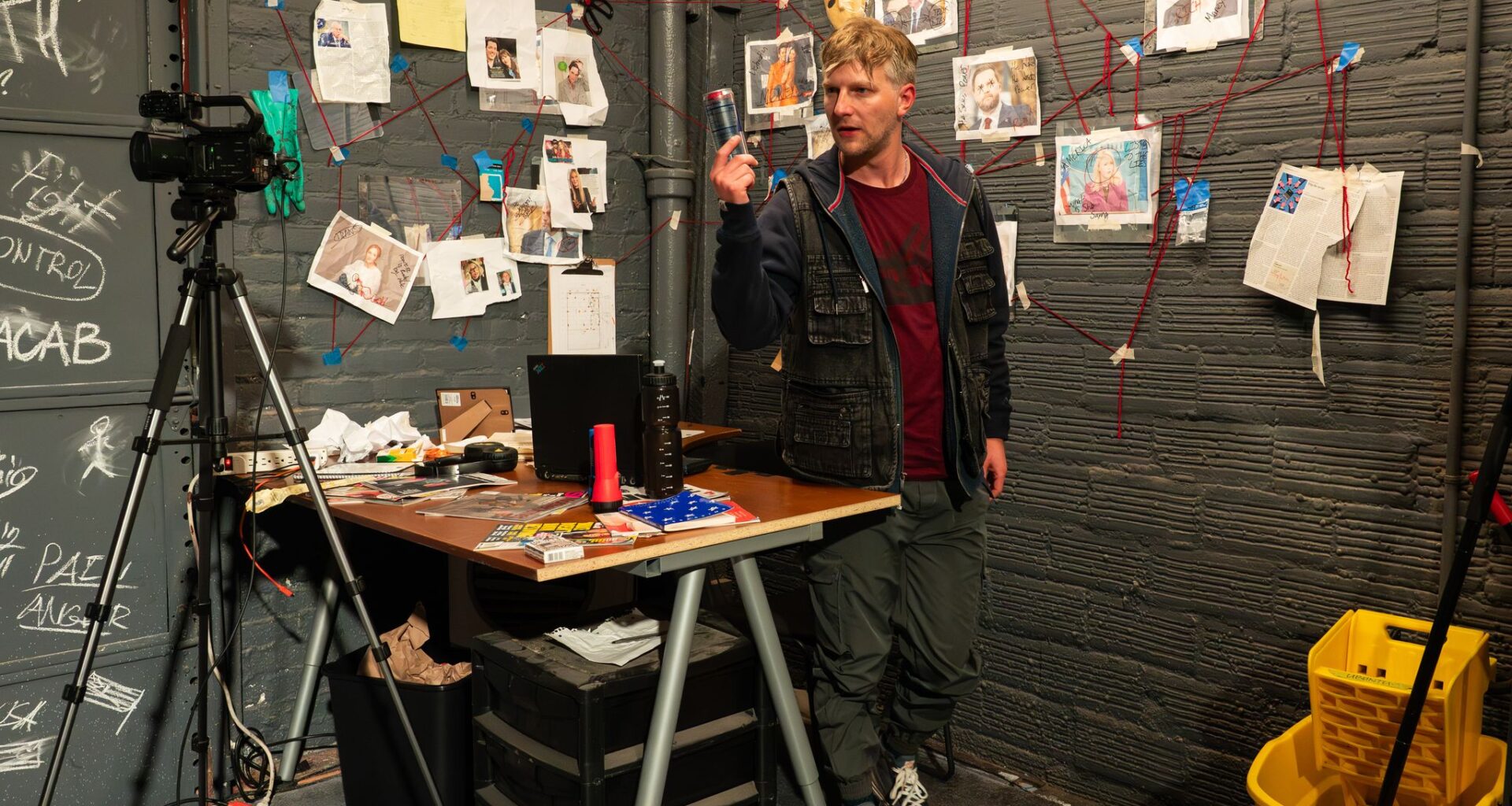
Adam KuveNiemann delivers a career-defining performance in Oakland Theater Project’s “Assassins.”
Ben Krantz Studio/Oakland Theater Project
The prospect of a solo musical might sound like a lot of high-speed windshield wiping: constant swiveling back and forth to play multiple characters in a dialogue or duet.
Perhaps unavoidably, there’s plenty of that in Oakland Theater Project’s marvelous one-man “Assassins,” John Weidman and Stephen Sondheim’s 1990 musical, about would-be and actual presidential assassins, that’s usually cast with about 10 actors. Whirling from John Hinckley Jr. to Lynette “Squeaky” Fromme, John Wilkes Booth to Lee Harvey Oswald, actor Adam KuveNiemann gets the kind of costume-drenching workout usually reserved for chorus line dancers.
But the show, which I saw Saturday, March 28, isn’t just-cuz gimmick or empty sweaty spectacle. Instead, director Weston Scott’s concept deepens the text, making the addled, voice-hearing brain that could commit or attempt assassination all the more real and dangerous.
Article continues below this ad
Adam KuveNiemann is like a one-man band in “Assassins.”
Ben Krantz Studio/Oakland Theater Project
KuveNiemann is frightening before he first speaks or sings, just stalking the conspiracy theorist’s lair of Sam Fehr’s set design, with printed out photos taped to a wall and connected with a web of dark red yarn. Scrolling on his phone, setting up various laptops and camcorders, and testing out projection screens, he has the air of one who’s made many bombs out of garbage while rattling off “just doing my own research” rants.
“Assassins”: Book by John Weidman. Music and lyrics by Stephen Sondheim. Directed by Weston Scott. Through April 5. One hour, 55 minutes. $10-$70. Flax Art & Design, 1501 Martin Luther King Jr Way, Oakland. 510-646-1126. https://oaklandtheaterproject.org
Music pipes in from tinny computer speakers via a playlist, seen through a projection, of the off-Broadway cast recording. As track one begins, a copy of the script flutters down from the ceiling. KuveNiemann picks it up and follows along, starting to bop on the lyric “Everybody’s got the right to be happy.” Then, when he joins in the recorded singing, it’s with a slow turn toward us and a possessed glint in his eye. This mysterious lost soul has found his cult and his missalette, and it’s pouring rocket fuel in his veins.
San Francisco Chronicle Logo
Make us a Preferred Source to get more of our news when you search.
Add Preferred Source
All those projections and devices make for a staging playground. Sometimes KuveNiemann embodies multiple characters by holding the camera up to his face for one and peeling it away for the other, such that we look at the projection for one voice and his in-the-flesh face for the other. In another scene, two mics on stands represent Fromme and Sara Jane Moore, who each tried to assassinate President Gerald Ford mere weeks apart in 1975. At first, as KuveNiemann darts back and forth across the stage, the forced pauses make the pair’s “Beavis and Butt-Head”-style dialogue all the loopier — like they had to think really hard before coming up with each bit of idiocy. Then, as the two warm to each other, KuveNiemann moves the mic stands closer to each other — like flirtatious strangers scooching close on a park bench.
Article continues below this ad
Scott also makes a one-of-a-kind funhouse out of mirrors. They become puppets or dance partners. Sometimes, we’re not looking just at a projection; KuveNiemann positions all his props in such a way that we see a projection of a reflection. In another moment, he holds a mirror to one cheek and his camera to the other, with the resulting pore-magnifying projection creating a trifold of his face. The effect of all these wildly inventive choices is of a splintered consciousness — and of an image that’s been photocopied so many times its pixels have become blobs. No wonder all these characters wanted to become assassins, Scott implies; they’re removed from reality by so many orders of magnitude that living, breathing fellow humans are just blurry images.
Adam KuveNiemann plays multiple characters in “Assassins,” a musical that’s usually cast with about 10 actors.
Ben Krantz Studio/Oakland Theater Project
And then there’s the moment when KuveNiemann is Lee Harvey Oswald, and eight other assassins are represented by individual props on the floor. Gesturing among the objects, toggling among rich accents, KuveNiemann is like a one-man band, but one where all the instruments swallow the player. If his singing throughout the show often strains, that plays into the overall idea: We’re seeing a man worn down by grievance till he snaps.
We Americans love touting our democracy and free market, but “Assassins” insists we reckon with the dark side built into our system: If we’re truly the land of the free and you don’t achieve here, you have no one but yourself to blame. That rage doesn’t go away. It festers as part of a long, continuous line. In bringing the show into the era of Thomas Crooks, who attempted to assassinate then-former President Donald Trump, Oakland Theater Project suggests just how many other terrible chapters “Assassins” could have in the future. Just look at KuveNiemann’s crooked grin, frozen, faraway eyes and twitchy bearing. If the American experiment doesn’t finally make a place for him and his ilk, they’ll mow down their own.