
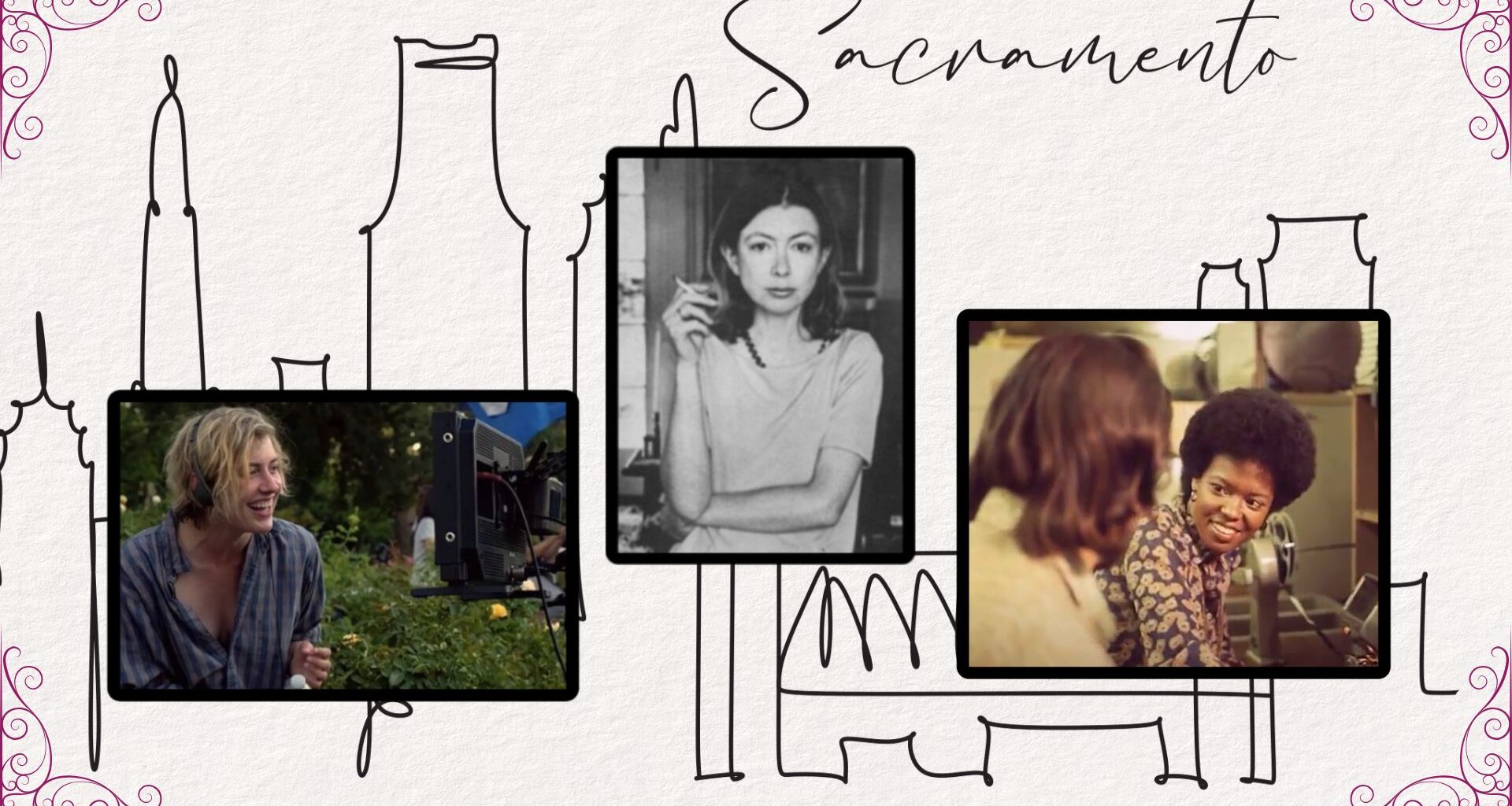
Sacramento has a rich artistic culture shaped by decades of creative work. One perspective has long helped portray the city’s charm to the outside world: the lens of women who have made Sacramento what it is today. Through women writers, film makers and journalists, Sacramento has been defined and elevated through a female gaze.
Joan Didion is one of Sacramento’s most notable literary figures, whose work reflects deep admiration and nostalgia for the city. During her career, she received numerous honors, including the National Book Foundation’s Medal for Distinguished Contribution to American Letters, National Book Award in Nonfiction and National Humanities Medal from former President Barack Obama.
Her Midtown childhood appears throughout her writing, including in ”Let Me Tell You What I Mean,” where she describes an “obsessive” yearning for Sacramento while in New York.
“In order to discover what was on my mind I needed room,” Didion said in her book. “I needed room for rivers and for the rain and for the way almonds came into blossom around Sacramento, room for irrigation ditches and room for the fear of kiln fires, room in which to play with everything I remembered and did not understand.”
RELATED: Community blooms at flower event celebrating Women’s History Month
Despite her fondness for her hometown, she writes about it with both love and criticism. In “Slouching Towards Bethlehem” she relates the city to the biblical garden of Eden while also acknowledging its harsher realities.
“It is assumed that those who absent themselves from its blessings have been banished, exiled by some perversity of heart,” Didion said in her book.
Didion portrays Sacramento through a deeply personal lens that reflects her affection for the city. Many residents share her sentiments, while others are introduced to the city through her work.
Her national recognition underscores her impact on Sacramento, reflected in local memorials honoring her.
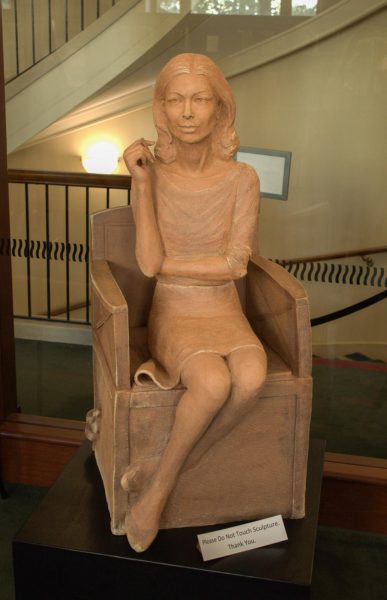 The work of Joan Didion is honored through a statue held in the Sacramento Room of the Sacramento Central Library Wednesday, March 18, 2026. Didion went on to win three awards and inspired future Sacramento related films such as “Lady Bird.” (Janelle Germain)
The Sacramento Central Library houses a statue of Didion in its Sacramento Room which explores the history of the city. Artist Lisa Rienerson created the statue, depicting Didion seated with a cigarette. The library also features a showcase honoring “a Sacramento daughter.”
Didion’s influence extends to other Sacramento artists, including director Greta Gerwig. Gerwig brought her vision of Sacramento to audiences in her 2017 film “Lady Bird.”
Featuring the coming-of-age experiences of a Sacramento teen in the 2000s, self-named Lady Bird explores growing up in the city, the social aspects that shape her surrounding community and her unstable family relationship.
The film opens with Didion’s quote, “Anybody who talks about California hedonism has never spent a Christmas in Sacramento,” setting the tone for Gerwig’s beloved town.
The main character expresses disdain for her hometown to her classmate at Immaculate Hearts Catholic High School and longs to leave for college in New York.
“Because it’s soul killing. It’s the Midwest of California,” Lady Bird said in the film.
Through humor and teenage angst, Gerwig explores the feeling of being trapped by familiarity. By the end of the film, Lady Bird reaches New York but begins to recognize Sacramento’s importance.
RELATED: Community blooms at flower event celebrating Women’s History Month
Prompting her to call her mother and express the moment her relationship with her hometown shifted, recalling the first time she drove in Sacramento she reveals how “emotional” it made her, changing her perspective on “all those bends” she’d known her whole life.
Filmed primarily in Sacramento, the movie captures the city’s landscape and offers a rare big-screen portrayal.
It features locations familiar to 2000s-era residents, creating a nostalgic time-capsule.
Some notable film sites include the State Capital World Peace Rose Gardens, Tower Bridge and the Fab 40s neighborhood to explore the garage band community of downtown. A montage displays flashes of the Tower Theater, Gunther’s Ice Cream and even a Sacramento Kings-dedicated mural to flesh out the culture of Sacramento.
Gerwig’s portrayal has resonated locally, including with Elk Grove artist Maren Conrad, who created a 2018 mural to honor “Lady Bird.”
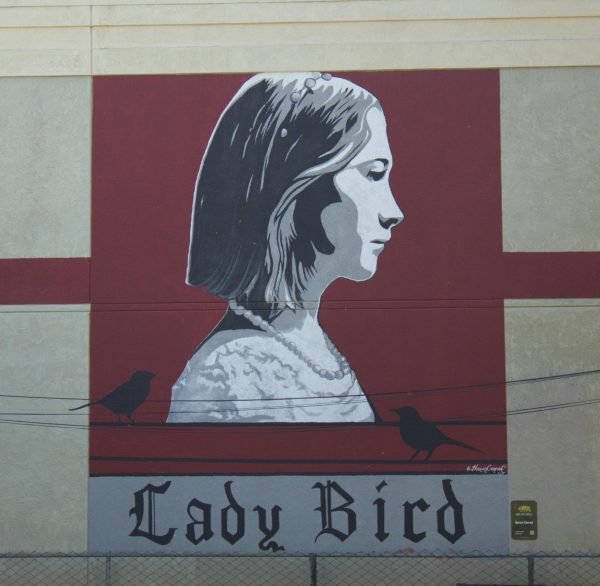 Greta Gerwig’s debut movie “Lady Bird” is celebrated through a mural painted by Maren Conrad between 16th and I Streets Wednesday, March 18, 2026. The film featured numerous Sacramento sites such as Gunther’s Ice Cream, the Fab 40s neighborhood and the Tower Bridge. (Janelle Germain)
According to KCRA 3, Conrad not only wished to heighten the pride and excitement for the movie by choosing this film poster design, but to curate a symbol of strong femininity and highlight the women-led accomplishments of this film through the color scheme.
“I hope that it’s this moment that really captures a change in climate and the seriousness in which we take women and the stories that women have to tell,” Conrad told KCRA 3.
The film received 41 major nominations, and won 13 awards, including a Golden Globe for best motion picture.
In 2023, Gerwig became the highest-grossing female director of all time. With her film journey starting at her roots, Gerwig describes to Submerge Magazine the reasoning for creating in Sacramento.
“This was really a desire to make a movie about home,” Gerwig said to Submerge Magazine. “Sacramento is that place to me. This is that love letter.”
These personal portrayals help elevate Sacramento and its community.
Ginger Rutland has served the Sacramento region since joining KCRA 3 in 1972, becoming the station’s first African American female TV reporter.
Rutland moved to Sacramento at age four and grew up in the community. As she came of age in the 60s, she shared with KCRA 3 how she found her love of journalism through her community, sparking her desire for the career.
“I grew up watching the civil rights movement, and I was quite inspired by the journalists I saw on television and read in the newspapers,” Rutland said to KCRA 3. “So I thought, ‘I want to be a journalist.’”
Though she said she once hoped to work as a CBS correspondent in Paris, she chose to build her career in Sacramento.
“I grew up in Sacramento, I knew Sacramento and my advantage for a bunch of reasons was that I knew this town really well,” Rutland said to KCRA 3. “That was an asset as a reporter.”
Rutland said she recalls being treated fairly on the job with the exception of some Northern California areas, but refused to report in over concern for her safety. The essential representation she provided for all women, especially those of color, worked to expand the viewpoints and experiences of those voiced in the media.
She later explored her experiences in her book “When We Were Colored, A Mothers Story,” which she adapted into a screenplay.
RELATED: ‘When We Were Colored: A Mother’s Story’ flips the script on Black theater narratives
“Its a story about what it’s like to move from a fully segregated world to suddenly an integrated world,” Rutland said to KCRA 3.
Rutland has received numerous honors, including an Emmy for her Diablo Canyon nuclear power plant documentary.
All of these women share a deep attention to the city in their work.
The impact of this decision is best described by Gerwig in a scene where Lady Bird’s principal, Sister Sarah Jones, observes her love for the city through affectionate written descriptions. However, Lady Bird dismisses this love and states she is simply paying attention, adding a newfound intensity to this word.
“Don’t you think maybe they are the same thing,” Jones said. “Love and attention?”
All of these women use their passions to create work that reflects both personal memories and deep affection for Sacramento, sharing their views with a wider audience.