
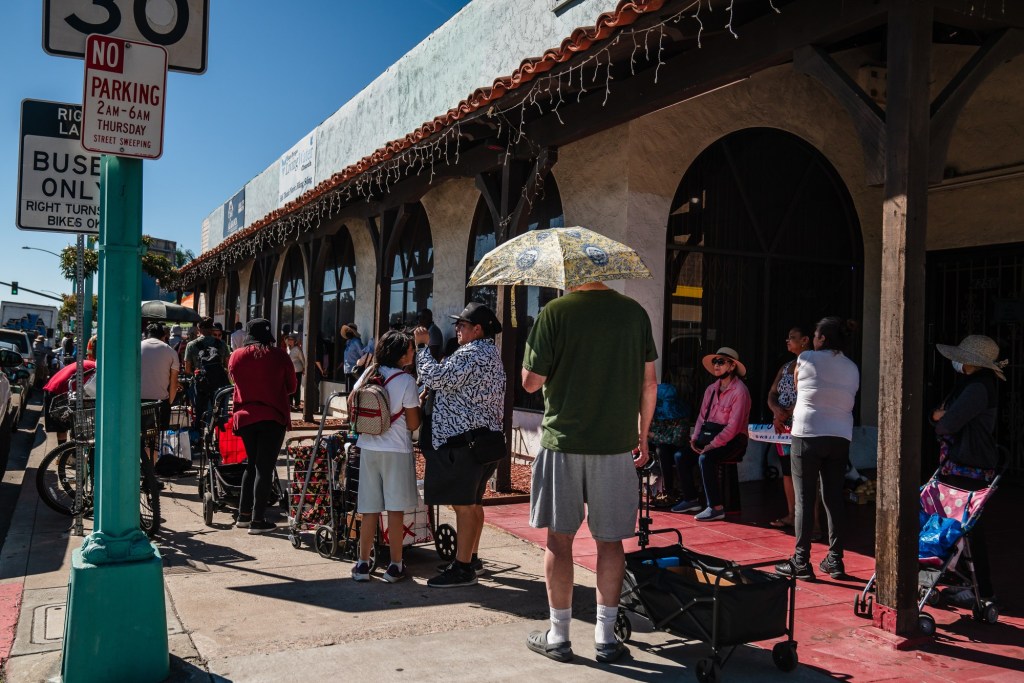
Cars lined Van Dyke Avenue in City Heights on Thursday afternoon as hundreds of people waited to pick up groceries through Iglesia Casa de Alabanza’s food distribution.
Some drivers turned off their engines as they waited in the hot sun. Dozens of people on foot lined up along El Cajon Boulevard, ready to fill their baskets and carts with much-needed food for the week.
“If it weren’t for this assistance, what would happen to us?” said Blanca Blanco, 64, as she waited.
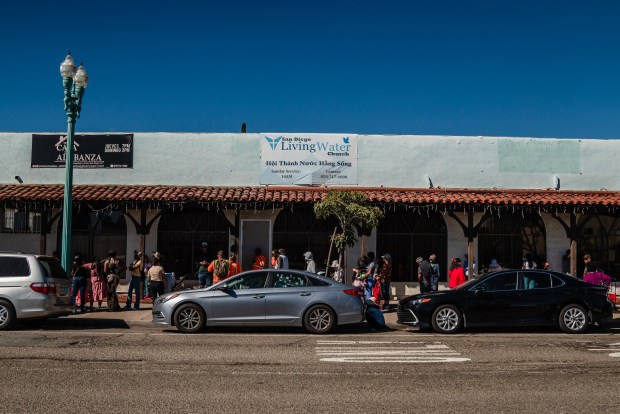 Cars and people lined Van Dyke Avenue for food from Iglesia Casa de Alabanza’s food distribution. (Ariana Drehsler / For The San Diego Union-Tribune)
The need for food assistance has grown steadily over the last year, as the rising costs of groceries, utilities and driving pushes more San Diegans to seek help from food banks and other nonprofits. The San Diego Hunger Coalition estimates that more than a quarter of San Diego residents are nutrition insecure.
Now, imminent changes to eligibility for CalFresh — California’s version of the Supplemental Nutrition Assistance Program, or SNAP, more commonly known as food stamps — threaten to leave more San Diegans hungry and reliant on local help.
Starting April 1, many legal immigrants — including asylum seekers, refugees, trafficking survivors, many Iraqis and Afghans with special immigrant visas and other immigrants who were previously eligible for CalFresh under humanitarian protections — will no longer be eligible for the federally funded food assistance program.
And on June 1, new work and volunteer requirements will go into effect, requiring most adults to work at least 80 hours a month to qualify for CalFresh.
Iglesia Casa de Alabanza is already struggling to feed all the people who need its help.
 David Villalobos, youth pastor at his church, Iglesia Casa de Alabanza, in City Heights, is also a TSA supervisor at San Diego International Airport. Photographed Friday March 27, 2026, in San Diego, California. (Howard Lipin / For The San Diego Union-Tribune)
“We don’t have enough food,” said David Villalobos, a pastor who runs the twice-weekly distribution with food from Feeding San Diego and the San Diego Food Bank. “We’re definitely going to see more people coming.”
For some, the changes won’t go into effect right away. Affected CalFresh participants can use their benefits until they are re-certified, typically every 12 months.
But ultimately the impacts could be staggering for many of the nearly 400,000 San Diego residents who rely on CalFresh benefits.
San Diego County officials estimate that up to 13,000 CalFresh participants will lose eligibility with the April 1 changes, and that as many as 93,500 more will lose their benefits after the June 1 requirements go into effect.
The changes are due to the federal law known as H.R. 1, signed last July, that limits federally funded benefits for several immigrant groups and low-income people.
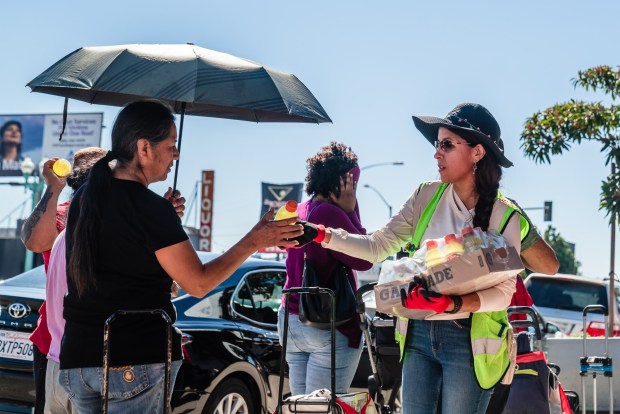 Lupita Guerrero, a volunteer hands out Gatorade that was donated by Father Joe’s to people waiting in line. (Ariana Drehsler / For The San Diego Union-Tribune)
“It didn’t have to be this way,” said Shawn VanDiver, the founder of AfghanEvac, a San Diego-based group that helps resettle Afghans who assisted the U.S. in the war in Afghanistan.
“The (Trump) administration wanted to make life harder for immigrants and refugees,” he said. “It seems unnecessarily cruel.”
With fewer people eligible for CalFresh, food banks are expecting to see a surge that could tax their resources.
They’re already seeing more federal workers turning to local food aid both before and during the ongoing partial government shutdown, and months after last year’s broader shutdown stalled paychecks for thousands.
Villalobos is among those workers.
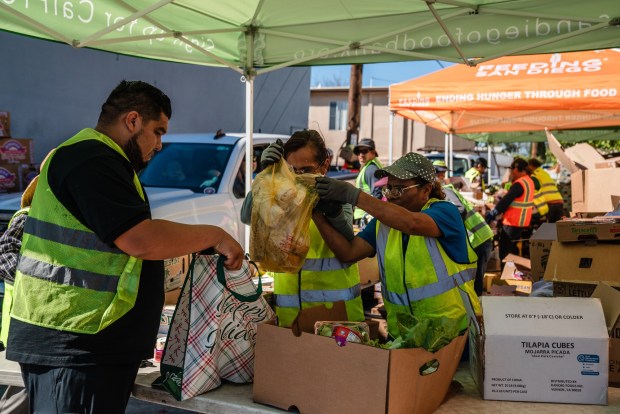 Pastor David Villalobos and Graciela Castellanos, helps a woman fill up her bag at a food distribution with food from Feeding San Diego at Iglesia Casa de Alabanza. (Ariana Drehsler / For The San Diego Union-Tribune)
While he leads the food distribution at his church, he’s also a screening supervisor with the Transportation Security Administration at the San Diego airport — and has been working without pay for more than a month. He has three children, including a 5-month-old, and has started collecting food from the church distributions himself.
Local nonprofits like the San Diego Food Bank and Feeding San Diego have been preparing to meet the demand.
Sam Duke, Feeding San Diego’s director of programs, has seen a rise in clients at food distributions in Escondido, in the South Bay and in more urban areas of East County. The nonprofit is working with its partners, including the county, and its food sourcing team to feed the areas in greatest need.
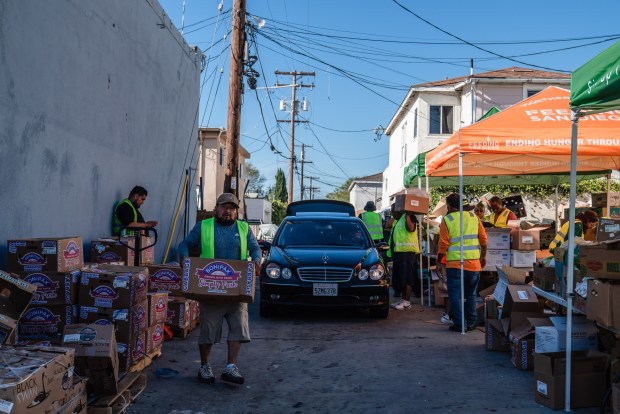 Cars wait in line at a food distribution with food from Feeding San Diego at Iglesia Casa de Alabanza in City Heights on March 26, 2026. (Ariana Drehsler / For The San Diego Union-Tribune)
And the San Diego Food Bank, which serves about 411,000 people per month, has begun buying more food so it can target nonprofits and neighborhoods that most need it — areas including City Heights, Mission Valley and Poway. It also offers rental and workforce assistance, and clients can volunteer at the food bank — hours that can go toward their eligibility requirement for CalFresh.
“When you’re coming to get food from us, it’s likely that you’re struggling in other areas,” said Casey Castillo, San Diego Food Bank’s chief executive officer. “We like to be that trusted source that can connect that individual or that family to other resources they might need.”
Residents aren’t just struggling with food. They say basic costs have grown unbearable, and surges in gas prices from the U.S. war in Iran are leaving many wondering how to pay for basic necessities. And CalFresh benefits have already been uncertain, with the federal government shutdown last fall delaying benefits then.
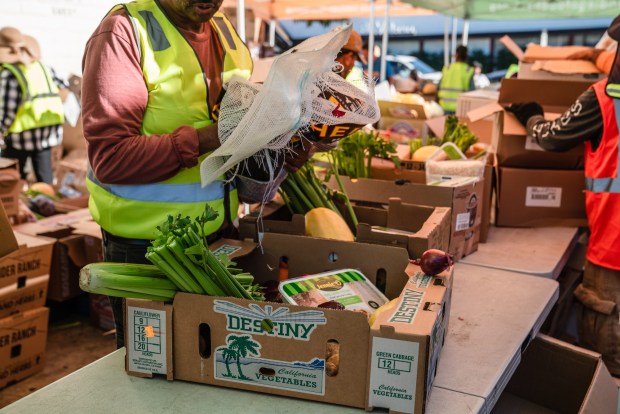 Some of the items that are given out are produce, cereal, jam, turkey, fish, Tilapia Cubes at the food distribution at Iglesia Casa de Alabanza in City Heights. (Ariana Drehsler / For The San Diego Union-Tribune)
Yet for many San Diegans, CalFresh could be an answer, says Alondra Alvarado, the president and chief executive officer of the San Diego Hunger Coalition.
Many San Diegans could qualify for CalFresh but are not enrolled, she said. Her organization has seen about 25,000 people disenroll over the last year, which she says may be due to fear — especially in immigrant communities — of accepting federal benefits.
The Hunger Coalition has offered training to local hunger organizations on the changes to CalFresh. But it’s also focused on enrolling more people, seeing the program still as the best way to fight hunger in San Diego County.
“If we are able to enroll all the people who qualify for CalFresh on the program, then we can alleviate a little bit of the burden that food pantries are receiving right now,” Alvarado said. “We can leave the food assistance for the people who are not going to be able to keep participating in CalFresh.”