
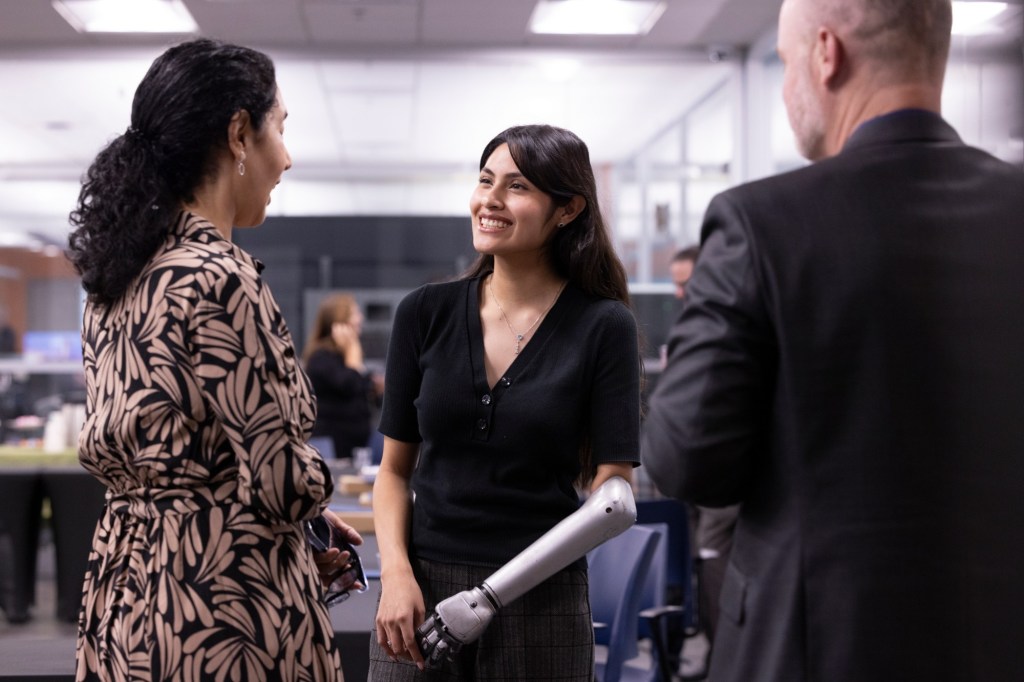
Within a few minutes of meeting Haley Barrios Gomez, a mechanical engineering major at Cal State Fullerton, the 21-year old’s character traits become readily apparent.
Gomez is determined, focused, confident and intelligent and credits her parents for instilling these qualities as a young child in Mexico City, and later in the U.S.
Gomez was born without her left arm from just below the elbow, the result of a congenital medical condition.
She immigrated to the U.S. with her family at about 2 years old, settling first in Mission Viejo and later in Lake Forest.
From an early age, Gomez began using a body‑powered prosthetic, which allowed her to perform basic daily activities and simply be a kid.
But Gomez has never characterized herself as a person with a disability and has always referred to the prosthetic as a “helper.”
“The doctors told my parents, ‘She will only be disabled if you make her disabled,’ ” Gomez said. “That’s why they would never really help me. They would always say, ‘You can do it. You’re fine.’ I’m very thankful for them because that’s why I am the way that I am now. Whatever I can do with my prosthetic, I can do without it.”
As she got older, Gomez started having physical complications, attributable to the prosthetic.
When providers and insurance companies repeatedly denied her requests for more suitable alternatives, Gomez stopped using the prosthetic.
As a teenager, she began doing her own research into myoelectric prosthetics, which can give users a higher level of control through sensors that can translate muscle movements into hand motions.
Gomez eventually returned to her insurance providers, making an evidence-based argument for the type of prosthetic she needed.
“I wasn’t allowed to say myoelectric,” she said. “I just had to tell them what I wanted to be able to do. They told me, ‘You’re fine with a body‑powered one. You don’t need something else.’ And I didn’t like that answer.”
So, Gomez collaborated with the Hanger Clinic, which designs and custom fits orthotic and prosthetic devices.
Working directly with a prosthetist and computer-aided design engineer, not only did Gomez secure approval for a myoelectric prosthetic, she also co‑designed key components herself, thus reducing the cost significantly by using 3D‑printed exterior parts.
“That’s when I realized, it’s not that I want to be a prosthetist,” she said. “I want to be the one making prosthetics. I shouldn’t have had to fight this hard just to get something that actually helps me.”
As a first‑generation college student, Gomez attended Irvine Valley College, where she excelled in math and physics, and cultivated passion for engineering.
She participated in MESA (Math, Engineering, Science Achievement) a public education partnership operated at California State Universities and community colleges, which provides STEM education to low-income and underserved student populations.
Gomez advanced from being a participant in MESA to being a tutor and ambassador.
“I can honestly say Irvine Valley College is where I really got my kickstart,” Gomez said. “Being in engineering classes and building robots … that’s when I told myself, OK, I can do this.”
Gomez also became an advocate, speaking at college events and donor functions and using her own story as proof of what access and support can make possible.
After earning her associate degree, she applied to multiple CSU and UC schools, ultimately choosing Cal State Fullerton because of affordability, proximity to her home and the opportunity to conduct hands-on research.
But before Gomez officially enrolled at CSUF, she was accepted into Project RAISE’s Undergraduate Research Experience in summer 2025.
Working under the direction of Sajil James, chair and professor of mechanical engineering at Cal State Fullerton, Gomez conducted research in the Titan Advanced Manufacturing Lab, where her project focused on hydrogen fuel‑cell–powered drones using solid‑state storage, proving that fuel-cell-powered drones improved energy efficiency compared to lithium‑only systems.
The research was difficult but rewarding, Gomez said, and the experience ignited her passion for research.
“Haley has been an exceptional student researcher, known for her strong work ethic, focus, and intellectual curiosity,” James said. “She quickly stood out for her ability to take initiative and tackle complex engineering challenges. Haley’s determination and commitment to continuing her research reflect her passion for the field and her drive to succeed.”
When Gomez transferred to CSUF in fall 2025, she continued working with Project RAISE, pursued advanced mechanical engineering coursework and remained active in research labs.
She participated in additional research under assistant professor Bingling Huang, contributing to autonomous rover design involving AI, machine learning and collaborative robotics.
At the same time, Gomez was selected for two highly competitive, six‑month industry mentorship programs.
She was among 10 Cal State Fullerton students selected for the inaugural cohort of Next-Gen Innovators — a new mentorship program run by Apple that is designed to inspire and prepare sophomore and junior students for careers in hardware engineering.
Gomez is also participating in Amazon Guides, a full-year mentorship program for undergraduate students created by the University Partnerships team at Amazon Robotics.
Balancing a heavy STEM course load, paid work, research, and mentorship commitments, she has demonstrated exceptional time management and resilience — while still prioritizing friendships, family and personal well‑being.
She has also served as a role model and mentor, assisting military veterans with limb loss and children in Camp No Limits, a nonprofit organization that hosts camps for children with limb loss.
She aspires to launch a company that produces accessible prosthetics.
“I want prosthetics to be more accessible and more customizable,” she said.
After she earns a bachelor’s degree in mechanical engineering, Gomez plans to pursue a master’s degree and perhaps a doctorate.
Said James, “She is a highly motivated and talented student with a very bright future in mechanical engineering.”