
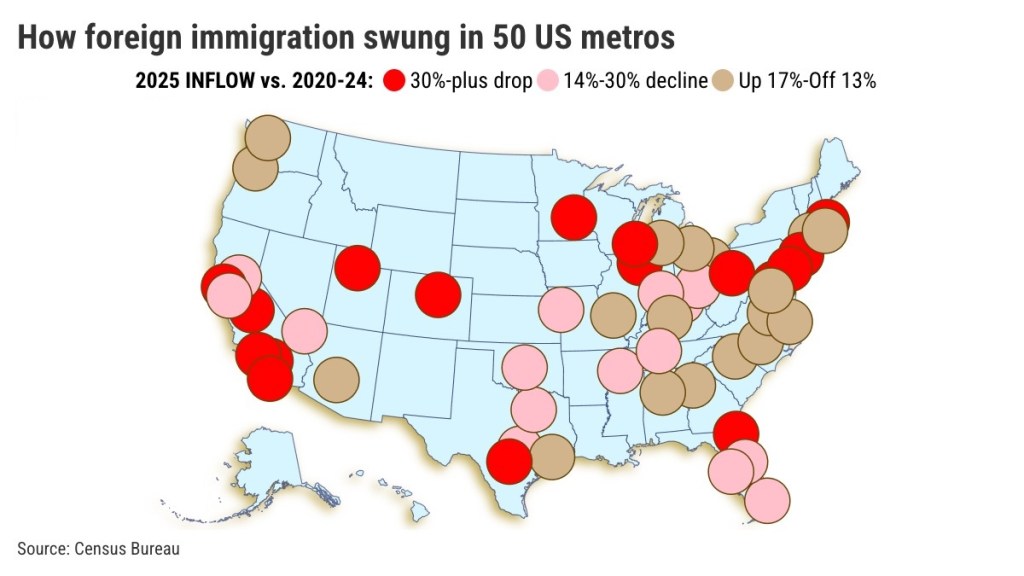
Amid the Trump administration’s immigration crackdown, Southern California’s foreign immigration saw its numbers cut in half in the past year compared with the previous four years.
My trusty spreadsheet reviewed new U.S. Census Bureau data tracking five years of population flows for the nation’s metropolitan areas, including immigration moves, from April 2020 through July 2025. The data looked at swings in net foreign immigration patterns – that’s arrivals vs. departures – counting residents no matter their legal status.
Results for the year ending July 2025 were compared to the annualized pace of foreign immigration from April 2020 through July 2024. In three Southern California metro areas spanning five counties, last year’s immigration count of 46,700 was a decline of 53,700 from the 2020-24 inflow pace, or a 53% tumble.
Fewer immigrants also helped dent Southern California’s overall population. The five-county region lost 209,300 residents over five years, a 1% decline, to 20.9 million residents.
The decline reflects only the first few months of the Trump administration’s efforts to limit the nation’s immigrant population dramatically. Donald Trump’s second term as president began in January 2025.
His tighter immigration policies have stirred plenty of debate, especially on economic grounds, in a region that’s long been a magnet for foreigners.
Critics of the harsher immigration policies say the drop in foreign inflow hurts the region’s overall business climate, as demand for goods falls and employers face worker shortages, especially for lower-wage work that immigrants often do.
Advocates for tightened immigration policies say the inflow decline lessens demand on parts of the region’s infrastructure, from housing and schools to public services.
Bigger picture
Southern California’s slowing immigration is not unique.
Ponder inflows in the nation’s 50 big metros. Last year, there were 952,200 foreign immigrants to these large regions – a drop of 297,900, or 24%, from the 2020-24 pace. So, Southern California accounted for 16% of the national decline in immigration.
And note that the overall population of the 50 large markets is growing despite the immigration dip: 189 million total residents last year, up 5.9 million, or 3% growth, over five years.
Also, consider the rest of California, where last year’s immigration of 62,600 was down 41,300, or 39%, from the 2020-24 pace. Overall population grew by 8,900, or 0.05%, to 18.5 million in five years.
Local slump
When looking across the nation’s 50 most-populated metro areas, you can see Southern California suffered some of the steepest drops in foreign immigration.
The Inland Empire, comprising Riverside and San Bernardino counties, had 2,000 foreign immigrants last year. That’s off 11,800, or 85%, from the 2020-24 pace – the second-largest percentage drop among the 50 U.S. metros.
Still, the overall population in the Inland Empire grew by 167,400, or 4%, to 4.8 million over five years. That ranked 20th best among the 50 large metros.
The metro covering Los Angeles and Orange counties had 38,500 foreign immigrants last year, 35,700 fewer than the 2020-24 pace. This 48% drop was the sixth-largest decline among the 50 metros.
L.A.-O.C.’s overall population fell 360,300 to 12.8 million in five years. That 3% drop was the biggest tumble among the 50 metros.
And in San Diego County, 6,100 immigrated from foreign nations, 6,100 below the 2020-24 pace. That 50% drop was the fourth-largest among the 50 metros.
San Diego’s overall population fell by 16,400 to 3.3 million in five years. The 0.5% drop was the sixth-biggest decline.
Jonathan Lansner is the business columnist for the Southern California News Group. He can be reached at jlansner@scng.com