
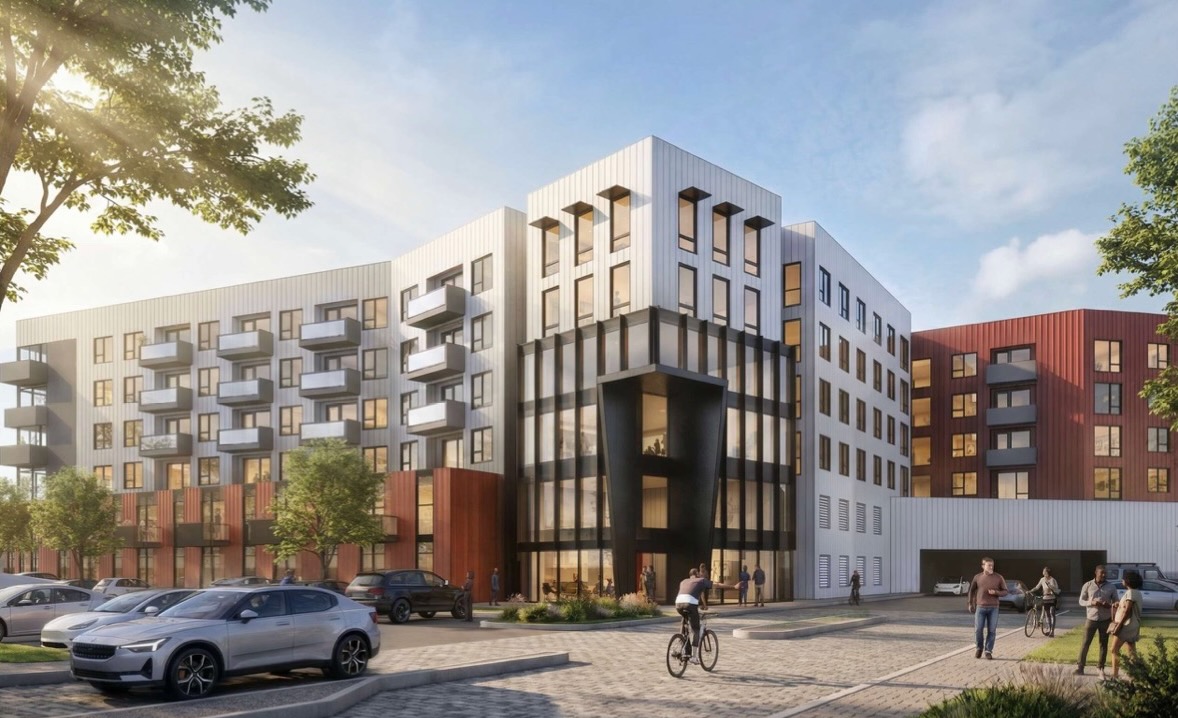
A rendering of the proposed 294-unit residential community near Sausalito’s downtown.
AC Martin
Some four months after Sausalito voters passed a plan to allow taller and denser buildings on about 16 acres along a commercial strip north of downtown, a developer has filed a preliminary application to build what would be the seaside town’s largest residential complex.
Bayspring Development Partners has submitted a pre-application for a 294-unit residential community at 1 Harbor Drive, across from Mollie Stone’s along Sausalito’s Bridgeway corridor.
The proposal, which represents a direct implementation of Measure J, the multi-site housing overlay approved by Sausalito voters in November 2025 with more than 75% of the vote, calls for a six-story building to replace an existing office building. The adjacent office building at 3 Harbor Drive would remain. Of the 294 rental units, 46 of them would be set aside for very low-, low- and moderate- income households.
Article continues below this ad
While development has traditionally faced strong opposition in Sausalito, residents will have little recourse to block the Harbor Drive project. As a designated Measure J overlay site, 1 Harbor Drive is eligible for ministerial approval and is not subject to discretionary or environmental review under the California Environmental Quality Act. Based on the level of affordability provided, the project also qualifies for a 100% density bonus.
“1 Harbor Drive was identified as a cornerstone opportunity in the City’s Housing Element because it is uniquely suited to deliver meaningful new housing in Sausalito,” said Bryce Holman, principal at Bayspring.
San Francisco Chronicle Logo
Make us a Preferred Source to get more of our news when you search.
Add Preferred Source
Located on the flats along the city’s primary traffic corridor the site “offers the ability to add homes without displacing maritime or industrial uses in the Marinship,” Holman said.
“Voters made their priorities clear with the passage of Measure J, and we’re excited to help bring that vision to life,” he added.
Article continues below this ad
In a news release Bayspring said the building, designed by AC Martin, would front Bridgeway and “reflect the Marinship’s character and working waterfront heritage through its materials, and architectural expression.” The project includes two levels of parking with four residential levels above. The rental units will include a range of living options, including studios and one, two and three bedrooms.
A few hundred yards removed from the waterfront and its boat building and diving and small engine repair shops, the 12 parcels that were rezoned include a collection of one- and two-story tilt-up buildings housing law firms, banks, medical offices and co-working spaces. There is a mushroom coffee business, an artisan tile showroom and an indoor play space for children.
The rezoning is aimed at satisfying the town’s state-mandated housing requirement of planning for 724 units by 2031, while not interfering with the eclectic mix of funky industrial, arts and waterfront uses that give Sausalito its signature salty vibe. Measure J allowed between 415 and 530 dwellings to be built, according to an analysis by City Attorney Sergio Rudin.
Sausalito permitted just 58 units in the eight-year Regional Housing Needs Allocation, or RHNA, cycle between 2015 and 2022. The town’s last significant housing development, the 22-unit Rotary Village, opened in 2004. The 724 units the California Department of Housing and Community Development is requiring Sausalito to permit is a 800% increase over the last cycle.
Article continues below this ad
While by far the biggest, the Bayspring project is not the only one likely to come to the rezoned area. Developer Dan Morgan is looking at building between 65 and 80 units on two parcels at 2650 and 2656 Bridgeway, just to the north of the 1 and 3 Harbor Drive property. Other properties rezoned include 2680 Bridgeway, which could accommodate 63 units, and 3000 Bridgeway, which Sausalito planners say could be redeveloped with 20 units.
After the vote in November, Morgan said he was “quite surprised” that Prop J won with such overwhelming support.
“I have been in Sausalito since the early ’80s and my observation is everything in Sausalito is always about 50/50 and is always a big fight,” he said. “I have never seen anything pass with 65% or 70%.”
Marin land use attorney Riley Hurd, who represents the developer, said, “I don’t think anybody should be surprised by the size of the project.”
“This application is a direct response to not only the city council selecting the site but the voters,” he said. “The project is a direct response to Sausalito saying, ‘This is where housing goes.’”
Article continues below this ad
While officials in other Marin towns, like Fairfax and Tiburon, have attempted to argue that projects don’t qualify for ministerial approvals, so far it hasn’t worked, Hurd said.
“Ministerial means ministerial,” Hurd said, adding the law “was designed to prevent that kind of NIMBY response.”