
On March 17, Coronado Middle School was transformed into a powerful, hands-on learning environment as Safe Harbor Coronado delivered its annual Drug Prevention Program to more than 220 sixth-grade students from across Coronado, with additional programming for seventh- and eighth-graders and their families.
The comprehensive, evidence-based initiative—developed in partnership with Coronado Middle School staff, community professionals, and more than 75 volunteers—aimed to equip students and parents with the tools they need to recognize risk, resist peer pressure, and make healthy, informed choices.
“What makes this program so impactful is that it goes beyond simply saying ‘don’t do drugs,’” said Safe Harbor Coronado Executive Director Danielle Maske. “We focus on teaching students how to manage emotions, test boundaries in healthy ways, and make confident decisions when faced with peer pressure.”
All sixth-grade students took part in Safe Harbor’s signature Drug Prevention Program, an interactive, scenario-based experience that guided them through a series of dramatic scenes and educational stations.
The day began with Scene 1 – Setting the Stage, led by Sean Murphy, where students were introduced to what they would see and learn. From there, they moved through a carefully designed sequence meant to mirror real-life situations that young people may face.
In Scene 2 – Effects of Vaping, students watched as a Coronado Middle School student character faced a difficult choice: whether to vape with friends or walk away. The scene highlighted how quickly peer pressure can escalate and how challenging it can be to say no in the moment.
The stakes rose in Scene 3 – Party, where high school students demonstrated both positive and negative choices. One Coronado High School student modeled effective refusal skills at a party, while another accepted drugs and collapsed. The dramatization included a 911 call and the arrival of an EMT unit attempting to revive the student, underscoring the real and immediate dangers of substance use.
That storyline continued in Scene 4 – Hospital ER, where students watched the medical response unfold in a simulated emergency room setting. Nurses and staff walked through typical procedures for saving a young person’s life.
In Scene 5 – The Ending, the message was brought home: incidents like the one portrayed are not abstract or distant; they can and do happen to students their age. The goal was to help students internalize the seriousness of substance use and the importance of their choices.
The experience concluded with Scene 6 – The Debrief, where school counselors met with students to process what they had seen, share feelings and reactions, and reinforce healthy coping and decision-making strategies.
Between scenes, sixth graders rotated through eight interactive learning stations, each designed to address a different aspect of substance-use prevention, health, and resilience. The stations included information on brain health and substance abuse, refusal skills, natural highs, drunk goggles, and more.
Each student session lasted eight minutes, with three-minute transitions between them, allowing sixth graders to experience a wide range of perspectives in a single morning.
While sixth graders moved through scenes and stations, programming for older students and families focused on deeper education on current substance use trends.
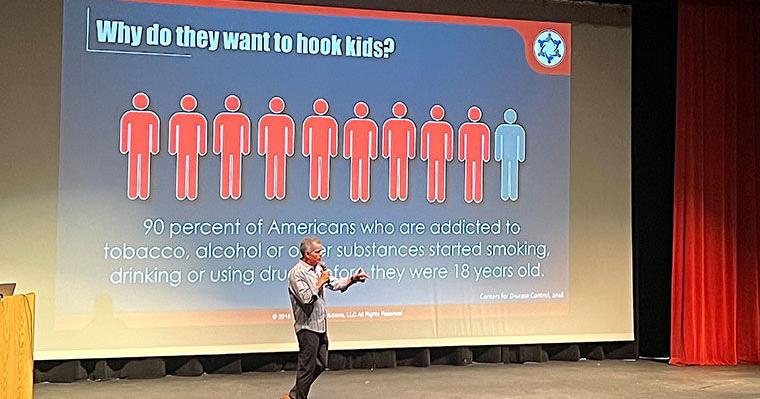
Nationally recognized youth drug and alcohol prevention expert Clayton Cranford—a child safety authority with more than 20 years in law enforcement—spoke to parents and caregivers. His presentation highlighted:
• How the vaping industry targets teens
• The role of social media, peer influence, and online access in driving youth substance use
• Warning signs of substance use
• How to talk confidently with children about drugs
• Practical steps families can take to limit access to substances at home
In the afternoon, Cranford addressed seventh- and eighth-grade students in the Coronado High School Theater. His talk placed a strong emphasis on vaping and the increasing independence of middle schoolers, reinforcing prevention messages at a time when many students are encountering greater exposure and pressure.
This year’s event continued a tradition that began in 2008, when Safe Harbor Coronado first launched what was then known as “Drug Store.” Since then, the program has evolved into a cornerstone of the organization’s prevention work.
The March 17 event mobilized 75 volunteers and eight Safe Harbor staff members, alongside Coronado Middle School educators, health professionals, law enforcement, and high school student leaders. Together, they created a multi-grade, family-inclusive program that addressed not only the dangers of drugs and alcohol, but also the skills and supports young people need to thrive.
“This event was such a success because of the incredible collaboration behind it. We had volunteers, students, schools, first responders, and local organizations all working side by side,” Maske told me. “It truly shows that when Coronado comes together, we can create something really impactful for our youth and families… The morning event included 223 6th graders from all schools on the island, and I couldn’t be more proud of how smoothly it ran and the impact it has had on our community.”
Safe Harbor Coronado, a nonprofit serving the Coronado community since 1998, is dedicated to empowering youth and families through evidence-based prevention education, social-emotional learning, and mental health support. By investing in programs that build resilience, confidence, and lifelong coping skills, Safe Harbor aims to prevent youth substance use before it starts.
Through immersive scenarios, honest conversations, and science-based education, the Drug Prevention Program at Coronado Middle School made one message clear: when schools, families, and community partners work together, students are better prepared to navigate pressures, protect their health, and choose a drug-free path forward.
VOL. 116, NO. 12 – Mar. 25, 2026