
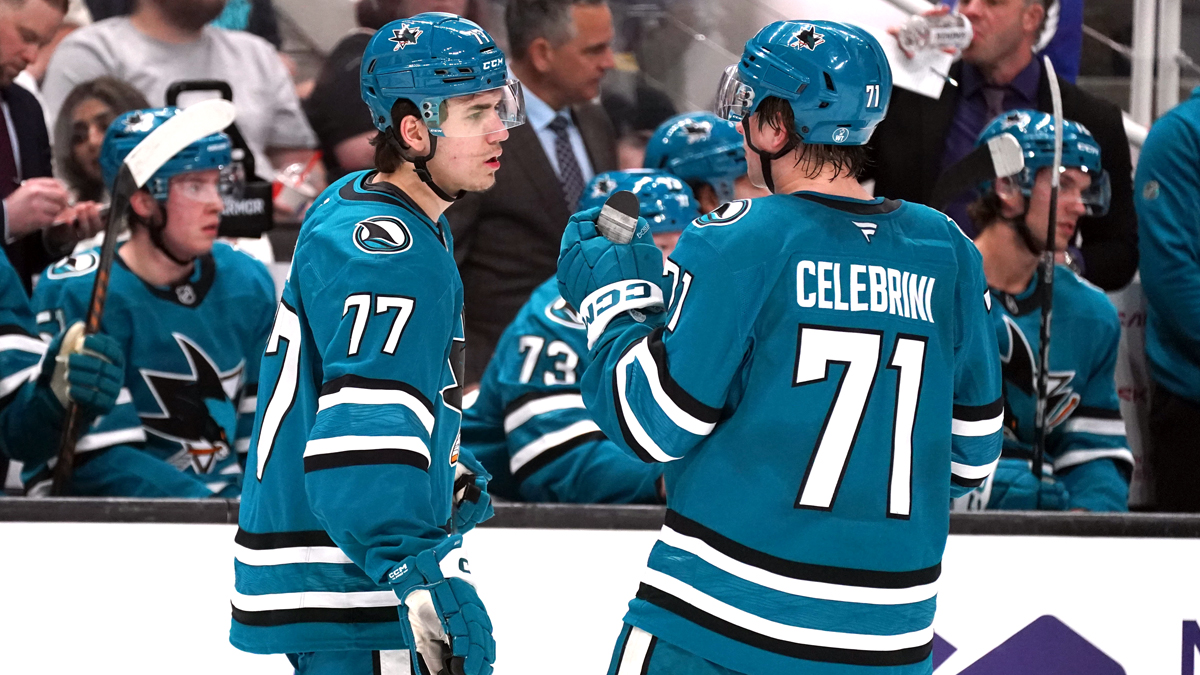
Sharks center Michael Misa has shown lots of promise during his rookie NHL season.
“Kid’s going to turn up some juicy numbers,” an NHL scout, not affiliated with the Sharks, told San Jose Hockey Now. “He’s going to control the pace of a shift.”
Macklin Celebrini and Misa “will be possibly the best one-two center alignment in the NHL” one day, this scout predicts. “These two centers will change the West.”
But today?
Misa, the No. 2 overall pick of the 2025 NHL Draft, is just trying to earn a little more ice time in his rookie campaign.
How can he get more playing time?
The 19-year-old center played a career-high 17:53 against the Philadelphia Flyers on March 21.
For the most part, however, Misa (13:12) has played fewer minutes than Macklin Celebrini (21:59), Alex Wennberg (20:20), and, sometimes, fourth-line center Zack Ostapchuk (10:19), since his return from World Juniors on Jan. 11. On the surface, playing that much less than Celebrini and Wennberg might not make sense.
But there is a logical reason for this: Celebrini and Wennberg are special teams’ staples, and even Ostapchuk plays more on the second-unit penalty kill than Misa on the second-unit power play. Misa isn’t necessarily ready for either top power-play time or short-handed minutes.
At even strength, Misa (12:07) is much closer in deployment to Wennberg (14:41). Celebrini (18:41), of course, is the alpha dog, while Ostapchuk (8:38) brings up the rear.
“For the most part, we’re a good team when we roll our lines,” head coach Ryan Warsofsky said. “When he’s going, he’s playing. But there are games, as a young guy, you just fight a little bit, you play him a little bit less. And that’s something that he’s learning.”
Functionally, Misa is the Sharks’ third-line center right now, a heavy burden in a playoff race. He has done a credible job there, too, especially offensively, with six goals and 13 points in 27 games since Jan. 11.
But what does he have to do, in all honesty, to overtake Wennberg as the Sharks’ second-line center? If not this year, then next? It’s not that complicated, according to Warsofsky … but it’s not easy, either.
“He’s got to learn when he doesn’t have his A-game, which you’re not going to for 82 games, your C-game has to be impactful,” Warsofsky said. “And we’ve seen that with some older players, they’ve learned that. That’s just a step in his development.
“When he’s struggling to make [offensive] plays, he’s a playmaking center that can make plays, and there’s going to be games where he just doesn’t feel confident or you can’t connect on a play or your hands are not there that night or your legs … your play away from the puck, your physicality, defending, being responsible away from the puck, that’s how you grow.”
Wennberg, 31, is a model for this: The 2013 Columbus Blue Jackets’ first-round draft pick, while not as offensively gifted as Misa, has transformed himself into one of the better two-way centers in hockey.
“You look around the league, centers that can play defense,” Wennberg said, “you get trust from the coaching staff, and at the end of the day, [that] helps you win hockey games. That’s what it really comes down to.”
Misa understands that.
“It’s been a learning curve for me defensively,” Misa said.
So how, exactly, can Misa improve defensively?
When people talk about pace in hockey, they often refer to the offensive side, but defending with pace is just as important.
“Sometimes, the game has sped up on him a little bit, which is to be expected,” Warsofsky said. “You got to defend in this game. You have to be quick to do it and read it quick.”
Misa agrees with Warsofsky.
“For me, it’s more being aware of my responsibility, when their offense is in motion, guys are criss-crossing, just staying on my guy,” Misa said.
There were a couple of examples of potentially quicker reads that Misa could have made during the Sharks’ recent six-game losing streak.
Trent Frederic (10) pinches on Sam Dickinson (6); it’s a 50-50 puck battle along the wall. Misa (77) skates by, expecting Dickinson to come up with the puck. On the other hand, veteran center Adam Henrique (19) helps out his teammate, wins the puck, and finds Vasily Podkolzin (92) in the slot.
Jack Han, Hockey Tactics 2026 author, doesn’t put it all on Misa.
“80-20 [puck battle], then you should go,” Han said. “If it’s 20-80, then you shouldn’t. 50-50, hard to say.”
If Dickinson wins the puck to Misa, the centerman is off to the races, a step ahead of Henrique.
But that’s not what happened.
“Always supporting the play as the center,” Misa said. “It’s something I’m continuing to work on.”
It seems strange to blame Misa for this Rasmus Dahlin (26) breakaway goal, considering Dahlin was Mario Ferraro’s man. But if you rewind the tape, Dahlin gets a step on Ferraro (38) because of a slow Sharks’ line change: Ferraro, just jumping on the ice, never has a chance.
Once again, to be clear, the weight of this goal, like Podkolzin’s, isn’t mostly on Misa. But it’s the kind of defensive breakdown that a more veteran center might recognize quicker and try to help out on.
“I don’t know if he gets to Dahlin, either way,” Han said. “But if he looks, maybe he can get a stick on the pass.”
Misa also is still filling out his 19-year-old frame.
“Coming in as a young centerman, you got to get guys up in the corners and just be tougher on guys,” Misa said. “He wants me to be [better] defensively … playing [harder to play against] on guys.”
That said, Misa has made defensive strides this season.
“He’s good with puck battles, second effort on pucks, probably one area has really improved up since beginning of the year,” Warsofsky said.
Also, per Stathletes, Misa is fairly responsible with the puck.
For example, he has averaged just 3.21 Neutral Giveaways Per 60 since Jan. 11, fifth among Sharks forwards. Celebrini, who has earned that superstar license to try pretty much whatever he wants on the ice, actually is team-worst in this category, just over double Misa’s rate.
Misa’s puck management isn’t bad for a teenager who dropped 134 points on the OHL last year. Usually, that profile of a prospect is far riskier with the puck in his rookie year.
All this has Misa feeling more trusted, defensively.
“I’m getting a lot more chances to take defensive zone draws, because Warso is starting to trust me there,” Misa said. “It’s a good feeling. When you get out there defensively and you break the puck out and [that] leads to offense.”
Offense, of course, is what Misa is going to be known for.
And he has made strides there, too.
“He’s gotten more comfortable playing in the middle of the ice with the puck,” Warsofsky said. “When he gets pucks to the middle of the ice, he’s skating, he’s looking to attack. That’s one area that’s really improved…He’s comfortable with it on his stick. You can see he’s got his head up.”
“He has definitely improved, and is looking more comfortable and confident,” another NHL scout said, “looks more assertive and sure on the ice.”
The defense has grown for Misa. So has the offense. And more ice-time will come with it, maybe not this year, but next season, when he should be quicker and stronger.
“There’s still ways to go in that regard, and he’ll continue to learn and get better,” Warsofsky said. “We’ve had some really good moments of growth with Mis here. He’s gonna be a hell of a player. We’re excited about him. He’s come a long way from day one.”