
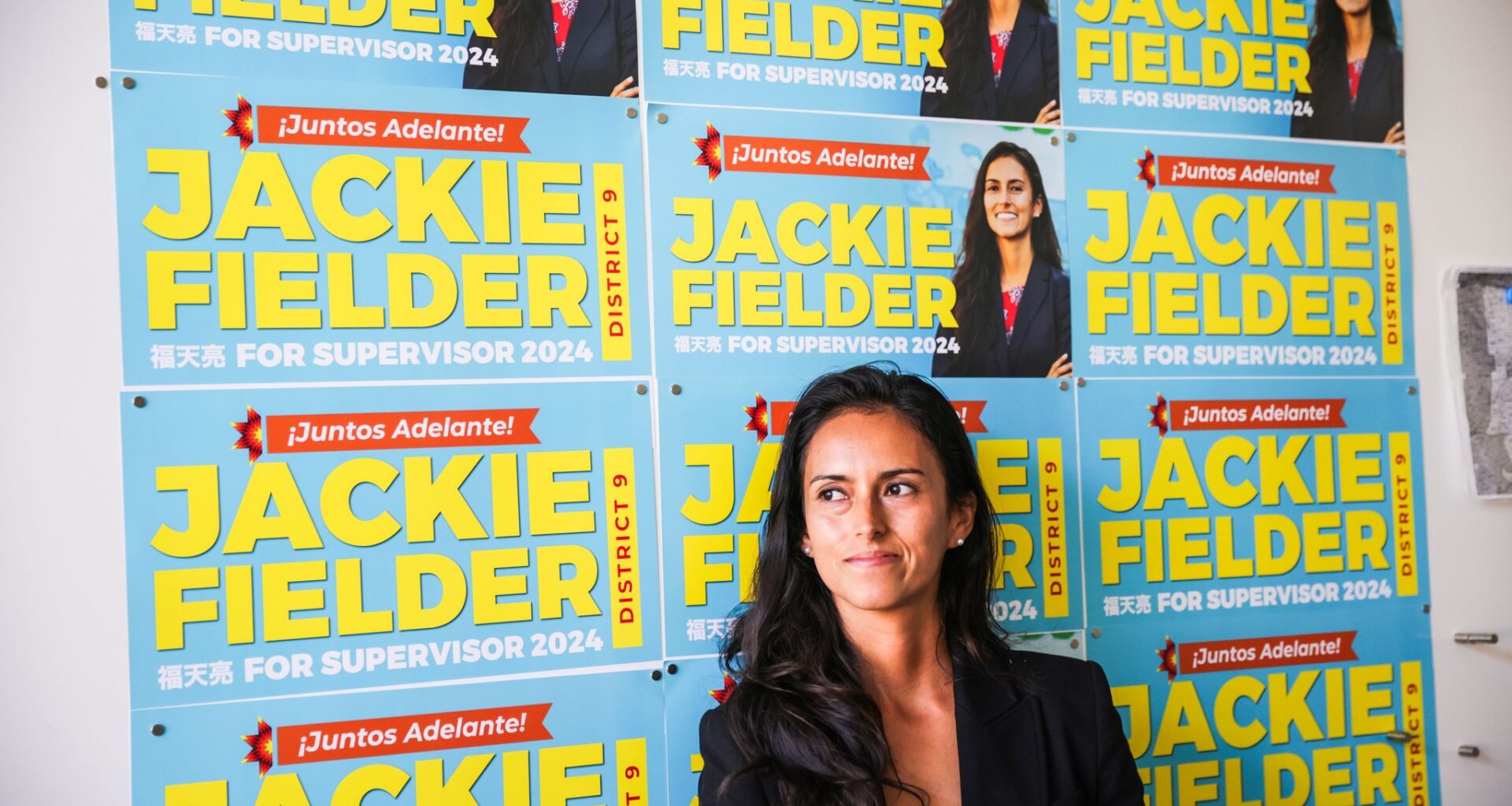
While Supervisor Jackie Fielder’s circumstances are unique, her allies have drawn inspiration from how the city responded to other politicians who had to temporarily retreat from their duties.
Gabrielle Lurie/The Chronicle
Supervisor Jackie Fielder, shown in a file photo, may ultimately reaffirm her previously stated plan to step down. But she is unlikely to meet serious resistance at City Hall if she decides to stay on after her health improves.
Roland Li/The Chronicle
Supervisor Jackie Fielder is not the first sitting San Francisco politician to contend with a health concern or step back from her duties, though the particulars of her situation appear to have few local parallels.
The disclosure by Fielder’s aides that she is struggling with a mental health issue and needed to take time off before determining her political future is without modern precedent among elected officials in the city. But Fielder has received an outpouring of support from throughout City Hall and beyond in a sign of how public officials are trying to reduce stigma around mental health challenges.
In 2010, then-Supervisor Michela Alioto-Pier was sidelined for an extended period while she was hospitalized because of an injury. More recently, Supervisor Danny Sauter took a few weeks off after his child was born last year. Former Mayor Gavin Newsom and former Supervisor Aaron Peskin each announced they were struggling with alcohol use while they were in office, but neither of them officially took time off from their jobs.
Article continues below this ad
While Fielder’s circumstances are unique, her allies have drawn inspiration from how the city responded to other politicians who had to temporarily retreat from their duties. Supervisor Myrna Melgar, for example, noted in a Sunday statement that when Alioto-Pier was out 16 years ago, San Francisco was “able to facilitate the representation of that district and her staff kept working.” Melgar said she had “full confidence” that Fielder’s aides could do the same.
Fielder’s aides said Sunday that she would take a “medical leave of absence” for an unspecified period because of a “mental health condition” that caused her to go to the hospital last week. Fielder had told a reporter Friday that she was unwell and planned to resign, but the statement from her aides said she needed “time and space to recover before making any major decisions.”
San Francisco Chronicle Logo
Make us a Preferred Source to get more of our news when you search.
Add Preferred Source
Fielder, a progressive who has been in office for more than 14 months, may ultimately reaffirm her previously stated plan to step down. But she is unlikely to meet serious resistance at City Hall if she decides to stay on after her health improves.
“I don’t think there would be any issue if she decided — after taking the time she needs and getting the treatment that she needs — to say, ‘I’ve reconsidered. I have a renewed sense of mission and I’m going to return to my job and return to work as a San Francisco supervisor,’” said political consultant Jim Ross. “Anybody who made it an issue, I think it would hurt them — politically and in public opinion — more than it would hurt her.”
Article continues below this ad
Fielder’s situation follows some high-profile examples of politicians outside San Francisco who have sought professional help in response to mental health problems.
Sen. John Fetterman, a Democrat who represents Pennsylvania, spent some six weeks receiving inpatient treatment for clinical depression in early 2023. After experiencing a stroke during his campaign the year before, he started experiencing intense symptoms and eventually developed thoughts about harming himself, he told NBC’s “Meet the Press” later that year.
Fetterman’s openness about his depression diagnosis earned praise from from his colleagues and inspired other lawmakers to share their own experiences, including Sen. Tina Smith, Democrat of Minnesota, who wrote about receiving treatment for depression in a personal essay; and Lina Hidalgo, the elected chief executive of Harris County, Texas, where Houston is located.
Hidalgo took a leave of absence for several weeks in 2023 to receive treatment for depression at an inpatient facility in Ohio. She had experienced symptoms, including suicidal thoughts, for years before seeking treatment, she told the Houston Chronicle, adding that she wished she had sought care earlier.
Both Hidalgo and Fetterman returned to their positions after receiving care, and both have given extensive interviews about their conditions.
Article continues below this ad
“As it becomes more of a shared experience, it loses stigma,” said Ross, the political consultant. “The reason why is because you have more and more people who are taking steps to take care of their mental health.”
The experiences of Hidalgo, Fetterman and Fielder are a reflection of how much the national conversation around mental health has shifted in the last half-century. In 1972, then-Sen. Thomas Eagleton’s mental health struggles led to him withdrawing as a vice-presidential candidate shortly after he joined the Democratic Party’s ticket.
“Attitudes are changing, and that’s for the better,” said Patrick Murphy, a public affairs professor at the University of San Francisco. “When we look at things that used to be disqualifiers for political careers, there’s a few I wouldn’t mind having back, to be honest, but the fact that this is no longer one of them — I’m fine with it.”
Fielder had already missed multiple meetings of the full Board of Supervisors and its committees by the time her mental health crisis burst into public view on Friday. The board is on its spring recess this week, which may alleviate some immediate pressure on Fielder to make a final decision about her political future.
Still, given her status as an elected official, Murphy said the process won’t play out “necessarily just on her time table,” which he called unfortunate.
Article continues below this ad
For now, other San Francisco leaders are signaling that they want to give Fielder enough room to recover.
Mayor Daniel Lurie, who would appoint Fielder’s replacement if she resigns, has said that he wants “everyone to give her the time and space to get better” so she can do her job “fully.” Board of Supervisors President Rafael Mandelman told the Chronicle on Sunday that Fielder and her aides had made “the right call” by delaying a decision on her next moves at City Hall.
“She needs to take care of herself, and there’s no need to rush any longer term decisions,” Mandelman said in a text message.
Fielder did not actually have to declare an official leave of absence, according to Peskin, the former supervisor widely known for his mastery of city laws. He said supervisors can only be removed from office in four ways: resignation, recall, death or by the mayor removing them for “official misconduct” that is agreed upon by a super-majority of the Board of Supervisors.
Supervisor Matt Dorsey, who has been open about his struggles with addiction and relapsing, said he took leave from city jobs three separate times to receive treatment. All three occasions were before he became a supervisor in 2022.
Article continues below this ad
“In the grand scheme of things, a month or even two or even three isn’t that much time, but in hindsight, I can say it’s some of the most important work I’ve ever done in my life,” Dorsey said. “I recommend it when people talk to me about their struggles.”
He said he has been approached by people who have told him that his openness about his experience with addiction and recovery have inspired them to get sober. He is glad that the stigma and social censure around addiction and mental health has become less acute in recent decades, he added.
“What I would say about drug addiction and alcoholism is, it’s more personal for more people than you think, and I think that’s true for a variety of mental health challenges,” he said.