
Why is Congress debating how to improve the odds that a house hunter can buy their own home?
It’s because 40 years after a major tax reform push attempted to make homeownership more attractive, the share of folks living in the home they owned last year was below par in both California and nationwide.
The 21st Century ROAD to Housing Act has passed the Senate with bipartisan support and awaits House action. Simply put, the bill would limit how much certain large investors can be involved in the ownership of single-family homes.
The legislation parallels growing frustration across the nation about the numerous challenges house hunters face — most notably, steep affordability hurdles. And the ROAD Act could mean wannabe owners face less competition when seeking a home.
My trusty spreadsheet’s review of homeownership statistics from the U.S. Census Bureau finds that despite numerous government efforts to boost the number of owners over many decades, there’s been minimal — if any — progress.
Back in 1986, for example, Congress nudged ownership by cutting tax breaks for landlords, while mortgage interest remained the only major consumer borrowing that was tax-deductible.
Vintage 2025
California’s 2025 homeownership rate was 55.3% — the third-lowest among the states and 9.9 percentage points below the national rate of 65.2%.
By the way, 2025’s gap equals the average difference between California and the U.S. ownership over the past 40 years.
Only the District of Columbia (40.3%) and New York (52.2%) had lower rates. Highest ownership? West Virginia at 78.1%, Delaware at 75.5% and Vermont at 75.3%.
One-year slip
At least California’s rate was flat last year vs. 2024.
U.S. ownership was off by 0.4 percentage points in 2025, with 25 states experiencing declines, led by Idaho, down 3.3 percentage points, Oklahoma, down 3, and Colorado, down 2.8.
Biggest gains? Rhode Island, up 3 percentage points, Kentucky, up 2.9 and Arkansas, up 2.3.
4-decade rank
Ponder 2025’s ownership in a 40-year periscope.
California’s 55.3% ownership rate last year ranked only the state’s 20th-best level since 1986—basically, a mid-range score.
Last year’s U.S. rate was the nation’s 23rd best over 40 years.
Yes, Vermont had a record-high ownership rate in 2025, at 75.3%. Hawaii, at 60.9%, and Rhode Island, at 65.1%, both had their second-best years.
But Oklahoma, at 63.8%, and Idaho, at 68.3%, had their worst ownership rate over four decades. North Carolina’s 64.5% was its second-worst, and Utah’s 68.3% was its third-worst.
Oh, there’s Texas, with a 2025 rate that was its 15th-best. And Florida? No. 26.
If ownership is a national economic priority, that’s not much progress.
Can’t beat average
Now contemplate the 40-year average ownership.
In California, it’s 55.8% — third worst among the states. Nationally, it’s 65.7% nationally.
Again, just the District of Columbia (41.1%) and New York (53.2%) were worse. Highest? West Virginia was at 76.1%, and Michigan and Maine were at 74%.
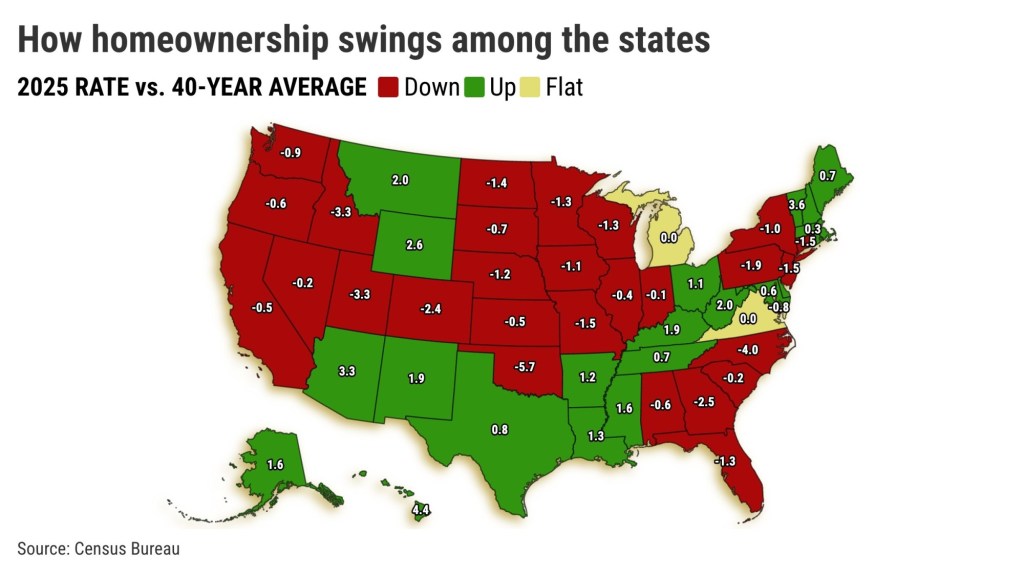
Sadly, last year’s ownership rates could not meet this standard in roughly half the states. California’s 2025 rate was half a percentage point below par. By the way, that’s the same ownership deficit as the nation.
There were 27 other states also below average, led by Oklahoma, 5.7 percentage points below; North Carolina, 4 percentage points below; and Idaho and Utah, 3.3 percentage points below.
Conversely, Hawaii’s rate was 4.4 percentage points above average. Rhode Island was up 4 points. And Vermont was 3.6 higher.
If homeownership is the American Dream, expanding that goal has been a nightmare.
Jonathan Lansner is the business columnist for the Southern California News Group. He can be reached at jlansner@scng.com