
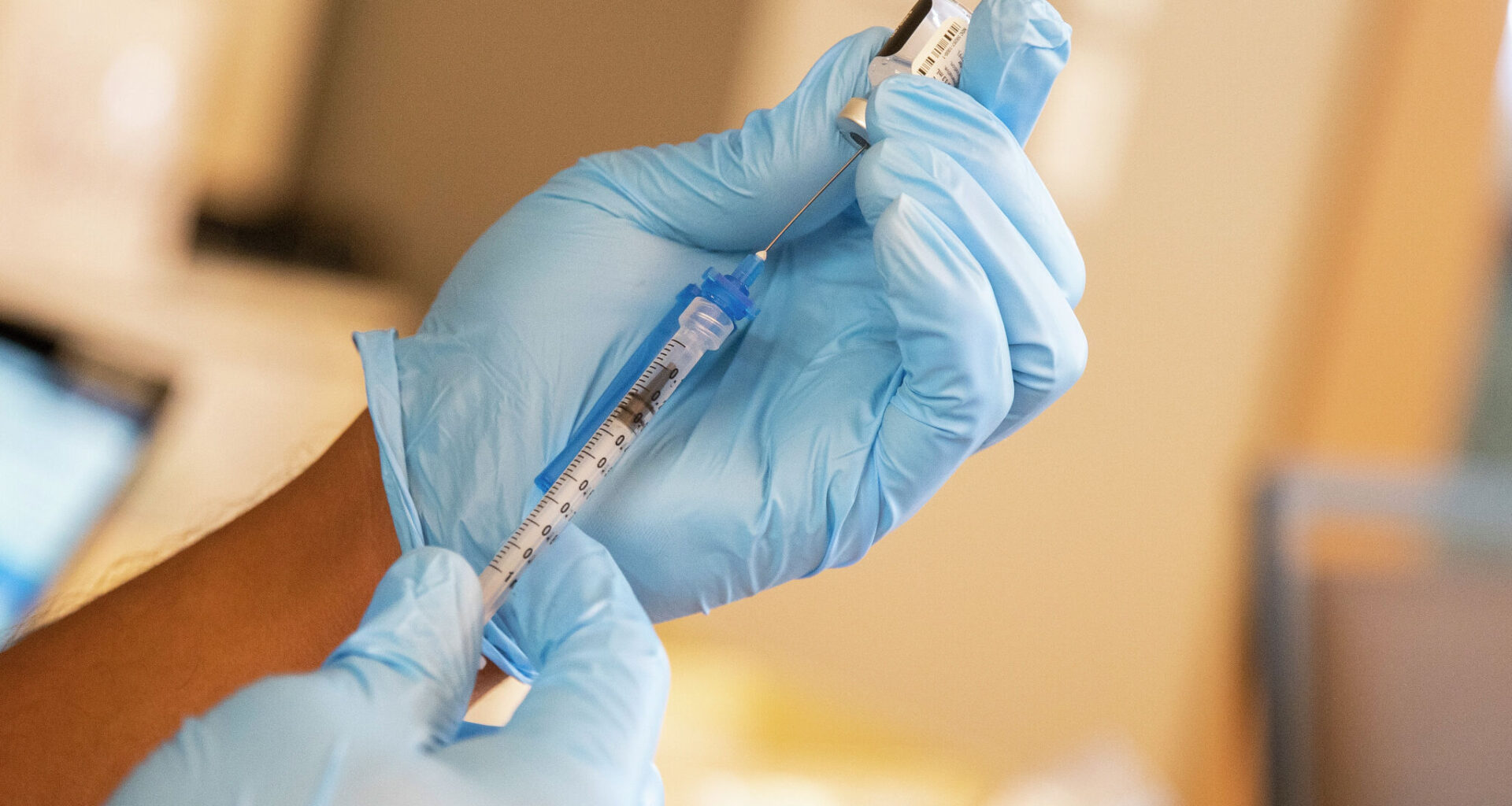
Pfizer will shutter its South San Francisco research site and corporate office at the end of April, marking a significant retreat from the Bay Area’s flagship biotech hub and raising questions about the region’s post-pandemic life sciences economy. The Pfizer COVID vaccine is shown in a 2021 file photo.
Santiago Mejia/The Chronicle 2021
Pfizer will shutter its South San Francisco research site and office at the end of April, marking a significant retreat from the Bay Area’s flagship biotech hub and raising questions about the city’s post-pandemic life sciences economy.
It is unclear how many employees are stationed at the company’s 181 Oyster Point Blvd. facility, but all currently “designated to the site will transition to remote roles,” company spokesperson Jerica Pitts told the Chronicle in a statement.
The move by Pfizer, one of the country’s largest drugmakers and a once high-profile tenant in that city’s dense life sciences cluster, appears to signal that the company is ending its presence in the Bay Area. Pitts did not respond to questions about whether Pfizer leases any other offices in South San Francisco or elsewhere in the region, and its website does not list any Bay Area research facilities, including the one South San Francisco site, which Pitts said is not being used to its full capacity.
Article continues below this ad
“After careful evaluation, Pfizer has decided to close its South San Francisco office as the office space is currently underutilized,” Pitts said. “Pfizer continues to maintain a strong presence in California, including its facilities in San Diego.“
The planned closure comes after the company sought to sublease nearly half of its 164,000-square-foot facility, which is located in The Cove at Oyster Point, a multi-building office and lab campus near Highway 101 and the waterfront. It is unclear whether the company has signed with any subtenants at the Healthpeak Properties-owned building, which consists of a mix of shell space, office and labs, according to a brochure for the space.
San Francisco Chronicle Logo
Make us a Preferred Source to get more of our news when you search.
Add Preferred Source
The facility once served as the headquarters for sickle cell disease drug developer Global Blood Therapeutics, which Pfizer acquired for $5.4 billion in 2022. Two years later, Pfizer cut 52 jobs at that location.
Pfizer likely has far fewer employees remaining in South San Francisco than its rival Genentech, which had about 10,000 employees stationed in the city as of 2024, and another 1,000 more spread out across the Bay Area, per the San Francisco Business Times.
Article continues below this ad
But even Genentech has scaled back its workforce in the city. The biotech giant announced late last year that it would be slashing more than 100 jobs from its South San Francisco site, following cuts to over 700 jobs in the 18 months prior.
Other companies, like Arsenal Biosciences, a cell therapy biotech, and oncology biotech Sutro Biopharma, which is also based on Oyster Point Boulevard, cut major portions of their staff last year as part of restructuring efforts.
Veteran commercial broker Michael Moran, vice chairman of brokerage CBRE’s Peninsula office, said his team was expecting to close 1 million square feet of deals for life sciences space in the first quarter of the year, but was surprised when a majority of that activity was completed late last year.
That’s because some life sciences landlords are currently involved in “aggressive” deal making to land tenants, including providing heavy concessions to drive up occupancy. Moran estimated that vacancy for South San Francisco’s roughly 12 million-square-foot laband office space is near 30%.
Moran said he is seeing more new space requirements from tenants in the 5,000-square-foot to 20,000-square-foot range — often startups bringing new technology to the sector — but for big spaces ranging from 100,000 square feet to 200,000 square feet, few tenants are in the market.
Article continues below this ad
In recent years, the biotech sector has faced a mix of structural and cyclical headwinds: The post-pandemic funding surge has reversed, rising interest rates have made borrowing more expensive and pressured valuations, operating costs for labs and offices has climbed, and competition for specialized talent in markets like the Bay Area remains fierce.
Moran said that in order to receive fresh funding, companies have to show a credible growth strategy and path to liquidity, noting that “exits” for young companies have become increasingly “challenging.”
The current “lull” in the city’s biotech sector is due to a “shift in technology,” referring to artificial intelligence, and “how it is affecting science,” Moran said.
“That has slowed some of the growth and investment in older companies down, but we expect, as AI and new technology comes into the scientific arena, to see future growth,” he said, describing the current pivot as overall “positive.”
Article continues below this ad