
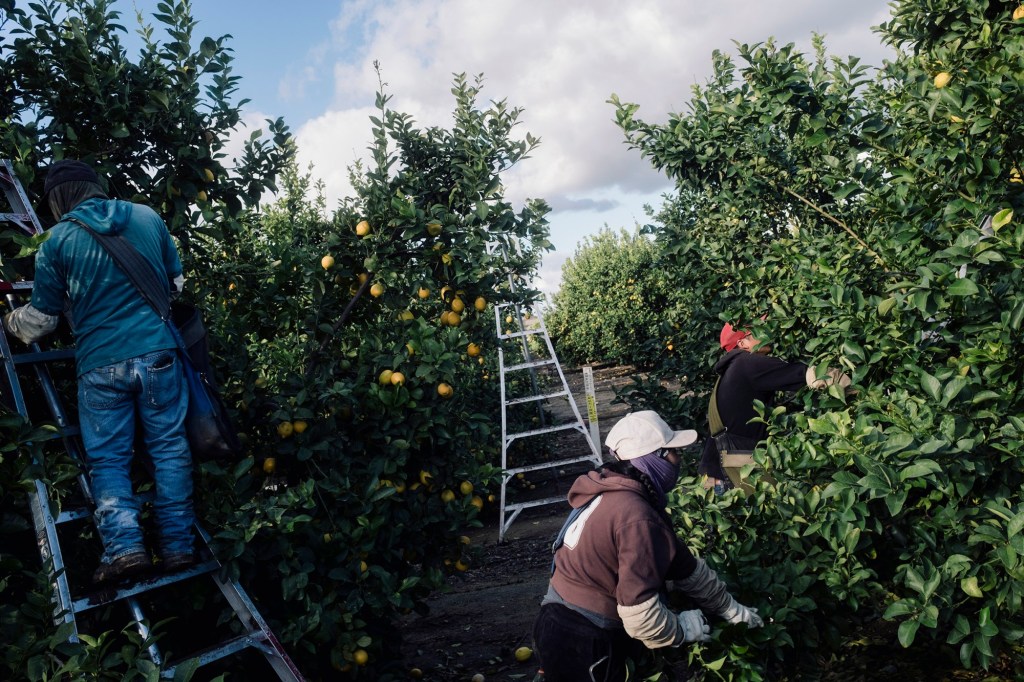
California is honoring the movement for farmworkers’ rights Tuesday with its first Farmworkers Day, renamed just last week from Cesar Chavez Day days following sexual abuse allegations against the late labor leader.
The newly named holiday celebrates the collective fight for fair wages and working conditions for agricultural workers in the U.S.
“We’ve never been one for heroes or icons,” said Roberto D. Hernández, a professor of Chicana and Chicano Studies at San Diego State University. “So this is I see it more as California making right by honoring the farmworkers as the ones who should have been honored all along.”
Chavez’s name is inextricably linked with the labor movement and the Chicano Movement. But last month, an investigation by the New York Times detailed allegations that he had abused young girls and raped fellow union leader Dolores Huerta.
The revelations sparked anger and sadness across California, where he had long been celebrated. They also prompted institutions, from school districts to the union he co-founded, to move swiftly to strip his name and likeness from positions of honor.
Gov. Gavin Newsom signed a law Thursday officially changing the name of the holiday to Farmworkers Day. Locally, the San Diego County Board of Supervisors unanimously voted Tuesday to support the change. And San Diego is moving to officially rename the holiday at the city level, which requires a City Council vote.
“Farmworkers contribute tremendously to this great state,” said County Supervisor Paloma Aguirre, who proposed the county resolution. “So I am excited to shift the focus back to where it needs to be — which is them, collectively.”
Chavez died in 1993 at the age of 66, and Cesar Chavez Day was a state holiday celebrated on March 31, his birthday, for the past 25 years. It’s often marked with community service events and educational programs highlighting Chavez’s legacy.
The name change marks a significant moment in the history of the larger workers’ rights movement.
In the 1960s and ’70s, Hernández says, the movement lifted up certain leaders like Chavez as a way of gaining broader legitimacy and recognition, especially for historically oppressed groups like farmworkers. But by the ’80s, there was a push to better highlight the collective effort involved.
Today, many community members don’t celebrate Cesar Chavez Day, he said. Hernández doesn’t himself.
“Holidays are state actions,” he said. “From a teaching perspective, we’ll continue teaching about the collective work that makes movements what they are.”
Local government offices are closed Tuesday to observe the holiday.
The city of San Diego has meanwhile removed Chavez’s name from its community center in San Ysidro and is working to rename Cesar Chavez Parkway, said spokesperson Nicole Darling. City staff will attend a Barrio Logan Planning Group meeting this week to discuss the name change.
Local events scheduled for Tuesday have also shifted some of their focus.
A guided bilingual nature walk at Mission Trails Regional Park was originally intended to be in honor of Cesar Chavez Day. The event is still on, but it’s now referred to only as special holiday programming, said Jennifer Morrisey, executive director for the Mission Trails Regional Park Foundation.
And Project New Village, a community group that helps provide food access and security in southeastern San Diego, will honor some other prominent leaders of the labor movement at its fundraising event Tuesday evening, including Dolores Huerta, Larry Itliong, Philip Vera Cruz, Gilbert Padilla and Mack Lyons.
The organization was already planning to focus its event on the broader workers’ movement, said Jason Cardenas, communications and design consultant for Project New Village. A service day at its community garden earlier this month was named after Huerta and Chavez, though Chavez’s name was removed from the event following the news of the allegations.
“We had already kind of transitioned to uplifting farmworkers’ rights, not just one person,” Cardenas said. “So it worked well for us to be able to look at these unsung heroes.”
Hernández wants the broader public conversation to focus not on Chavez or name changes but on the survivors of sexual abuse.
While elected officials can move to quickly change the name of the holiday, community members are taking this moment to reflect on how to move forward.
“On the ground, frankly, people are still trying to grapple with this reality,” he said. “And that’s why I think there’s more of a pause than a rush to just celebrate something new.”