
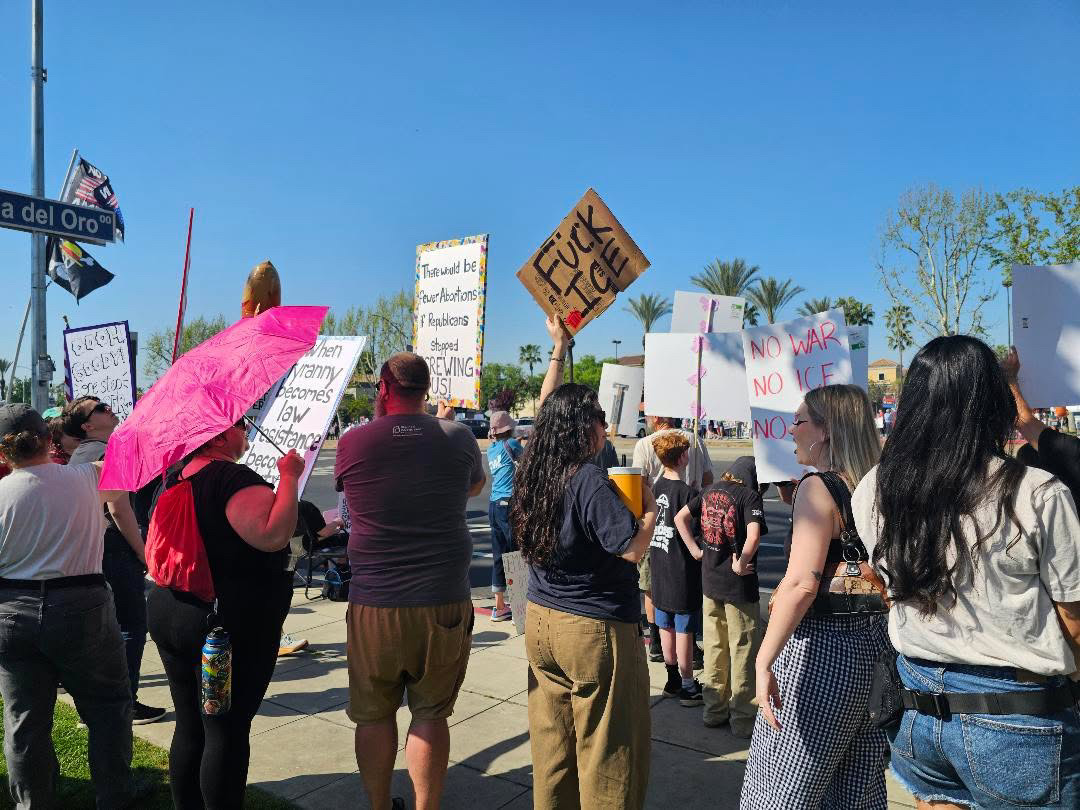
Fresno took part in the nationwide No Kings protests on March 28 as millions across different U.S. cities rallied against the current government and their policies.
Thousands gathered in the midday heat of Fresno’s River Park, lining the sidewalks of both the north and south sides of Blackstone, from Nees Ave. down to Alluvial Ave. The protest was non-violent, as were most of the protests around the country.
Countless signs waved towards the cars passing by, some with criticisms of President Trump’s presidency, some with calls to action and others with pleas for peace.
These protests began in response to many of Trump’s policies, and as the name suggests, are a push back against what many feel is an encroachment upon American democracy, by an increasingly monarchal or oligarchal regime.
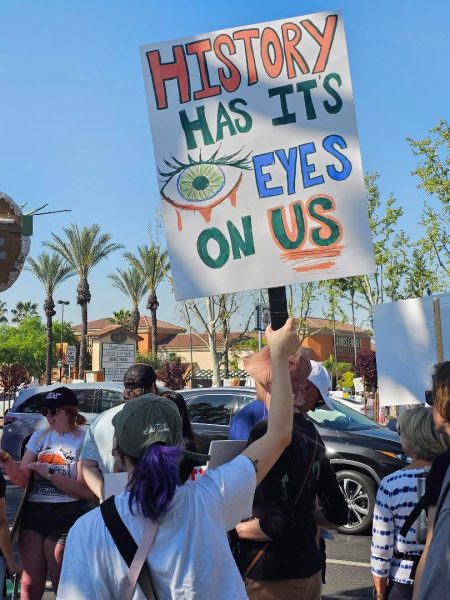 One protester holding a sign that says, “History has its eyes on us” expressing the significance of current affairs during the No Kings protest by River Park on March 28. (Photo by: Kenneth S. Fulton)
The constant sound of car horns honking in solidarity with the protestors was heard over cheers, cries and music all throughout the streets during the protest, which lasted from 10 a.m. to noon.
Among the most widely mentioned issues were the war in Iran, ICE’s detainment of immigrants, the Epstein Files and the U.S. backed genocide of Palestinians.
This was the third No Kings protest held nationwide. The first two were held June 14 and Oct. 18 of 2025 and were hosted by thousands of cities and towns, garnering crowds of 5 and 7 million people, respectively. This round of collective protests were held in even more places and is believed to have had even larger crowds than the first two, with all 50 states having events.
The crowd was diverse and contained all types of people.
Among the crowd were members of the Fresno Resistance, who danced around the sidewalk carrying a speaker playing cumbia. One member, Alfred Aldrete, spoke of the continuously growing number of people who are unhappy with the Trump presidency.
“Today is a gathering of people all across the nation that are standing in solidarity with people that are fed up with this regime and what’s going on all across the United States,” Aldrete said.
He also spoke on the way people in Fresno are affected and how there’s concern for people in the community, saying, “The marginalized communities are always affected by the decisions of the rich. For instance, people that were immediately affected were people whose document status is in question or are working on becoming citizens here, those were the first people affected.”
Trump’s deployment of immigration officers and border patrol has been a widely criticized topic and has sparked outrage throughout the country after many cases of cruel treatment, unlawful detainment of U.S. citizens and immigrants and several deaths at the hands of officers. Videos and reports of these incidents have been widely shared through social media, creating even more protests separate from the No Kings protests.
These detainments and deportations have caused fear within immigrant communities, making even daily tasks a dangerous mission.
Different protestors spoke out about this issue, sharing stories of family and community members who fear being separated from their families.
“Coming from immigrant parents, I’m first generation here,” protestor Gloria Aguirre said. “So my mom can’t go to the grocery store without the fear of thinking, ‘What if ICE is there?’ I mean she’s got a green card and she’s here legally, but that doesn’t matter anymore. I have that fear that one day I’m going to get that call from someone saying that my mom was taken. My heart breaks for my culture and not being able to show it and this is how we can.”
Another protestor, Natalia, who declined to give a last name, spoke about how fear of this government is spreading quickly to other communities as well, saying, “It’s not just undocumented people anymore, it’s everybody. It’s so unexpected, a lot of people go missing and are being kidnapped and it’s infuriating.”
Natalia also spoke about the hope for an awakening in the country, mentioning America’s diversity.
“The diversity here makes this country beautiful,” Natalia said. “Being one by being different is beautiful. I just hope that we can keep spreading awareness and wake people up.”
Many different groups were being represented at the protest. Among them was the United Farm Workers (UFW), being represented by many protestors. Two of them, Violet and Juanita, who declined to give last names, spoke about the UFW’s current lawsuit against the Department of Labor, which is a pushback against the Trump administration’s wage cut rule that proposes to cut $5 to $7 per hour from H-2A guest workers and field workers.
They also spoke about the current state of the UFW.
“You just have to remind people that it’s about the farm workers and who’s in the field right now,” Violet said.
Juanita, who said she’s been part of the UFW since the 1970s, also spoke on the racism against her people by ICE officers, and mentioned the overall disruption of agriculture because of the recent mass deportations.
Many peoples’ frustrations are not just with Trump, but with the current state of U.S. politics as a whole.
“People are angry,” Kaleb Tafoya, a speaker at the protest, said. “Not just with Trump. As time goes on, I think people are getting disillusioned with both sides and seeing how our politics don’t put the people first. It puts rich people, corporations, billionaires, oligarchs first, and people are tired.”
Tafoya emphasized the importance of continuing the work after the protests ended.
“Whether you’re doing mutual aid, knocking on doors, getting people registered to vote, bail bonds, or de-arresting people,” Tafoya said. “there’s many different ways to support your community.”
Many have mentioned the importance of following up with actions like these after the protests finish in order to continue and further the work that needs to be done.
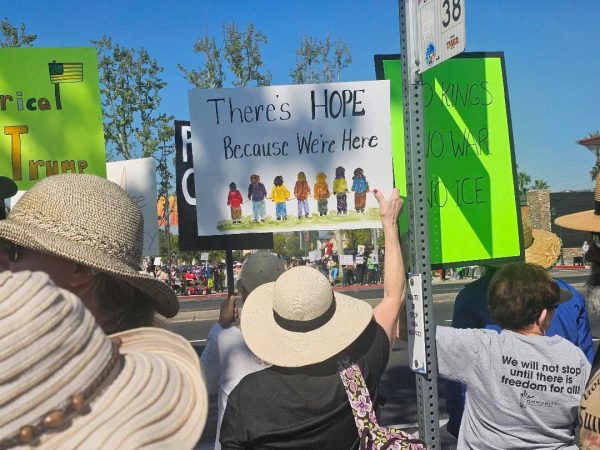 Protesters holding signs expressing hope for change during the No Kings protest by River Park on March 28. (Photo by: Kenneth S. Fulton)
People in the U.S. have a history of protesting and forming strong communities that fight against injustice and inequality. The No Kings protests are becoming a part of American history and will undoubtedly be mentioned in future discussions as significant, no matter the outcome of our country.
At this time, there is no official date scheduled for another No Kings protest.