
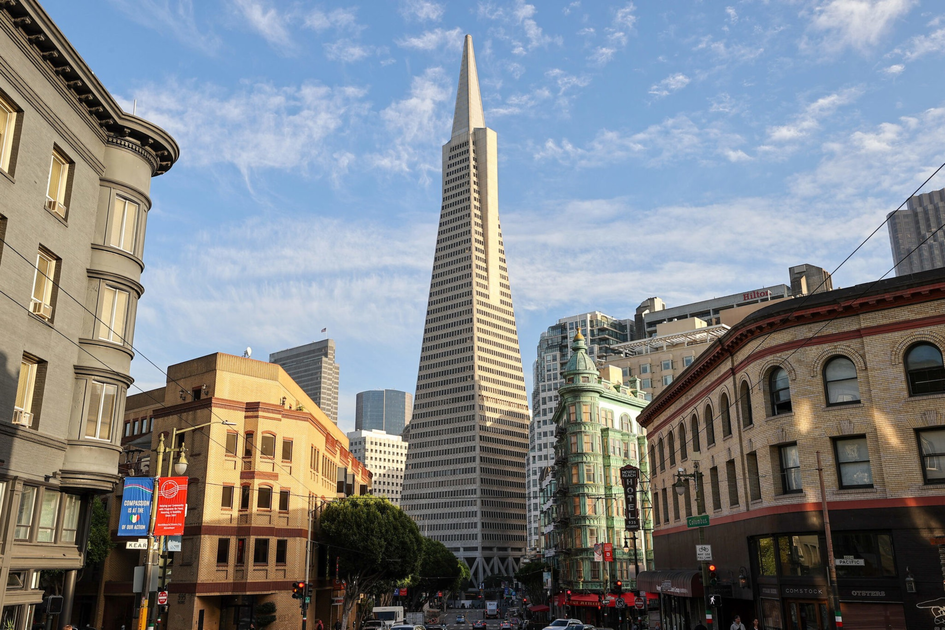
For six years, Michael Shvo’s audacious bet on the Transamerica Pyramid was the toast of the town. But by the end of his stewardship of the iconic property last week, it traded like any other debt in a San Francisco still marred by the pandemic: distressed and discounted.
Cyprus-based Yoda PLC on Friday closed its purchase of the skyscraper in four parts, totaling roughly $691 million, according to public records.
That’s technically a small gain from the $650 million Shvo’s investors — Bayerische Versorgungskammer (BVK) and Deutsche Finance — paid in 2020. But considering the partners spent an additional $400 million on renovations, the project will go down in both firms’ histories and on their balance sheets as a debacle.
In public, Shvo touted “record-breaking” leases at the renovated property as evidence that there was demand for his project. But the rent credits and generous remodeling allowances his team was giving tenants in order to woo them from other buildings cut into those profits.
With the tower already 85% leased this year, Shvo had limited avenues to increase the property’s earning potential moving forward.
 Michael Shvo with Mayor London Breed, state Sen. Scott Wiener, former Mayor Willie Brown, and Supervisor Aaron Peskin at the 2023 groundbreaking for the Transamerica Pyramid renovation. Camille Cohen/The Standard
Furthermore, the property includes two other office buildings on the same Sansome Street block that never garnered as much attention or rents. One of those buildings, at 545 Sansome, is entitled for redevelopment, but breaking ground would take it off the market for tenants and require even more investment.
Taken altogether, the San Francisco icon had become dead weight for Shvo’s investors — headlined by BVK, Germany’s largest public pension fund. Furious over billions of dollars lost on U.S. real estate bets made with Shvo, the investors departed with executives who had personal ties to the developer and explored ways to oust him as a partner last year.
Eventually, their only way out was to cut their losses and sell.
The pyramid alone cost Yoda $600 million, or $1,170 per square foot. The other two buildings and the outdoor park at 535 Washington St. cost $91 million.
Considering that the majority of office properties in recent years have traded hands for many times less, this was probably as good a deal as the sellers could have hoped for, given the limited pool of qualified and motivated buyers.
For example, 300 Howard St., the soon-to-be headquarters of Anthropic, was purchased last year by DivcoWest for $111 million, or $265 per square foot.
Sources polled on Yoda’s newly disclosed purchase said that measured against deals like that, the Cypriot firm got a good price but nowhere near a steal. The pyramid is still one of the most expensive buildings in San Francisco.
One developer, who requested anonymity to speak candidly, said Yoda’s bet might look “excellent” in a decade if the San Francisco office market recovers to the point of resembling the 2010s, when interest rates were low and vacancies were below 5%.
So Yoda had better be ready to hold on to the asset for a long time and have enough cash to pay down its debts. To finance its purchase, Yoda took out a $300 million loan from San Diego-based Axos Bank, according to public documents.
Little is known about Yoda, a publicly traded firm with Greek and Israeli ties. But CEO Alon Bar made his company’s intentions clear in a statement to The Chronicle: “The Transamerica Pyramid Center structure will serve as the anchor from which we intend to expand, accelerating the growth of our U.S. portfolio over the coming years.”
Over the decades, the property has survived earthquakes, financial busts, and a pandemic. Whether it can survive its own price tag is now Yoda’s problem.