
A woman walks a quiet South Bay road near Los Gatos at night, headlamp sweeping the asphalt. Every few feet, she stops — not for traffic but for bodies. Dozens of them. Newts, splattered by cars during their seasonal migration from the slopes of the Sierra Azul Open Space Preserve to the Lexington Reservoir. She crouches down, places a tiny ruler down on the road next to a body and photographs it. Then, she walks over to the next one and repeats the process.

She uploads all these images to an app. Years later, the data will force officials to redesign the road.
The app she used is iNaturalist, and this is what it can look like in action.
Article continues below this ad
An infrastructure for nature
In March 2008, 18 years ago this month, iNaturalist was founded by Ken-ichi Ueda, Nate Agrin and Jessica Kline, graduate students at UC Berkeley’s School of Information — it was their final master’s project. The app can be used on a smartphone or desktop, and it allows users to take photos of plants, animals and fungi and upload them to be identified. The date, time and location are also logged, making it easy for anyone to contribute to research.
A user of iNaturalist logging observations in China.
Photo courtesy of Scott Loarie, used with permission
Scott Loarie, iNaturalist’s executive director, joined the organization in 2010 and oversees a team of 20, up from just eight a few years ago. They make sure the platform continues to operate seamlessly for the 4 million community members who use it across the globe.
Article continues below this ad
Make SFGATE a preferred source so your search results prioritize writing by actual people, not AI.
Add Preferred Source
The app’s growth has been steady: “iNaturalist never had one of those overnight success stories,” said Loarie during a recent phone call.
Still, its impact has been significant.
A couple of weeks ago, iNaturalist hit a major milestone when it passed over 300 million verifiable observations. Data collected on the app has appeared in more than 7,000 scientific publications. On its birthday weekend, users logged over 80,000 observations. About 300,000 groups rely on the app to keep scientific projects organized.
Article continues below this ad
The result is something that doesn’t fit neatly into any category.
Sure, it’s an app, but it’s also a volunteer network, a scientific database, a community forum — and, in Loarie’s words, a public solution to an authority gap. “You bring together a bunch of people, you know, stitched together with technology tools, under this nonprofit organization,” he said. “And then you get this really important infrastructure that is something much more akin to … what a government would provide.”
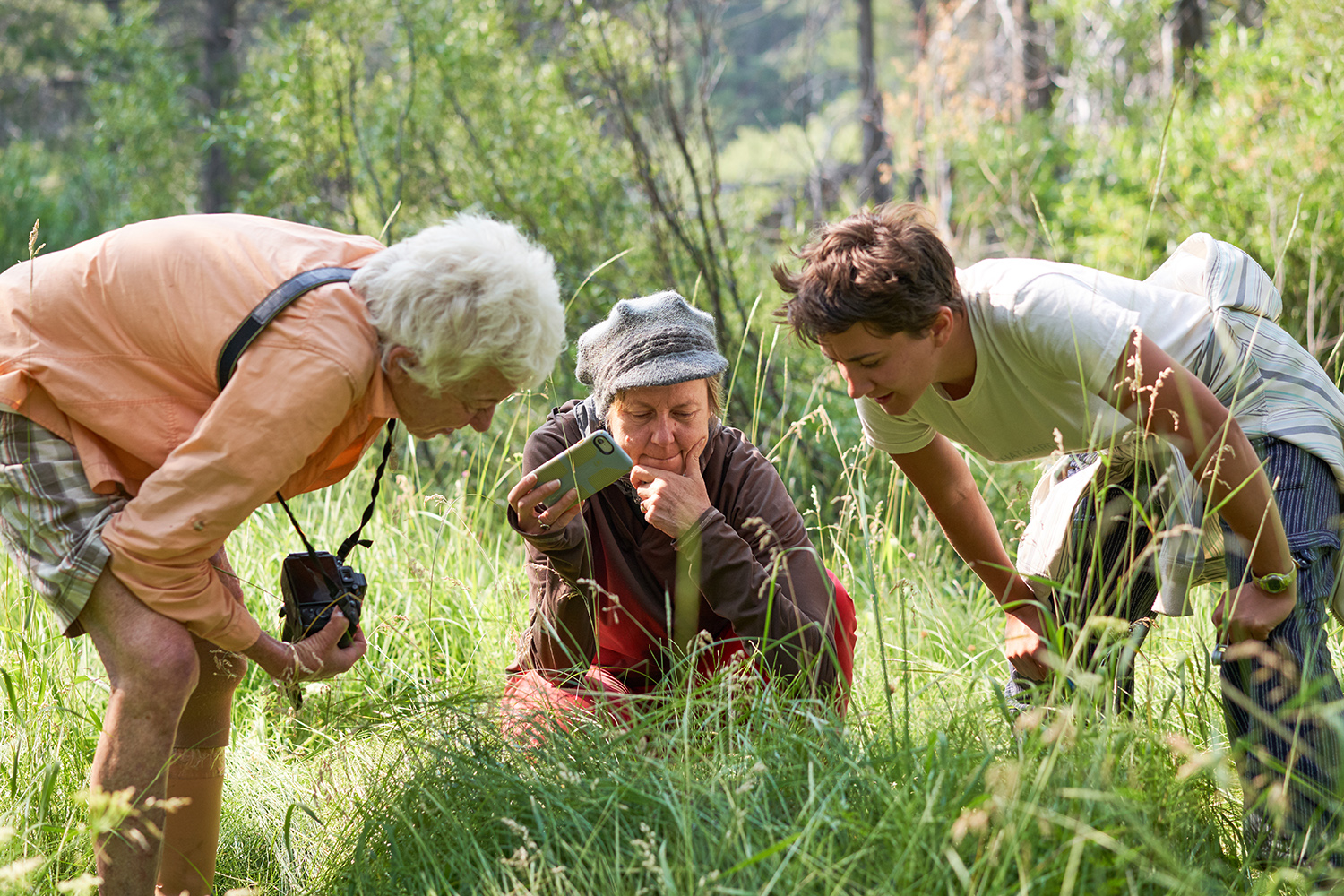
Users of iNaturalist logging observations in San Bernardino County, Calif.
Photo courtesy of Tony Iwane, used with permission
He says being a nonprofit is the whole point. Technology is a powerful tool, but it can also go sideways and get dysfunctional. “We can see all that come out of social networks and AI,” he said. The nonprofit aspect keeps iNaturalist anchored to a mission and keeps it working for the community rather than a bottom line.
Article continues below this ad
Changing how people see the world
Merav Vonshak is an entomologist, but iNaturalist changed the way she moves through the natural world. “Using iNaturalist, it kind of opened my eyes to look at everything,” she said during a phone call. “Everything becomes interesting.” She describes herself as “slightly addicted … in a good way.”
Vonshak, a former postdoc at Stanford, was introduced to the app there, but it didn’t stick right away. It wasn’t until she took a naturalist program with Grassroots Ecology in 2017, where the app was a requirement, that she got hooked.
For her, the app has a way of turning old experiences into new data. Vonshak described going back through photos from a trip to Australia she took more than a decade ago. “I opened the folder, and I realized that I never actually opened it after that trip, because there was no need for that.” With the app, she has a chance to not only relive the experience but amplify it. Suddenly, there was a reason to look through the images again: to identify, to share, to add to the database.
Article continues below this ad
A user of iNaturalist logging observations in Nevada County, Calif.
Photo courtesy of Tony Iwane, used with permission
The scope of the platform makes all of it possible. Unlike birding apps like eBird or many plant ID tools, iNaturalist covers it all.
The people behind the nature app
None of this works without the people behind it, ranging from staff members to platform users. “So much of the impact of iNaturalist is from this incredible global community that’s willing to participate and share all of their expertise,” Loarie said.
Article continues below this ad
Beyond the observers, the identifiers keep things going.
“It all relies on this thankless, kind of behind-the-curtain work that all these experts are pouring into the site from around the world,” Loarie said.
Alison Young, the group’s director of outreach programs, came over to iNaturalist after years of building community science programs at the California Academy of Sciences. Young calls it the nicest place on the internet. (That’s not just her sentiment. The New York Times said it, too, she proudly noted.)
In addition to generosity, Young said the community also polices itself. When artificial intelligence-generated images or web-scraped photos began appearing on the platform more frequently this year, it was volunteer curators, not staff, who caught most of them first, according to Young.
Article continues below this ad
Users of iNaturalist logging observations in China.
Photo courtesy of Scott Loarie, used with permission
People’s engagement on the app varies. Some are observers, uploading photos of whatever caught their eye. Some realize they can help identify other people’s observations. Others, like Vonshak, go further: organizing bioblitzes, launching regional challenges and building entire research programs.
Young’s latest push has been nudging people further down the path.
This past December, she ran iNaturalist’s first-ever ID-a-thon: a monthlong campaign to show casual observers that they could ID other people’s submissions without expert training.
Article continues below this ad
Where discoveries happen
The geographic spread of where engagement takes off has surprised even the people running the platform.
Texas Parks & Wildlife was one of the earliest institutional adopters, coming on board around 2012, Young said. Since then, the Texas community has shown up reliably, dominating the City Nature Challenge year after year. More recently, a driven group of iNaturalist acolytes in India helped grow the number of cities taking part in the challenge from just a few to more than 200. “The groups that do the outreach about iNaturalist are really amazing,” Young said.
The discoveries that come from this effort can be startling. Vonshak described photographing what looked like an unremarkable bee near Coyote Valley a few years back and forgetting about it entirely.
Article continues below this ad
Three years later, the observation was identified as the first of its species ever recorded on iNaturalist.
The bee, Centris california, an oil digger with no common name, is associated with a rare plant in southern Santa Clara Valley, Vonshak said. “It’s not, like, in the middle of the jungle,” she said.
The next challenge is the jungle.
A user of iNaturalist logging observations in San Bernardino County, Calif.
Photo courtesy of Tony Iwane, used with permission
The tropics — where the majority of the world’s species live — is also where iNaturalist has the fewest participants. Attracting people’s participation isn’t just a growth goal for Loarie; it’s something he views as a scientific necessity. The platform is monitoring about 500,000 of the world’s species, which is about 1 in 4 of those we know about.
Article continues below this ad
Loarie wants to get to half.
Observation to action
Back on that dark road near Los Gatos, the story of what iNaturalist helped make possible is still unfolding. It began with Anne Parsons, a Midpeninsula Regional Open Space District trail patrol volunteer who noticed something wrong near the trailhead she was patrolling: newts, dead on the road during the seasonal migration. She started documenting their crushed bodies on iNaturalist because she was already active on the app.
Then she came back. And kept coming back. Parsons surveyed the 4.2-mile road, divided in the two sections, at least once a week between November and April (the duration of the migration).
Article continues below this ad
Vonshak eventually joined and now leads the Newt Patrol group.
Over five years of continuous surveying, the Newt Patrol recorded an average of 6,000 dead individuals per season. By Vonshak’s estimate, that’s the highest mortality rate of any amphibian species worldwide. “You could only see that because one person decided that, OK, this is important,” Vonshak said. “And the data is so strong that we just kept collecting … because you can’t argue with it.”
The road cannot be closed — it serves as an emergency bypass for Highway 17 — but the data proved to be persuasive in other ways. In January of this year, Midpen’s board approved a $650,000 pilot “Newt Passage” project, which will include fencing and underground tunnels installed at the worst roadkill hot spots along Alma Bridge Road. Construction is expected to start in 2028, according to KQED.
The crossing locations weren’t determined by guesswork but by years of precise location data collected through the app. “And this is all because of iNaturalist,” Vonshak said. “Because it’s not just a way to document and to, you know, create a database but also to create a community around it.”
Article continues below this ad
That community-to-action pipeline is playing out on a larger scale, too. In California, iNaturalist data feeds into the state’s 30×30 initiative, an ambitious plan to protect 30% of California’s lands and coastal waters by 2030. The data also goes to the Global Biodiversity Information Facility, where it’s available to scientists worldwide.
Loarie has a name for the sum of all this. “This is what I like to call actionable hope,” he wrote in a recent message to supporters. “In this age of climate anxiety and biodiversity loss, you’re helping iNaturalist turn anxiety into action, and action into agency.”