
Peter Hartlaub walks us through the history of the Klan in the Bay Area and throughout Northern California.
Wendi Jonassen, Peter Hartlaub, Dan Hernandez
The Ku Klux Klan’s resurgence in the early 20th century must have felt like a distant problem to San Francisco Chronicle readers. Newspaper dispatches about the anti-Black, anti-immigrant, anti-Jew, anti-Catholic hate group were focused in Tennessee, Georgia and other Southern states.
But on May 19, 1922, city residents received some shocking news: According to an account in the newspaper that quoted John T. Kelly, a San Francisco traffic cop and new Klan recruit, nine members of the city’s police force were affiliated with the white supremacists.
Klansmen organize ahead of a cross lighting in Ceres (Stanislaus County) on Feb. 22, 1981. The Invisible Knights of the KKK rented a pasture from Lloyd Harrison, a local Klan sympathizer, while residents of the San Joaquin Valley community urged local officials to take action.
Vince Maggiora/S.F. Chronicle 1981
Women of the Ku Klux Klan march in an Independence Day parade in downtown Richmond in 1924 after Oakland revoked their permit.
M.L. Cohen, Collection of the Oakland Museum, Gift of Mr. Martin J. Cooney
The Klan was in San Francisco.
Article continues below this ad
“(It was) the first actual proof that open meetings of the Ku Klux Klan as an organization have been held in San Francisco,” the Chronicle explained.
If that news was shocking, what happened next was even more dreadful. Over the next three years, the Klan became much more visible in the Bay Area, filling Oakland’s largest indoor auditorium and marching openly in robes and hoods in Richmond’s Fourth of July parade. Stanford allowed the Klan to form a student club. The group burned crosses on Twin Peaks — twice.
A 1924 San Francisco Chronicle article covers a Richmond veteran group’s decision to allow the Ku Klux Klan to march in the city’s Fourth of July parade.
Chronicle archive
The Chronicle archive is full of surprises, with the city’s famed and forgotten history stored in tens of thousands of negative packets and folders. But few journeys through the stacks have yielded more contrasts to progressive modern-day San Francisco than the newspaper’s untouched-for-a-century Klan files.
The search started two months ago, after we learned about an occasionally circulated 1925 photo of 800 Klan members in full regalia at the 111-year-old Henry J. Kaiser Center for the Arts (formerly the Oakland Auditorium), which reopened earlier this year after decades of work.
Article continues below this ad
The Ku Klux Klan gathers in the Oakland Auditorium in 1925. Now called the Henry J. Kaiser Center for the Arts, the downtown Oakland venue recently reopened after a lengthy closure.
Courtesy Gary Mills
The Klan in Oakland sounded unbelievable, but as I dug through the archive, dozens more Klan reports surfaced, each more ghastly than the last.
The Klan’s modern incarnation emerged in the mid-1910s, founded in Georgia by Imperial Wizard William Joseph Simmons. The Chronicle published wire reports of their intimidating uniforms, cross burnings and anti-immigrant, genocide-coded hate speech, mostly concentrated in rural areas of Southern states.
But the Klan, which profited off membership fees and outfitting Klansmen in robes, hoods and patches, had started aggressive expansion efforts. In 1921, the Chronicle documented California cross burnings in Central Valley cities including Stockton and Taft (Kern County).
The first published Bay Area meeting of the Ku Klux Klan revealed elements of that marketing plan.
Article continues below this ad
Local Klan leaders on March 3, 1922, blindfolded reporters and drove them into the East Bay hills for a cross-burning ceremony with 1,000 members and 200 new recruits.
The Ku Klux Klan gathers in Tilden Park in the Berkeley hills in 1924. The group was visible in the Bay Area in the 1920s, initiating new members by the hundreds.
Courtesy Gary Mills
An unnamed Chronicle journalist, who agreed to wear a white robe as a condition of attending, surmised the event was in rural Contra Costa County after recognizing the echo and paving changes of the tunnel between Alameda and Contra Costa counties.
“The members gathered about an altar over which was draped an American flag and behind which was a great phosphorescent cross, throwing strange light on the forms of the 200 candidates,” the Chronicle reported the next day. “The latter took the solemn oath to support the invisible empire of the Ku Klux Klan.”
Nowhere in the article did the Chronicle explain in detail what the Klan stood for. But Simmons and his 1925 successor, Hiram Wesley Evans, were open in writing and meetings about “loyalty to the white race,” and an American future where people of color had no standing or were eliminated altogether.
Article continues below this ad
“The old-stock Americans … have begun to arm themselves for this new type of warfare,” Evans wrote in 1926. “Most important, they have broken away from the fetters of the false ideals and philanthropy which put aliens ahead of their own children and their own race.”
Klansmen rallied in Ceres (Stanislaus County) in 1981.
Vince Maggiora/S.F. Chronicle 1981
By 1924, as Klan leaders were increasingly preaching a future of violence in the name of white supremacy, they were shunned by most politicians in the West. Meanwhile with numbers growing, Bay Area Klansmen became more brazen.
Piedmont’s police chief was reportedly a member, and the Chronicle in 1923 reported that Robert Burnett, a Stanford graduate student from El Paso, Texas, had formed a campus Klan unit of 40 members. University president Ray Lyman said the group could continue as long as they didn’t use the Stanford name in any of their messaging.
On Aug. 18, 1923, the Klan made the Chronicle’s front page when 2,000 new Klansmen were initiated in the hills of Daly City — no blindfolds or hidden valleys this time — with 700 vehicles surrounding a flaming cross, and 5,000 friends and family gathered to watch.
Article continues below this ad
“Many were women, and several carried babies in their arms,” the Chronicle reported. “Hundreds of (vehicles) from all parts of San Francisco bay district, following instructions on a little printed card, brought scores more.”
Klansmen circle around a burning cross in Ceres on Feb. 22, 1981.
Vince Maggiora/S.F. Chronicle 1981
The Klan reached its peak in the Bay Area — and a breaking point — in 1924 and 1925. Klan officials in early 1924 announced the group’s state convention in Oakland on the Fourth of July weekend. Oakland’s police chief first granted, then rescinded, a permit to march in the city’s Independence Day parade.
Five hundred Klan members stormed an Oakland City Council meeting to protest that decision. Meanwhile, the Allied War Veterans group in charge of Richmond’s festivities sent the Klan a formal invitation with only one ask from organizers: no masks to hide their faces. Three thousand members joined that parade, striding down city streets for all to see.
But open condemnations of the Klan from local politicians gradually grew louder, and the group stopped announcing its events. When more than 8,000 Klansmen showed up on Aug. 23, 1925, at the Oakland Auditorium to initiate 500 new members, the Oakland Tribune published just two paragraphs with no apparent newspaper eyewitness. (The Chronicle had no coverage.)
About 100 demonstrators, chanting “Cops and the Klan work hand in hand,” march on the Ingleside Police Station in San Francisco on Nov. 15, 1981.
Steve Ringman/S.F. Chronicle 1981
Perhaps the most brazen Klan activity occurred in April 1925.
“Reports came in rapidly early yesterday evening to the police of a cross burning on the side of Twin Peaks,” the Chronicle reported. “They noticed an unusual number of automobiles departing, and later found the remains of the cross, constructed of iron pipe with charred bits of burlap wrapped about it.”
The Klan burned another cross near Twin Peaks two months later, but were quickly chased away when two boys noticed the flames and called police.
A 1925 San Francisco Chronicle article documents a Ku Klux Klan cross burning on Twin Peaks.
Chronicle archive
After 1926, the Klan remained out of newspaper reports in the Bay Area. The group resurfaced publicly in the 1960s, but there were no large initiations, and protesters outnumbered Klansmen at most gatherings.
New KKK Imperial Wizard Bill Wilkinson made several recruitment trips to the Bay Area in the 1970s, telling the Chronicle in 1976, “I anticipate a race war before it’s over.”
But his gatherings were inept, and he met a more progressive Bay Area seemingly unified against the Klan. Unable to secure a space for a 1979 East Bay recruitment drive, the Klan rented an American Legion hall in Castro Valley under the fake name “White Paint Publishing Co.,” enraging the duped owners of the building. Just three dozen Klansmen and Klan-curious citizens showed up, and could be heard meekly chanting “White power!” inside.
Grand Dragon Robert Wyer, from left, looks on as Imperial Wizard Bill Wilkinson speaks ahead of a cross lighting in Ceres on Feb. 22, 1981.
Vince Maggiora/S.F. Chronicle 1981
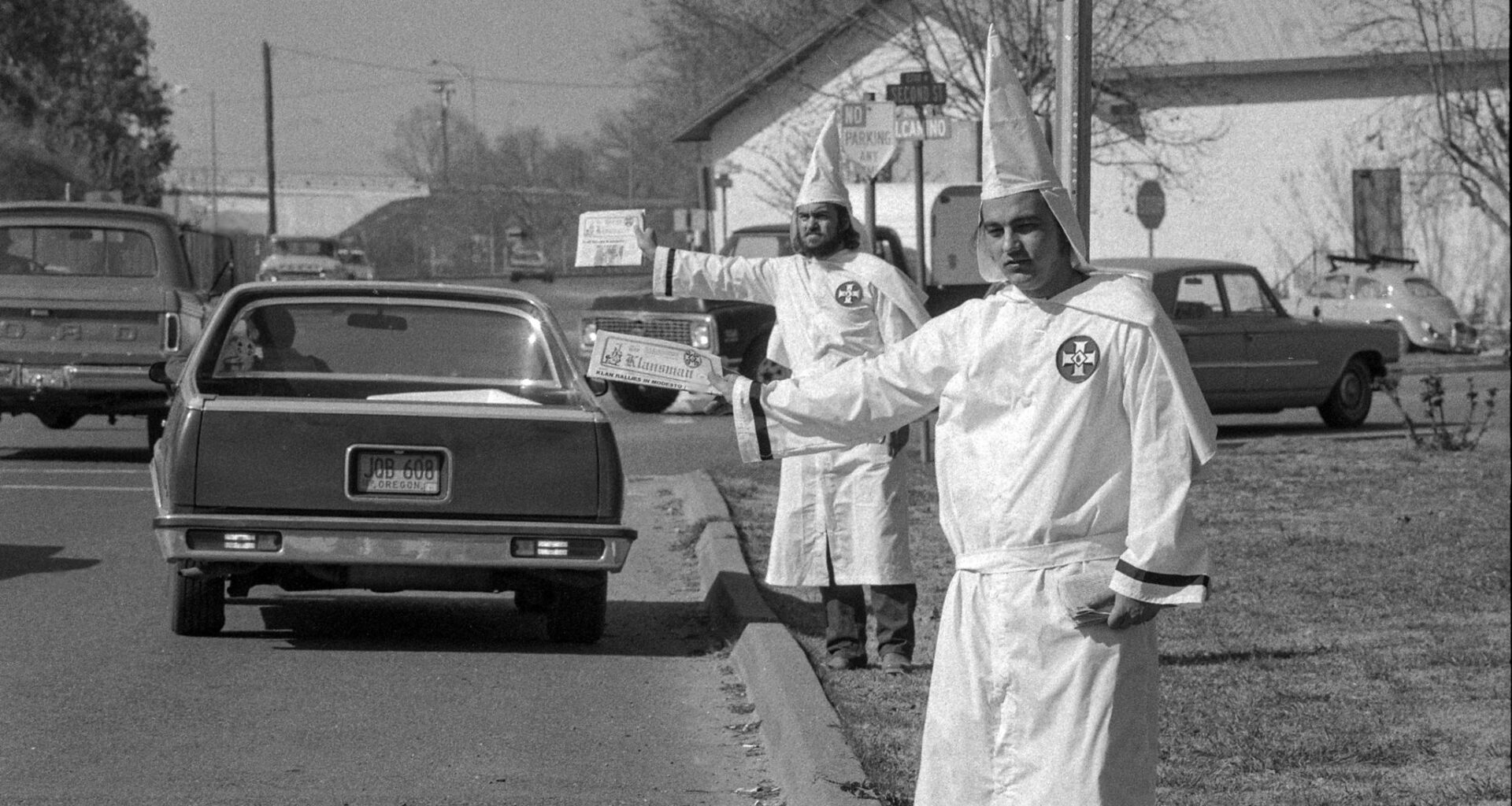
By 1981, the Klan seemed to have given up on Bay Area visits entirely, holding its biggest meetings in Stanislaus County.
Chronicle photographer Vince Maggiora captured dramatic photos at a gathering in the city of Ceres that year, including an eerie nighttime cross burning. But protesters greatly outnumbered the 100 members involved, and city officials were unified against the group, at one point turning the sprinklers on robed Klansmen when they tried to congregate in a public park.
“It’s hard to legislate away a philosophy of hatred and bigotry,” Ceres Mayor Gary Condit said.
Wilkinson came off as a moronic figure. One Klansman anonymously griped to the Chronicle that the Imperial Wizard demanded to visit Jack-in-the-Box whenever he came to California.
“He loves the Jack-in-the-Box tacos,” the Klansman said. “We want to take him to a Mexican restaurant where he can have some real tacos, but we’re trying to figure out if he’s too prejudiced to go into one.”
Wilkinson lost his position in 1984 and subsequently moved to Belize.
Klansmen stood guard after a clash with protesters at the American Legion Post 649 hall in Castro Valley on Aug. 19, 1979.
Fred Larson/S.F. Chronicle 1979
Bay Area hate groups, including the Klan, showed up in a 2017 Southern Poverty Law Center report, but they kept a much lower profile. Chronicle attempts to contact the groups failed.
In my 15 years mining the Chronicle archive for San Francisco stories, I didn’t know we had a Ku Klux Klan folder. The Daly City and Twin Peaks cross burnings, attended by thousands of long-since-gone locals, were never mentioned in the newspaper again.
The Klan has splintered into different smaller factions, mostly in the South and East Coast again, no longer filling 8,000-seat arenas.
But the history is preserved in newsprint, more shocking with each passing generation.
“KU KLUX KLAN HAS NEWSMEN SEE INITIATION,” one Chronicle’s headline reads.
Better remembered so it never happens again.