
State government and transportation leaders spoke this winter about the completion of a California high-speed rail facility next to a state highway in the Central Valley as proof the project is on the cusp of becoming a real, visible system — at least between the Kern County and Fresno-Madera areas.
They declared it a turning point for the controversial project that’s yet to produce actual train tracks in the 17 years since California voters first approved it.
Gov. Gavin Newsom called it the arrival of “the phase everybody’s been waiting for.” California High-Speed Rail Authority CEO Ian Choudri described it as something that was no longer a concept or a plan, but something that “is physically here.”
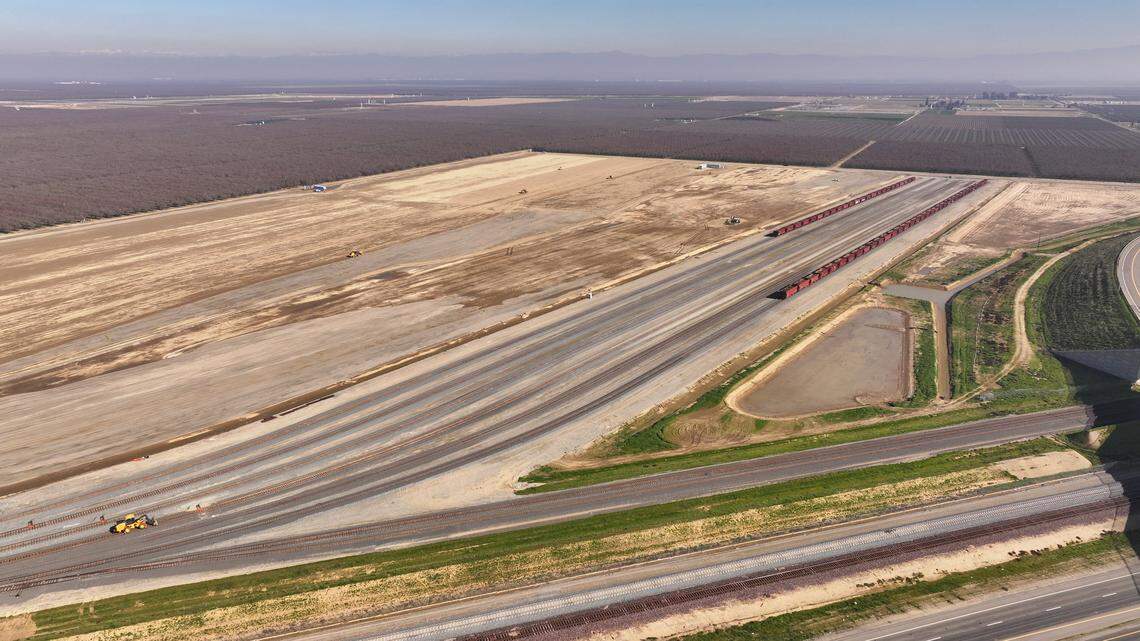
But what exactly will the Southern Railhead Facility — a 150-acre yard nestled between agricultural fields and Highway 43 about halfway between the Kern County cities of Shafter and Wasco — do for the project?
It’s the first of several railhead facilities the rail authority will build as it lays tracks across the state. But this one will be the base for the project’s first track work — which the rail authority has committed to beginning some time this year. The railhead’s massive size and location will allow it to receive, store and send out materials as the track work advances northward along the initial 119-mile stretch being built.
The rail authority broke ground on the facility in January 2025 and Choudri said it was finished in October, meaning its construction lasted less than one year. But its completion came more than a decade after high-speed rail construction first began in the Central Valley. Construction alone in the Central Valley, which is being performed in three “packages” covering work between Madera and Kern counties, is today hovering around $9 billion after more than 1,600 change orders have upped the price in the area.
The project has grown controversial since California voters in 2008 approved $9.95 billion in bonds for a train that would connect the state’s major metro areas at a total cost of about $45 billion. Today, after years of delays and cost increases, the rail authority is required to focus on first completing a 171-mile Merced-to-Bakersfield route, which the agency is hoping to finish by 2032 at an estimated cost of $34.76 billion.
Choudri is asking state legislators to pass a slew of laws to help quicken the pace of construction, reduce the risk of cost increases and move the project toward Los Angeles and the Bay Area. That includes removing the $500 million spending cap on work outside the Central Valley, which he says could impede a partnership he’s trying to land with private investors who will likely want to help build routes toward the state’s major metro areas.
But the rail authority has told The Bee multiple times this year it is still committed to finishing the Merced-to-Bakersfield route.
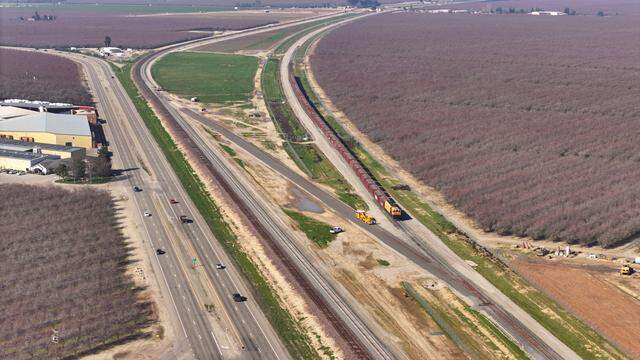 An aerial view of the California High-Speed Rail Authority’s Southern Railhead Facility. CA HSRA Why is high-speed rail’s ‘giant staging yard’ important?
The rail authority calls the railhead facility a “giant staging yard.”
“This railhead is important for us to … start laying tracks from here all the way into Merced and then all the way into Bakersfield,” Choudri said in February at the facility.
It has six freight lines inside it, as well as 10 miles of temporary storage tracks built in partnership with the BNSF Railway. The 150-acre yard also has a maintenance yard, a control office and warehouse space for the storage of materials needed for the rail system: crushed rock known as ballast, overhead poles for the system’s electric power supply, concrete ties that the trains travel over and more.
The site connects to the national freight train network, allowing it to receive materials that originate in other states, the rail authority says.
The rail authority started officially requesting bids last year from suppliers for $507.1 million worth of materials that will be used to lay tracks on the first 119 miles of the Central Valley segment. In recent months the agency started proposing awards to suppliers of overhead poles, rail and concrete ties, and also put out a request for bids on a $3.5 billion track and systems construction contract.
According to a report released last month, that construction is scheduled to begin in the second half of this year.
By mid-2027, there will be “hundreds of people working” at the railhead sending out materials for track construction to the north.
In a video recently posted to the rail authority’s YouTube channel, Choudri said the agency plans to build another facility of this kind as work approaches the Fresno area.
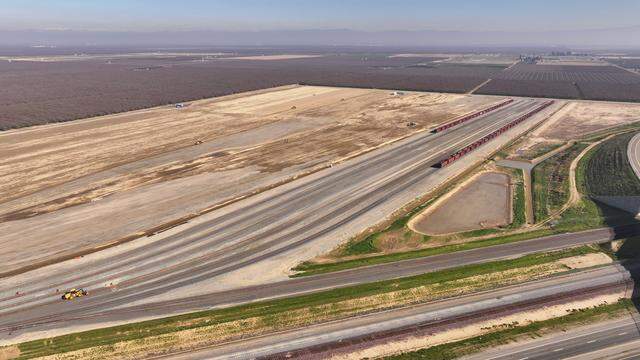 An aerial view of the California High-Speed Rail Authority’s Southern Railhead Facility. CA HSRA
Related Stories from Fresno Bee

The Fresno Bee
Erik is a graduate of the Missouri School of Journalism, where he helped launch an effort to better meet the news needs of Spanish-speaking immigrants. Before that, he served as editor-in-chief of his community college student newspaper, Riverside City College Viewpoints, where he covered the impacts of the Salton Sea’s decline on its adjacent farm worker communities in the Southern California desert. Erik’s work is supported through the California Local News Fellowship program.